


Quick Answer: What Does Jiang Lang Cai Jin Mean?
Jiang Lang Cai Jin (江郎才尽, jiāng láng cái jìn) means to run out of creative inspiration or to seem past one’s creative best. Jiang Lang refers to the writer Jiang Yan. One story says that he dreamed of returning a five-color brush and that his poetry later lost its former distinction.[1][2][3]
- The name: Jiang Lang is the writer Jiang Yan.[1]
- The image: He returns a five-color brush in a dream.[1][2]
- Modern use: Describe a writer, artist or other creator whose fresh ideas seem to have dried up.[1][3]
The expression can be a sharp criticism or a self-deprecating joke.
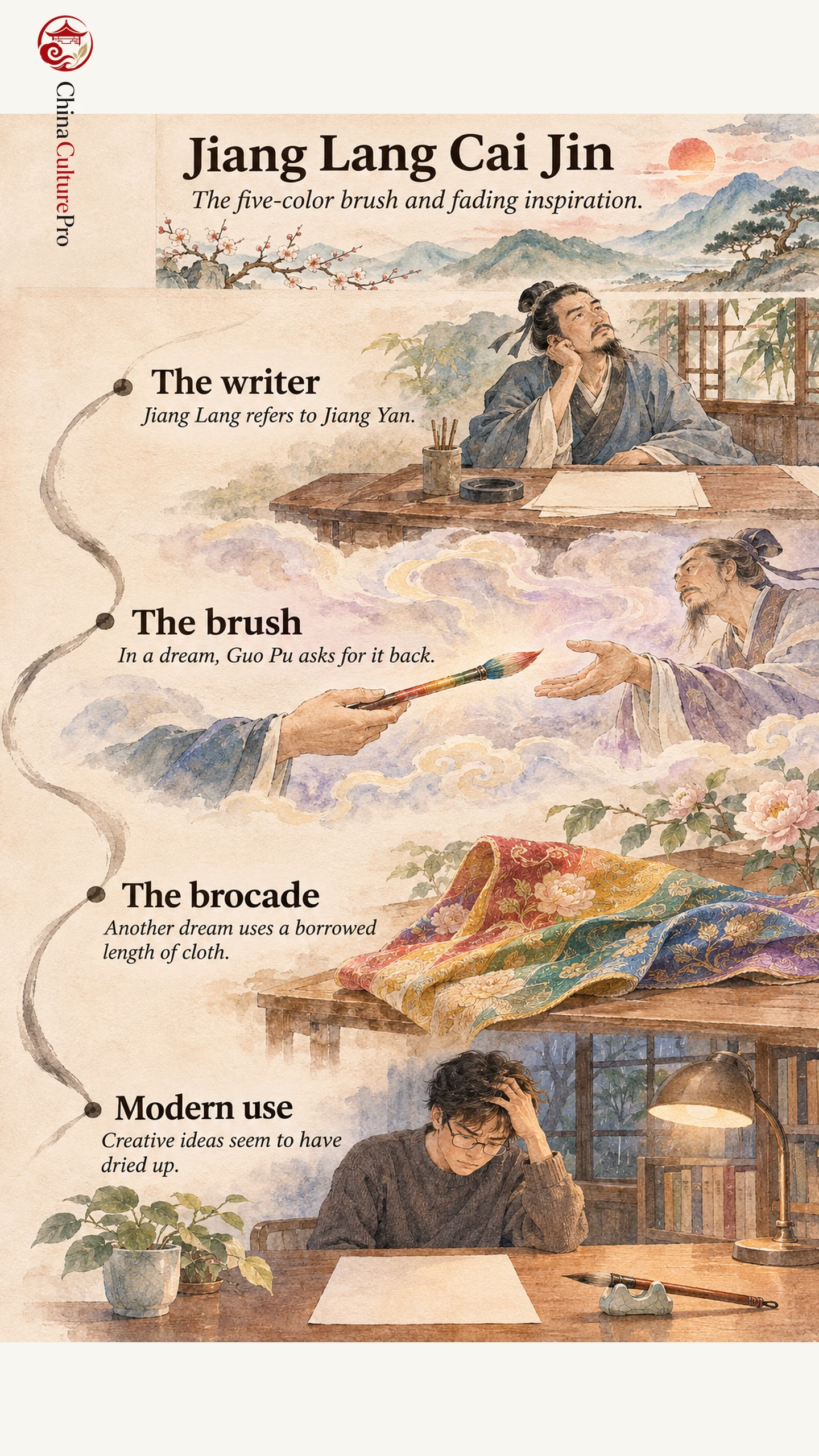
One story makes Jiang Yan’s changing reputation concrete by having him give back a borrowed brush. The sources also preserve a simpler judgment about Jiang Yan’s later writing and another dream involving a piece of brocade.[1][2]
Who Is Jiang Lang?
Jiāng is the writer’s family name, and láng is a way of referring to him. Cái means talent, while jìn means exhausted or used up. The four characters say that Jiang’s talent has run out. The phrase relies on an earlier reputation for accomplishment to make that judgment meaningful.[1][3]
The Book of Liang describes Jiang Yan as famous for his writing when young. It says his literary powers declined somewhat late in life and that people spoke of him as having exhausted his talent. The biography also records a substantial body of writing. Its wording records a judgment people made about his later work.[2]
The Brush Dream and the Brocade Dream
In Zhong Rong’s Rankings of Poetry (诗品, Shīpǐn), Jiang Yan dreams that the earlier writer Guo Pu asks for a brush he left in Jiang’s keeping. Jiang reaches into his clothes, finds a five-color brush and gives it back. The tale connects the return of the object with a decline in the poems that follow.[1]
The History of the Southern Dynasties (南史, Nánshǐ) includes the brush dream and a separate dream involving a length of brocade. A man identifying himself as Zhang Jingyang asks for the cloth back. The two stories turn the same judgment into images of a borrowed gift being reclaimed.[2]
How to Use Jiang Lang Cai Jin Today
A reviewer might write 他的新作一再重复旧点子,有人怀疑他已江郎才尽。 The writer once had ideas worth following, but the new work keeps repeating them. The sentence presents a harsh opinion about the creator’s ability to produce something fresh.[1][3]
Someone can use it more lightly about their own situation. A line such as 今天实在江郎才尽,一个好标题也想不出来 jokes about being unable to think of a title. The smaller scale makes the grand literary comparison humorous.[3]
Choosing the Right English Tone
“He seems to have lost his creative spark” suits a serious assessment. “I’m fresh out of ideas” preserves the joke when the speaker is talking about a single task. Keep the brush image if the passage names Jiang Yan or asks the reader to recognize the story.[1][2][3]
FAQs About Jiang Lang Cai Jin
Did Jiang Yan literally return a magical brush?
The five-color brush is returned in a dream described in literary and biographical sources. The tale makes a reported decline in creativity vivid.[1][2]
Does the idiom only apply to poets?
The original association is with writing. Today it can also describe a loss of inspiration or fresh ideas in other creative work.[1][3]
Can I use it about myself?
Yes. Used about oneself, it can make a temporary shortage of ideas sound playfully dramatic.[3]
Sources
[1] Taiwan Ministry of Education. Idiom dictionary entry for 江郎才盡
[2] Taiwan Ministry of Education. Parallel passages on Jiang Yan
[3] Taiwan Ministry of Education. Revised idiom entry for 江郎才盡