


Quick Answer: Who Was Wei Zifu?
Wei Zifu (卫子夫, Wèi Zǐfū) was an empress of Emperor Wu of Han. The dynastic history describes her first as a singer in the household of Princess Pingyang and later as the mother of Liu Ju (刘据, Liú Jù), the crown prince. She died in the court crisis of 91 BCE.[1][2][3][4]
- Entry into court: Emperor Wu noticed her at a gathering in his sister’s household.[1][3]
- Family influence: Her brother Wei Qing and her nephew Huo Qubing gained high military office.[1]
- Succession crisis: Accusations of sorcery sharpened a struggle around Liu Ju, followed by his defeat and the loss of her position.[1][2][4]
The biography in the Book of Han records the roles and sequence of events. It gives fewer clues about Wei Zifu’s private motives or how she understood the charges.[1][2]
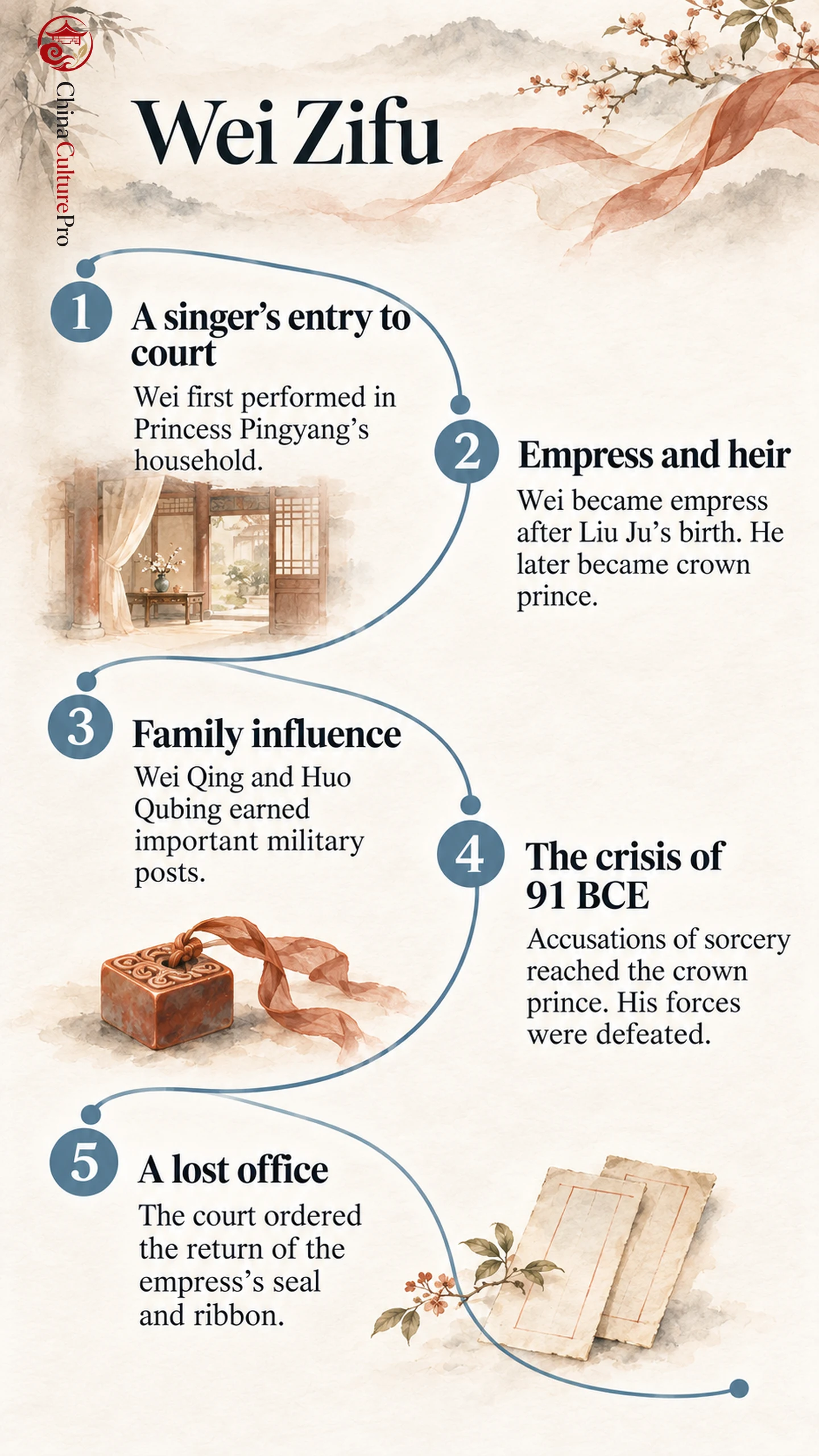
From a singer in a princess’s household, she became the mother of a Han crown prince. Her rise tied her family to the imperial house through kinship and military office. Decades later, a crisis around her son’s succession put that position at risk.
How Wei Zifu Entered the Han Court
The Book of Han describes Wei as a performer employed in Princess Pingyang’s household. Emperor Wu noticed her singing on a visit to his sister, and she was sent to the palace. This account explains how households close to the throne gave some performers access to the imperial court.[1][3]
After Wei gave birth to Liu Ju, she became empress. Liu Ju later became crown prince. Her status came to matter beyond the palace household because her son was now the heir apparent to Emperor Wu of Han.[1][2]
Why the Wei Family Became Politically Important
Her brother Wei Qing rose through military office. Her nephew Huo Qubing also received honours for military service. The dynastic account records several relatives who received rank or titles. The family’s influence grew through military office as well as its connection to the empress and crown prince.[1]
Within the family’s rise, the available evidence for each person is different. The chronicles describe the men’s offices and campaigns in detail. For Wei Zifu, they chiefly record her position as consort and empress, the birth and recognition of the crown prince, and her family’s fate.[1][2]
What Happened to Wei Zifu in 91 BCE?
Late in Emperor Wu’s reign, investigations into alleged sorcery reached Crown Prince Liu Ju. The Book of Han describes the investigator Jiang Chong’s conflict with the prince and the Wei family. Liu Ju moved against Jiang, and the ensuing struggle brought armed fighting in the capital. The prince’s forces were defeated.[1][2][4]
The court ordered the recovery of the empress’s seal and ribbon, the tokens of her office. The dynastic biography then records Wei Zifu’s death by suicide. Her fate connects the accusations about the imperial household with the wider struggle over the succession.[1][2]
The later court treated Wei’s burial differently. The Book of Han records that under Emperor Xuan she was reburied and posthumously honoured as Empress Si. That change is evidence of how a later Han reign remembered her.[1]
FAQs About Wei Zifu
How was Wei Zifu related to Wei Qing and Huo Qubing?
Wei Qing was her brother. Huo Qubing was the son of her older sister and thus Wei Zifu’s nephew. Both rose to significant Han military commands.[1]
Did Wei Zifu’s son become emperor?
Liu Ju was named crown prince but died in the aftermath of the 91 BCE crisis before succeeding his father.[2][4]
Sources
[1] Book of Han. Volume 97A: Imperial Relatives and Empress Wei
[2] Book of Han. Volume 63: The Sons of Emperor Wu
[3] Amelia Ying Qin. History and Lore: Historical Interpretation and Court Narrative
[4] University of California, Berkeley Repository. Study of the Han Shu Historical Tables