

Quick Answer: What Does Crabapple Mean in Chinese Art?
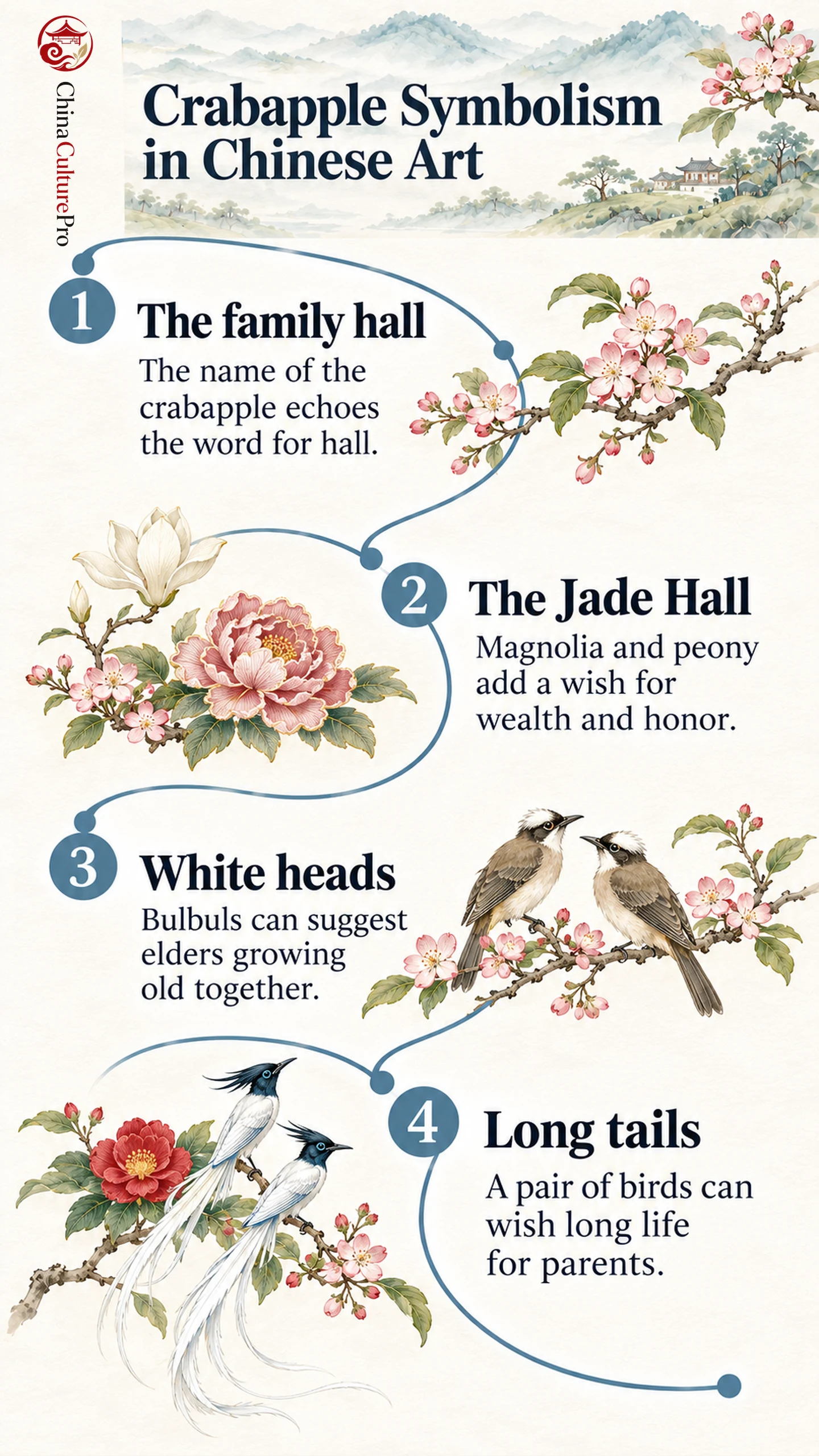
Flowering crabapple (海棠, hǎitáng) can represent the family hall in Chinese art because the last syllable of its name sounds like the word for hall. Magnolia and peony can make the combination a wish for prosperity. White-headed or long-tailed birds can give it a different meaning, such as long life for parents.[1][2][3][4]
- With magnolia and peony: The three flowers can express wealth and honor for the household.[1]
- With white-headed bulbuls: The pair can suggest the two elders of a family growing old together.[3]
- With long-tailed birds: In a dated scroll by Shen Quan, the company of birds and flowers expresses a wish for parents’ longevity.[4]
The flower can point to the household, while other motifs specify the blessing. Look at its companions to find out what the artist wishes for them.[1][3][4]
A woody branch with small blossoms can fit into very different compositions. In a painted scroll the branch gives a bird a perch. On embroidered silk, the blossoms can supply part of a phrase even when no figure is present.[1][3]
How Haitang Brings the Family Hall Into a Design
The last character of haitang is 棠 (táng). It sounds like 堂 (táng), the word for a hall. In a Chinese decorative rebus, the sound can connect a flowering branch with a family home. The rest of the composition can specify a prosperous household or point to the parents in it.[1][2][3][4]
Some English labels render haitang as “begonia,” including in descriptions of woody flowering branches. Compare the Chinese title and the plant’s habit in the picture. The crabapple is usually rendered as blossoms on a woody twig, while autumn begonia is an herbaceous plant often recognized by its uneven leaves. A pink flower on its own leaves the identity open.[1][3]
Magnolia and Peony in the Jade Hall
A Qing embroidery dating to the late seventeenth or early eighteenth century combines magnolia, crabapple and tree peony in silk embroidery on silk twill. The magnolia’s name contributes the sound for jade. Crabapple supplies the sound for hall, and the peony evokes riches and honor. Together they express wealth and honor in the Jade Hall (玉堂富贵, yùtáng fùguì).[1]
A covered porcelain jar made around 1920–1940 shows peonies and crabapple with ribbon-tailed birds. Here the crabapple again helps refer to the household, but the design also adds a wish for long life. The ruyi-shaped decoration at the neck adds the idea of wishes coming true. Look at the decoration above the body as well as the flowers to understand how the design builds its message.[2]
How Birds Turn the Flower Into a Longevity Wish
A fourteenth-century handscroll in ink on paper shows bulbuls on flowering crabapple. The bird’s Chinese name can mean “white-headed old man.” Together with the crabapple, it evokes white heads in the hall (堂上白头, tángshàng báitóu), a wish for the two heads of a household to live to old age. The pale heads provide a clue that is different from the use of magnolia and peony on the embroidery.[1][3]
Shen Quan’s 1750 hanging scroll combines a crabapple branch with China rose and two long-tailed birds. The plants together evoke high hall (高堂, gāotáng), a respectful term for parents. The two birds supply the wish for long life for both of them. When comparing the scrolls, distinguish the bulbuls’ pale heads from the pair of trailing tails. Both works wish long life for the household’s elders. A written shou character can state longevity directly in another design.[3][4]
FAQs About Crabapple Symbolism
Does crabapple by itself mean wealth?
Crabapple can contribute the sound for hall. On the Qing embroidery, the wish for wealth and honor comes from the whole combination, especially the peony.[1]
Why do some English descriptions say begonia?
English translations of haitang can vary. In the Jade Hall and bulbul examples, the flower identified is a woody crabapple. Autumn begonia is a different plant with a related Chinese name.[1][3]
Sources
[1] The Metropolitan Museum of Art. Magnolia, Crabapple, and Tree Peony
[2] SFO Museum and Asian Art Museum. Hidden Meanings: Covered Jar With Birds, Peonies and Crabapple
[3] The Metropolitan Museum of Art. Chinese Bulbuls on Flowering Crab Apple
[4] The Metropolitan Museum of Art. Crabapple, China Rose, and Indian Flycatcher by Shen Quan