

Quick Answer: What Does a Begonia Mean in Chinese Art?
Autumn begonia (秋海棠, qiūhǎitáng) can mark the season in Chinese painting and express longing in poetry. Flowering crabapple (海棠, hǎitáng) is a different plant with a similar Chinese name. On a Qing embroidery, its sound helps form a wish for wealth and honor.[1][4][5][6]
- Autumn painting: A begonia can take its place among other flowers of the season.[1][4]
- Poetry: Some writers connect it with yearning, while others draw attention to its flowers opening in cool weather.[2][5]
- Decorative pun: In the Jade Hall design, check the flowering branch and the names of its companion plants.[6]
The same English translation can obscure differences in the plant and its role in the composition.
The title of an artwork can settle a question its brushwork leaves open. Compare the original plant name with what you see. On a painted sprig, the kind of stem and the outline of a leaf are useful clues.[1][6][7]
How to Tell Autumn Begonia From Crabapple
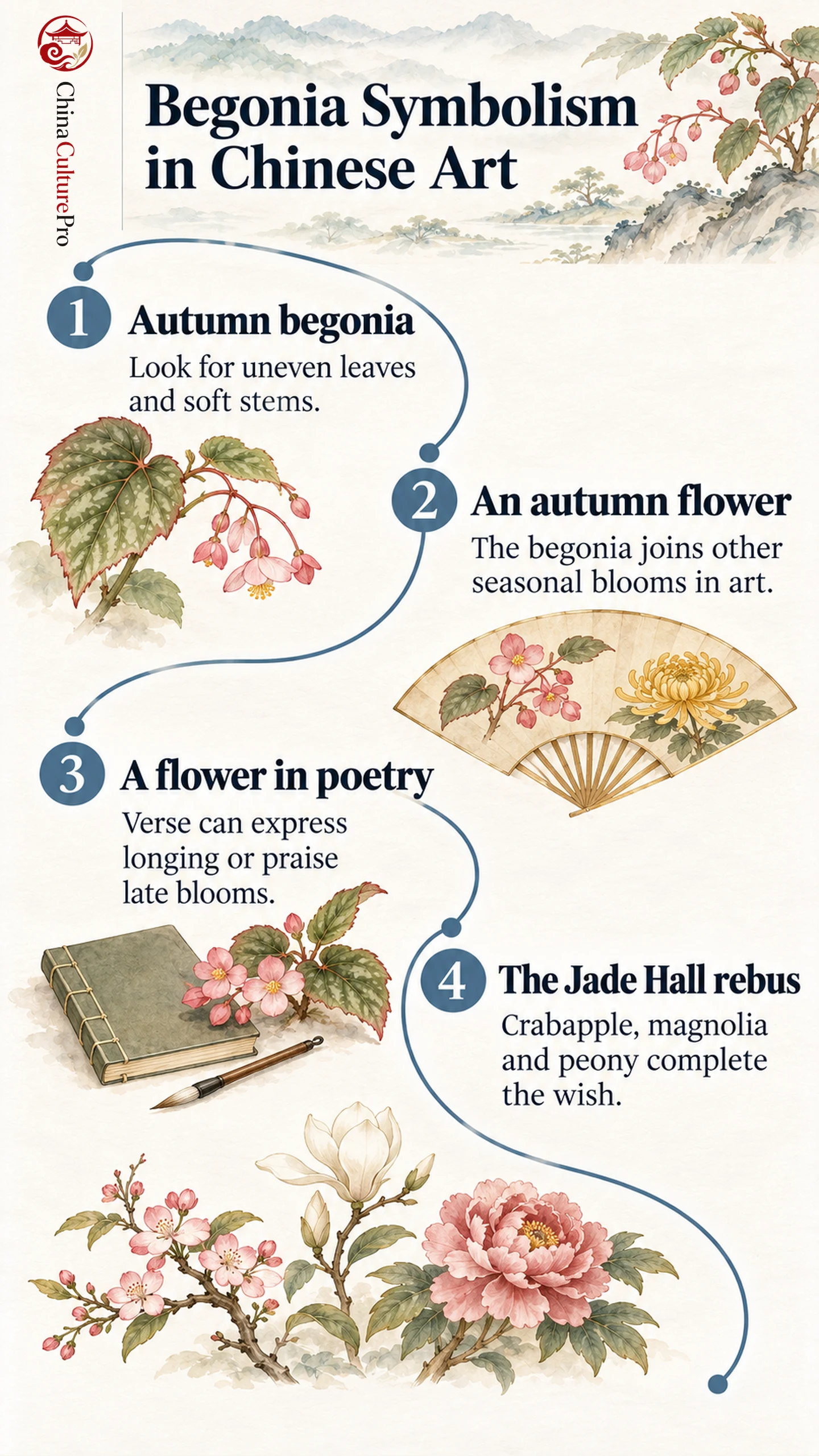
The hardy autumn begonia is an herbaceous plant. Its broad leaves have an uneven, often heart-shaped base. The two sides of the blade can differ visibly where they meet the leafstalk. Flowers may hang in a cluster above or beside the foliage. Look for a soft stem and the shape of a large individual leaf.[5][7]
In the traditional crabapple motif, the flowers grow from a woody branch. The blooms in a stylized design can look similar in color to a pink begonia. Give the stem, foliage and title greater weight than color. Some English descriptions of the crabapple rebus use the word “begonia.” A Chinese title with the autumn qualifier can help recover the distinction.[1][6][7]
Begonias in Qing and Modern Autumn Paintings
A Qing album by Wang Tubing has a leaf titled Begonia in Bloom and a separate calligraphy leaf containing a poem on the plant. Their setting in an album of autumn flowers gives the subject a seasonal context even before the poem is read. The poem turns to color and cool-weather flowering and recalls the attention gardens give to spring. The paired leaves make it possible to see the plant and then read the poem as two treatments of the same autumn flower.[1][2]
In Zhang Xiong’s 1884 fan painting Nine Autumn Flowers, begonia appears alongside other plants including osmanthus and chrysanthemum. The gold-toned fan ground ties the different branches together visually. The nine autumn plants can evoke the season of abundance and the celebration of harvest. That reading belongs to the group, with the begonia contributing its season.[4]
Qi Baishi’s Begonias and a Bird on a Rock offers another clue in its Chinese title, Autumn Colors. The hanging scroll uses ink and color on paper. The bird and rock give the plant a setting. The title gives that setting a time of year without requiring the viewer to work out an auspicious phrase from the bird and flower.[3]
Longing and Autumn in Begonia Poetry
Autumn begonia has a documented literary association with yearning and lovesickness. The flower can take on that emotional role when a poem tells of separation or remembers someone. For a painting that lacks words about absence or a story of parting, autumn is often the stronger first clue.[2][4][5]
Qiu Jin’s poem on the autumn begonia offers a different use of the flower. It asks readers to notice blooms that open without borrowing the force of spring. That seasonal independence gives the plant a role beyond melancholy. A reader comparing the poem with the Qing album can see how both writers care about when the plant flowers while giving that timing different emphasis.[2][5]
Why the Jade Hall Rebus Uses Crabapple
On a late seventeenth- or early eighteenth-century Qing embroidery, magnolia, crabapple and tree peony together express wealth and honor in the jade hall (玉堂富贵, yùtáng fùguì). The beginning of the name for magnolia supplies the sound for jade. The last syllable of haitang supplies the sound for hall. The peony carries the idea of wealth and honor.[6]
This is a decorative rebus built from the combination. A picture of true autumn begonia can have a seasonal or poetic reading even though part of its Chinese name sounds the same. The embroidery brings all three parts of the wish together on silk twill.[1][2][6]
FAQs About Begonia Symbolism
Is haitang another name for begonia?
In the jade hall rebus, haitang identifies flowering crabapple. The name qiu haitang refers to the autumn begonia, a different plant.[1][5][6]
Does a begonia always represent sorrow?
Some poetry associates it with yearning. In autumn flower paintings it can signal the season, and in the nine-flower grouping it helps evoke a time of harvest.[4][5]
Sources
[1] National Palace Museum. Begonia in Bloom by Wang Tubing
[2] National Palace Museum. An Ode to the Blooming Begonia Commissioned by Emperor Qianlong
[3] The Metropolitan Museum of Art. Begonias and a Bird on a Rock by Qi Baishi
[4] China Academy of Art Art Museum. Zhang Xiong: Nine Autumn Flowers
[5] Shanghai Botanical Garden. Autumn Begonia in Horticulture and Poetry
[6] The Metropolitan Museum of Art. Magnolia, Crabapple, and Tree Peony
[7] Missouri Botanical Garden. Begonia Grandis