

Quick Answer: What Is a Tianjing Skywell?
A skywell (天井, tiānjǐng) is a compact open-to-sky court inside a traditional building. In many Huizhou houses, surrounding rooms and eaves frame it. The opening brings daylight and outdoor air into the interior and can receive rain from roof slopes that face the court.[1][2]
- Daylight: The court can light a hall or rooms with few external windows.[2][3]
- Air: The opening connects the house to outdoor air.[1][3]
- Rain: Inward-facing roof slopes can direct runoff into the court.[1][2]
Look at the roof edges and the paving below them. The same opening can admit light from above and receive rainwater below.[1][2]
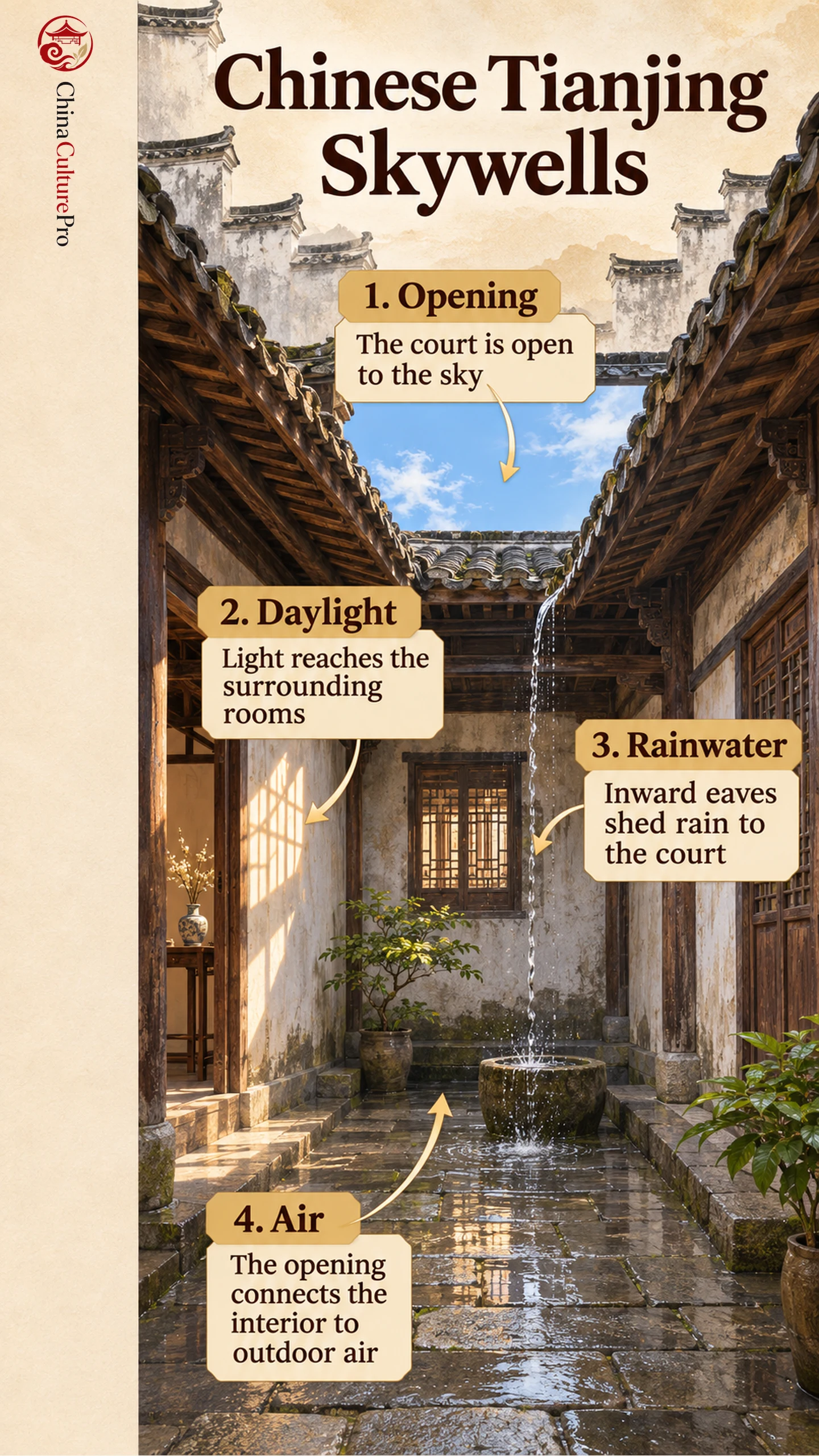
Standing under the eaves, you can see how the court connects spaces that otherwise feel enclosed.[1][2]
How a Skywell Sits Inside the House
In a compact Huizhou dwelling, a skywell may sit in front of a main hall. Rooms, walls and covered circulation define its edges. Measured plans from Xixinan village show skywells within the footprint of houses and relate them to the sequence of halls and rooms.[2]
A broad courtyard gives the eye a wider field of sky. The narrow proportions of many skywells make the surrounding rooms feel close to the opening. In traditional Chinese architecture, both layouts can bring daylight to rooms facing inward. Identify the hall and the open space in the plan before comparing it with another house.[1][2][3]
Why Rainwater Flows Toward the Court
Some roofs slope down toward the opening. Water runs from the tiles to the eave edge and falls onto the court below. A lower area, channel or drain can then receive it. Follow the roof slope and the floor together to understand where the water goes in a particular house.[1][2][5]
Four Waters Return to the Hall (四水归堂, sì shuǐ guī táng) describes this inward drainage arrangement in Huizhou architecture. The study of Xixinan houses also records an auspicious reading of the name. The visible layout explains the flow of rain, and the expression gives that flow a cultural meaning.[1][2]
What Studies Found About Light and Air
In one Huizhou dwelling monitored over a year, researchers found the patio was the main daylight source for living and sleeping rooms. They also found that daylight fell short at times and that relative humidity remained high. In that house, the skywell provided a route for light without guaranteeing bright rooms throughout the day.[3]
A separate study compared eight skywell houses across Xidi, Zhifeng and Yuyuan. Researchers found that evaporation probably helped explain cooler average temperatures inside the courts at Xidi and Zhifeng during the measured conditions. The comparison ties the cooling result to particular buildings and conditions.[4]
Air movement depends in part on how the opening connects to adjoining spaces. The Huizhou ventilation study varies the court’s dimensions in a computer model and reports changes in indoor airflow. The measured house study found satisfactory summer conditions but less comfortable winter conditions. An opening that connects the rooms to outside air has different consequences across seasons.[1][3]
FAQs About Chinese Tianjing Skywells
Does the skywell have a roof?
The traditional form discussed here has an open roof gap above the court. Surrounding eaves cover parts of the circulation around it.[1][2]
Is a skywell a kind of courtyard?
It is a compact interior court. Many Huizhou examples occupy a smaller opening within a roofed house than the main court of a broad courtyard compound.[1][2]
Does rainwater simply collect in the house?
Inward-facing eaves deliver water to the open court. A lowered area or drain at floor level can collect or lead it away.[1][2][5]
Sources
[1] Buildings. Skywell Shape and Indoor Air Movement in Huizhou Dwellings
[2] China–Portugal Joint Laboratory of Cultural Heritage. Survey of Traditional Dwellings in Xixinan Village
[3] Zhijia Huang and colleagues. One-Year Field Study on Indoor Environment of Huizhou Traditional Vernacular Dwellings in China
[4] Gang Yao and colleagues. The Thermal Performance of Chinese Vernacular Skywell Dwellings
[5] Chinese Traditional Culture Promotion Association. Skywells and Four Waters Return to the Hall