
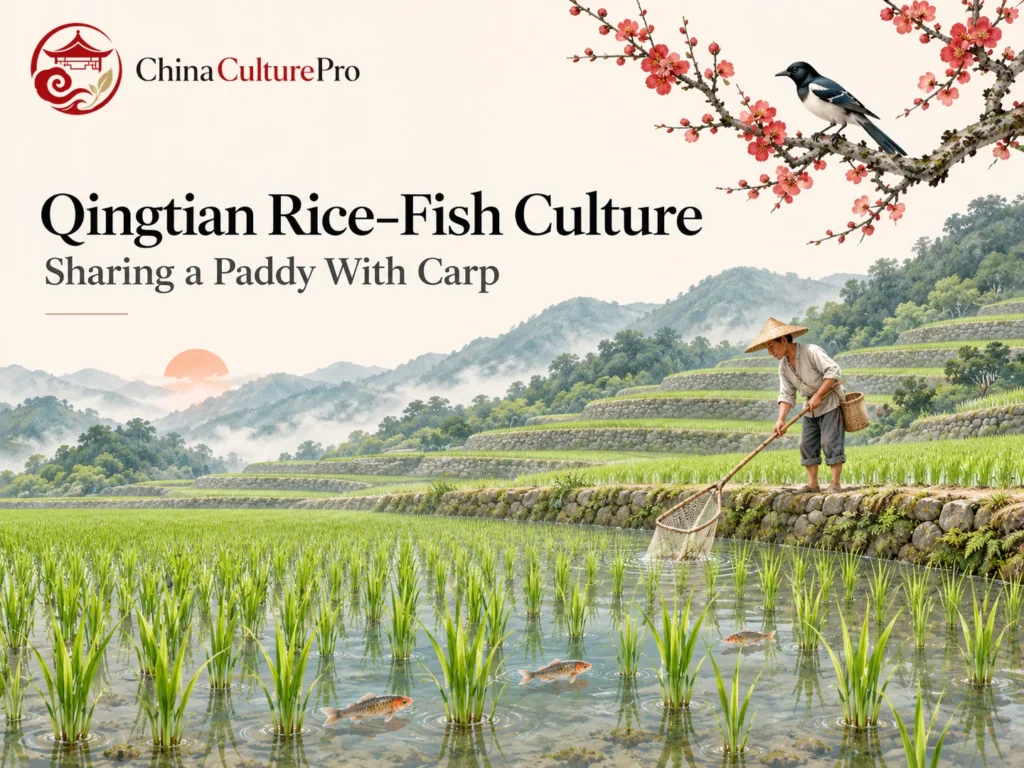

Quick Answer: What Is Qingtian Rice–Fish Culture?
Qingtian rice–fish culture (稻鱼共生, dàoyú gòngshēng) raises rice and fish in the same flooded field. Longxian village in Zhejiang’s Qingtian County is a documented example. The rice plants cast shade over the water. Fish feed and move between the plants, and households can harvest both rice and fish. [1][2]
- Shared water: The paddy serves as growing space for the crop and habitat for fish including local carp. [1]
- Two-way effects: Rice can shade the water. Fish can eat some pests and contribute nutrients. [1][2]
- Living heritage: FAO recognized Qingtian’s system as a Globally Important Agricultural Heritage System in 2005. [1]
The heritage lies in keeping the two kinds of farming connected and passing on the knowledge needed to manage them together.
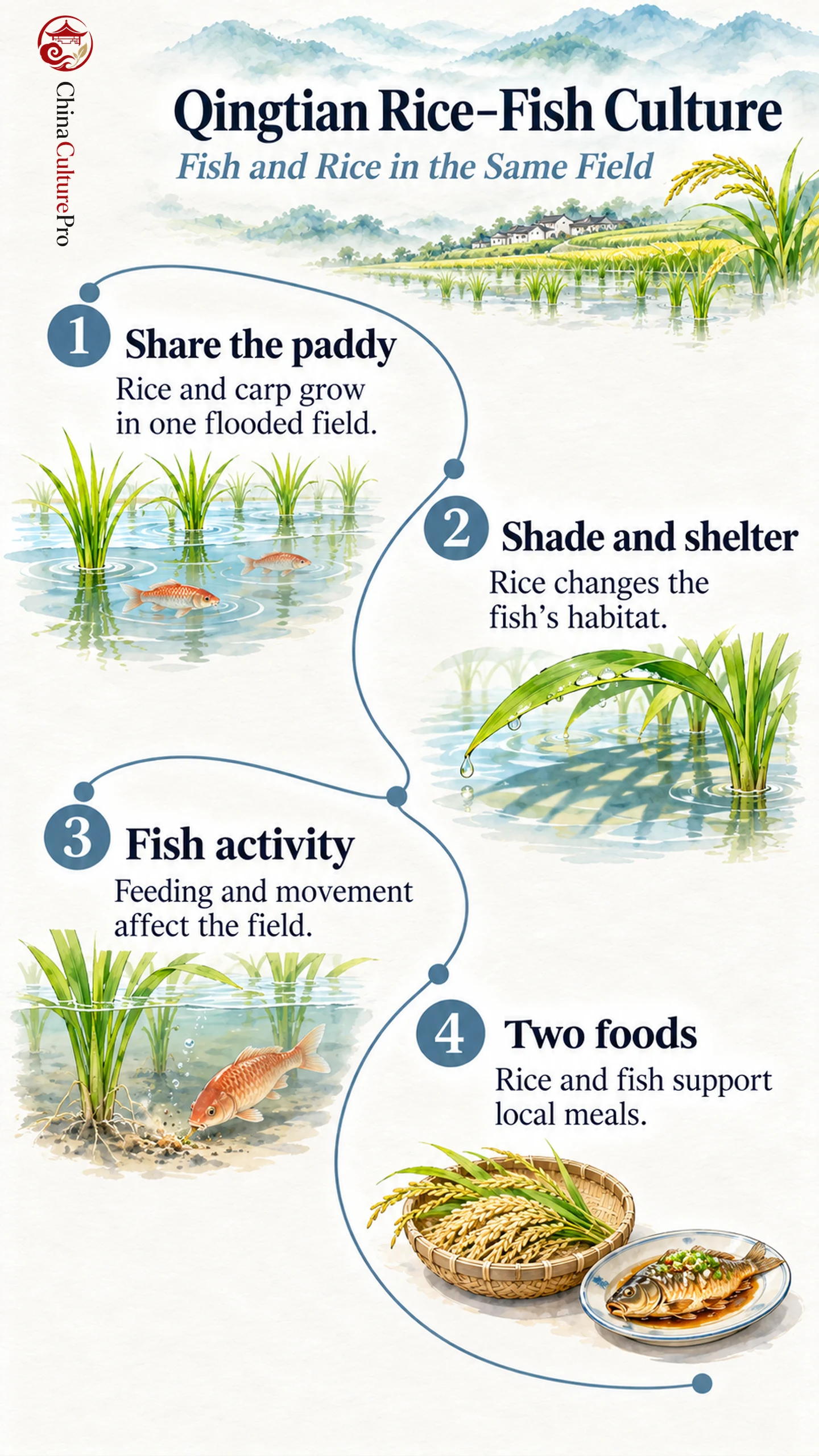
A paddy usually draws the eye to the shoots above the water. In Qingtian, part of the crop moves beneath them. Looking at both layers helps explain why a field can be managed as a shared habitat.
What Rice and Fish Do in the Same Paddy
| Part of the system | Función | What that means for farmers |
|---|---|---|
| Rice plants | Leaves shade parts of the field and offer cover. [1][2] | Water is both a rice-growing condition and a habitat for the fish. [1][2] |
| Carp and other paddy fish | Feed, move and release nutrients in the shared water. [1][2] | Can change weed or pest pressure and add a second food harvest. [1][2] |
| Field management | Water and the crop need to be managed together. [1][2] | A decision about rice can affect the fish, and vice versa. [1][2] |
What Makes the Relationship Work
Fish can eat some larvae and disturb weeds or insects, which can reduce the need for certain inputs under studied conditions. A field study of rice–fish production in Zhejiang identified different benefits for the two parts of the system. It explored how the rice modified the environment for fish and how fish influenced pests and nutrient use. An advantage in a studied system still depends on how a particular field is managed. [1][2]
FAO describes ditches, furrows and other deeper refuges that can hold fish when conditions in the shallow part of the paddy are unsuitable. Managing water therefore involves the planted surface and its margins. Households can also cooperate in maintaining channels on which several fields depend. [1]
The physical arrangement belongs to a wider history of Chinese agriculture. The Qingtian example makes a specific principle visible: one flooded field can produce two foods. A different integration survives in Huzhou’s mulberry–fish ponds, where ponds and their planted banks have separate roles in a larger system. [1][4]
What the System Gives to Local Tables
FAO’s account connects farming with local field-fish dishes and dried sliced fish. The crop and fish can be eaten or sold. These uses make rice–fish more than a way of growing a single crop. The field sits within households whose livelihoods also include activities such as Qingtian stone carving. [1][3]
FAQs About Qingtian Rice–Fish Culture
Are rice and fish raised in separate ponds?
In the Qingtian rice–fish example, a paddy’s flooded space is used for growing the rice and raising fish together. [1][2]
Why can carp help a rice crop?
Their feeding and movement can affect pests and vegetation. Their wastes contribute nutrients within the system. The actual effects depend on conditions and farm practice. [1][2]
Is it a UNESCO World Heritage site?
Qingtian rice–fish culture is recognized by FAO’s agricultural heritage program. It is a distinct designation for a living farm system. [1]
Fuentes
[1] Food and Agriculture Organization. Rice Fish Culture China
[2] Jian Xie and colleagues. Ecological Mechanisms Underlying the Sustainability of Rice–Fish Coculture
[3] Food and Agriculture Organization. Qingtian Rice–Fish Culture and Local Farming Culture
[4] Food and Agriculture Organization. Huzhou Mulberry Dike and Fish Pond System