

Quick Answer: What Is Jingpo Manau Dance?
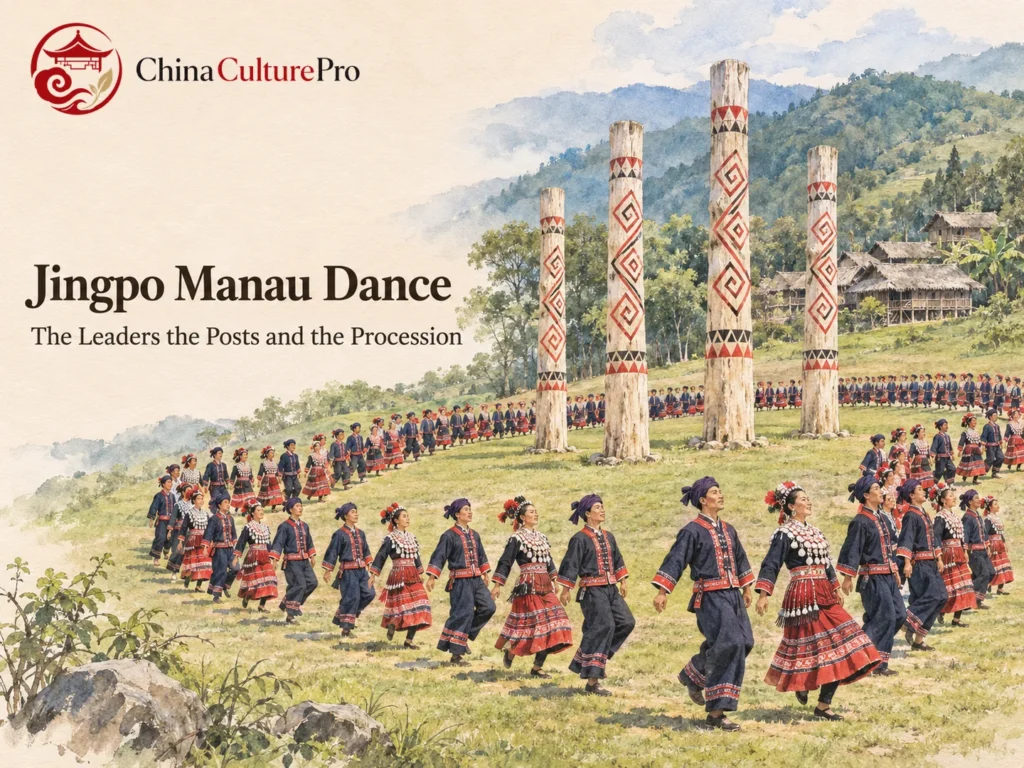
Manau (目瑙纵歌, Mùnǎo Zònggē) is a Jingpo (景颇族, Jǐngpōzú) festival and collective dance documented in Dehong (德宏, Déhóng), western Yunnan. Dancers follow leaders through the gathering ground around a set of tall, patterned posts.[1][2][3]
- Post designs can mark the paths followed by dancers.[2]
- A naoshuang (瑙双, nǎoshuāng) is a dance leader.[3]
- The Longchuan festival entered China’s national heritage list in 2006.[1]
The leaders and posts help a large group follow a shared route.

From the edge of the ground, the rows of dancers may seem to wind freely. Look for where the leaders turn and how the lines behind them change direction.
What the Painted Posts Do
The Longchuan record describes four upright posts at the center of the ground.[1] Their designs can indicate dance routes. In local interpretation, the winding patterns also recall the movements of earlier generations. The posts therefore show where the line moves and carry a remembered meaning within Jingpo culture.[2]
Who Guides the Dancers
A leader needs to know the route and keep the line moving. Zhao Baozhong (赵保忠, Zhào Bǎozhōng), a representative practitioner from Longchuan, studied with experienced leaders and learned the route patterns. His heritage record also documents leading at events in China and Myanmar.[3]
How the Dance Fits the Festival
The dance is the main activity in Longchuan’s Manau festival entry, which includes a tradition about birds dancing. The Manau Zaiwa epic also tells a story of the dance’s beginnings. These are accounts within the tradition.[1][4] The listed festival is one of several examples of intangible cultural heritage in Dehong, alongside the separate Achang Husa craft.
For a different Yunnan example of people moving together at a festival, compare the Jino sun-drum dance of Xishuangbanna.
FAQs About Jingpo Manau Dance
Where is the listed Manau festival from?
The national heritage entry names Longchuan County in Dehong, Yunnan.[1]
What do the lines on the posts mean?
They can indicate the route and recall Jingpo migration in local interpretation.[2]
Who is the naoshuang?
The naoshuang leads the dancers through the movement patterns.[3]
Fuentes
[1] China Intangible Cultural Heritage Digital Museum. Jingpo Manau festival
[2] Yunnan Provincial Publicity Department. Jingpo Manau in contemporary performance
[3] China Intangible Cultural Heritage Digital Museum. Zhao Baozhong
[4] China Intangible Cultural Heritage Digital Museum. Manau Zaiwa epic