

Quick Answer
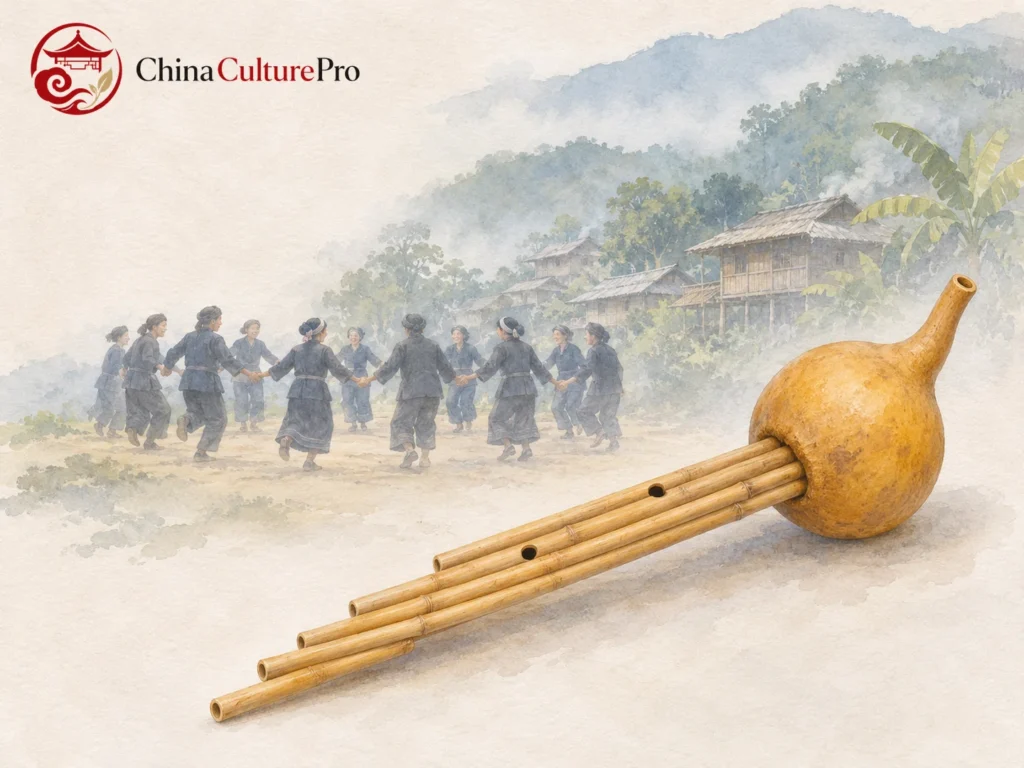
The Lahu gourd mouth organ dance (拉祜族葫芦笙舞, Lāhùzú húlúshēng wǔ) is a circle-dance tradition documented in Yunnan. A player blows into a gourd mouth organ (葫芦笙, húlúshēng) while moving, and dancers follow the tune with steps that can include stamps, kicks and turns.[1][2]
- Instrument: The Lancang heritage entry describes five bamboo pipes set into a gourd.[1]
- Places: Lancang and Shuangjiang records describe different repertoires and styles of leading the circle.[2]
- Occasions: The dance appears in festival observances and in more flexible social forms.[1][2]
The gourd serves as the mouth organ’s wind chamber. The name “gourd-lute dance” can obscure that the featured instrument is played by blowing.
In a circle of dancers, the person making the tune can also be the person setting the next movement. The Lahu records from Yunnan make that relationship especially clear. They show how the instrument, the leader and the occasion shape the dance, even when two groups share the same kind of mouth organ. The broader guide to Lahu culture puts the dance alongside oral literature and other music.
The Gourd Mouth Organ and the Dance Circle
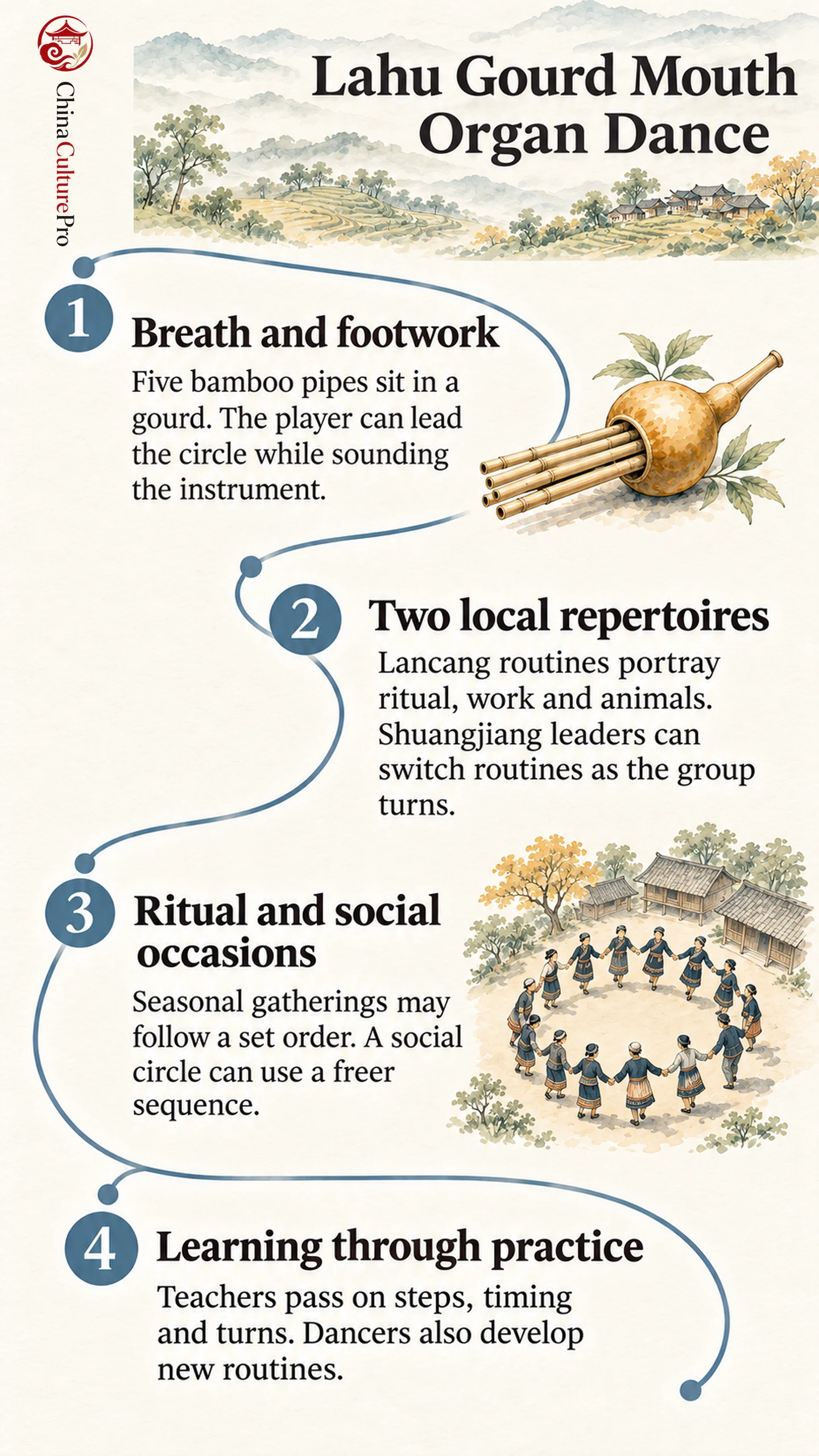
The national heritage description for Lancang Lahu Autonomous County places the gourd at the center of both the instrument and the story surrounding it. Five bamboo pipes are fitted into the gourd. In mouth organs of this family, breath from the player reaches reeds associated with the pipes. Finger placement lets the player select tones while continuing to move. Research on a Lahu community in northern Thailand describes the same broad wind-instrument construction and gives a useful comparison for how it works.[1][3]
The Lancang description records a formation in which men play and dance in a circle while women join hands and dance around them. The account describes a local performance pattern. Look first for the relationship between the player’s turn and the following footwork: the instrument can help organize the moving circle.[1]
The term lusheng (芦笙, lúshēng) can refer to instruments of different designs across southwestern China. The Miao Lusheng Festival provides another setting in which an instrument of the mouth organ family is central, with its own customs and repertoire.
How Lancang and Shuangjiang Repertoires Differ
Yunnan’s heritage record gives Lancang examples connected with ritual, work, everyday life, animals and moments of celebration. Some movements recall recognizable work, such as sowing grain or carrying the harvest. Animal routines take their cues from the movements of birds and other creatures. The repertory also gives dancers room to improvise in certain pieces while retaining recognizable opening and closing movements.[2]
In Shuangjiang the same provincial record describes a form called dage (打歌, dǎgē). A lead dancer can switch routines as people circle counterclockwise. Stamping, kicking, stepping and turning give the lower body a conspicuous role. The inventory records seventy-two routines for this form. That count describes a documented repertoire rather than a requirement for any one gathering.[2]
To compare the two, watch for how a change begins. In a set ritual sequence, the opening or closing routine has its place in the larger observance. In a more flexible circle, the leader can signal a different pattern and the group can take it up on the spot. The instruments may sound similar across such settings. The order of the movements tells you more about the event.[2]
When the Dance Takes Place
The national entry places the dance at the New Rice Festival (尝新节, chángxīnjié) and Spring Festival. In its account, the gourd also recalls an ancestral origin story. Harvest observances connect the dancing to gratitude and hopes for the next year. A seasonal or ritual performance can therefore have an opening, an order and an ending that matter to the people taking part.[1]
The provincial record also describes the dance at weddings, funerals and recreational gatherings. In the examples it gives, dancers at these occasions can dispense with the long sequence observed in more formal seasonal settings. When a performance is described as a festival dance, the village and occasion help explain how much of the larger sequence the dancers perform.[2]
How Dancers Learn and Adapt the Repertoire
In the national inventory, the Lancang dance entered the traditional dance category in 2008. The record of Li Shikai, a representative bearer, illustrates what it takes to transmit a named repertoire. He began learning from his father and a teacher at twelve. The inventory credits him with mastering eighty-three traditional routines and developing more than twenty routines based on animal movements.[1][4]
An archive can list the routine and record a performance. A teacher can also show a learner when to put weight down or how to move into a different step while the tune continues. In Shuangjiang the provincial record describes leaders and core dancers learning from teachers through oral and physical instruction. The two examples show how a group can preserve named routines while a dancer develops an individual style.[2][4]
FAQs About the Lahu Gourd Mouth Organ Dance
Why Do Some Sources Call It Lusheng Dance?
China’s national inventory calls the Lancang entry Lahu lusheng dance. The Yunnan record uses the name gourd mouth organ dance. Both document Lahu dance traditions accompanied by a blown instrument with a gourd and bamboo pipes.[1][2]
Can Lahu Dance Music Include String Instruments?
Yes. Yunnan’s Shuangjiang account names strings among the instruments that can supplement the mouth organ. A study of a Lahu community in northern Thailand also describes a distinct string lute used in dancing. The instrument named in the Yunnan gourd mouth organ dance is the wind instrument.[2][3]
Fuentes
[1] China Intangible Cultural Heritage Network. National inventory record for the Lahu lusheng dance
[2] Yunnan Intangible Cultural Heritage Protection Network. Lahu gourd mouth organ dance in Lancang and Shuangjiang
[3] Journal for the Anthropological Study of Human Movement. Dance and music among the Lahu Na Shehleh of northern Thailand
[4] China Intangible Cultural Heritage Network. Li Shikai representative bearer profile