


Quick Answer: What Does Lahu Culture Include?
Lahu(拉祜族,Lāhùzú)culture includes the languages, oral arts, music and community practices of people concentrated in southwestern Yunnan, with related communities across national borders. Lancang is an important setting, alongside places such as Menglian, Shuangjiang and other localities. [1]
- Language: Regional speech varieties and different writing traditions coexist.
- Oral literature: Creation narratives are transmitted through skilled performance.
- Music and dance: Instrument making, playing, singing and movement have distinct roles.
- Community life: Clothing, farming customs and shared food vary with place and occasion.
- Transmission: Printed editions, recordings and teaching preserve different aspects of cultural knowledge.
Neither a creation story nor a staged performance describes every Lahu person’s beliefs or daily routine.
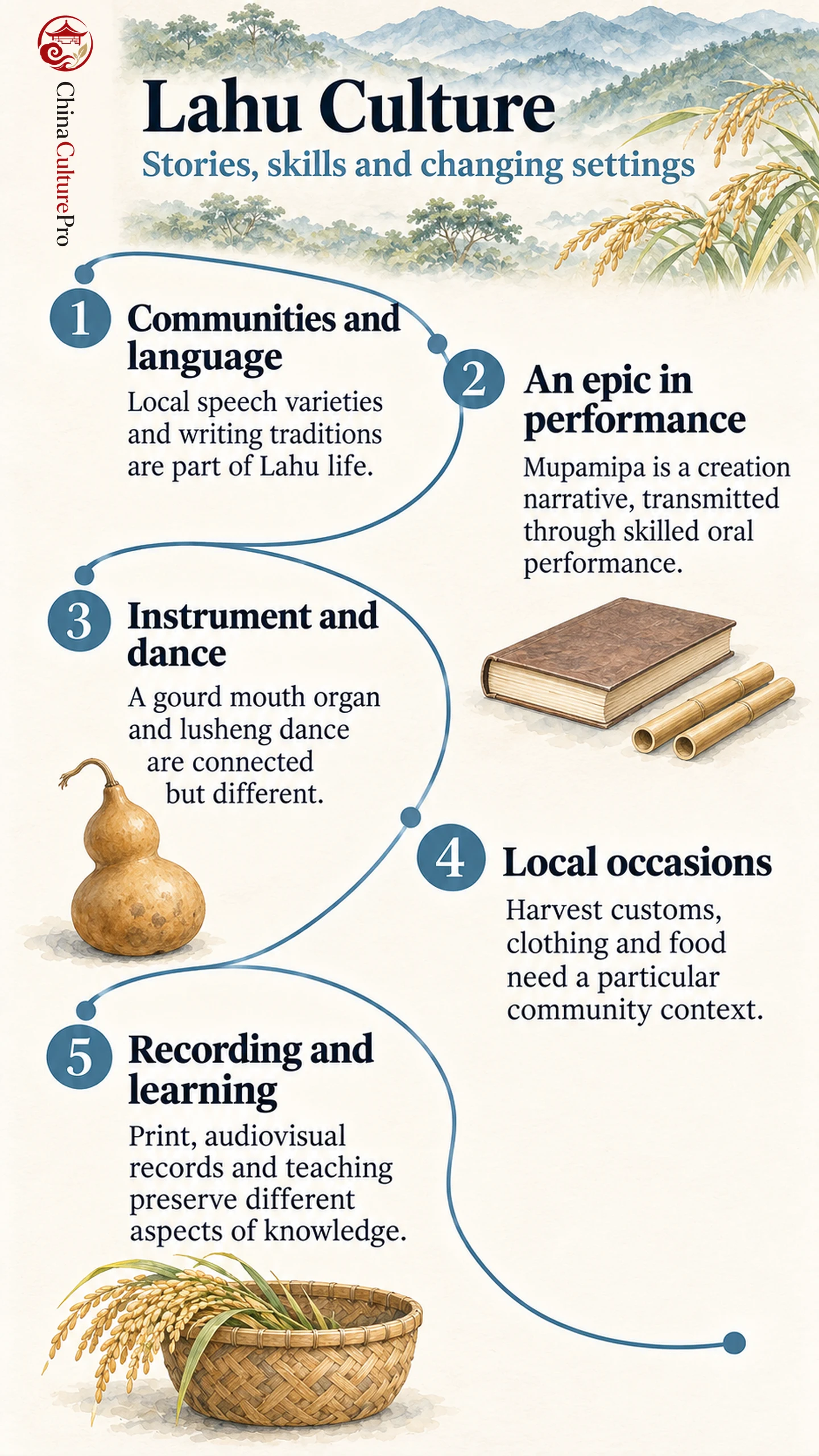
A gourd can appear both in a creation narrative and as part of a musical instrument. Those associations matter, but they are different kinds of evidence. Understanding Lahu culture means distinguishing stories, material skills and lived occasions within the wider diversity of Yunnan culture.
Communities, Language and Local Differences
Lahu communities live on both sides of the Lancang River and alongside neighbors including Dai, Han, Blang and Va communities. Local names include Lahu Na(拉祜纳,Lāhù Nà)and Lahu Shi(拉祜西,Lāhù Xī). These names identify community distinctions without determining every family’s occupation or appearance. [1]
The Lahu language(拉祜语,Lāhùyǔ)has documented regional varieties. Language recording work includes material from Lancang and from Kucung speech communities in Jinping and Mengla. An older Latin-based writing tradition and a revised system approved in 1957 also form part of its history. [2]
The difference between speaking, reading and performing an oral work is important. A person may understand a conversation without knowing a long narrative, while a printed text records only part of what a skilled performer brings to it. An ethnic category does not determine an individual’s proficiency in any of those skills.
Mupamipa: A Creation Epic in Performance
Mupamipa(牡帕密帕,mǔpàmìpà)is a long creation epic associated especially with Lancang. Its title refers to creating heaven and earth. The work entered China’s national heritage list in 2006 under folk literature. [3]
The narrative concerns the making of the world, living things and people, followed by subjects such as tools, farming and social relationships. Gourd imagery appears in accounts of human origins. These are creation narratives and cultural explanations, not archaeological demonstrations or literal population histories. [4]
Performance combines words with melodic delivery. Lead performers may be supported by other singers or share passages through alternating turns. Regional melodic differences and the relationship between wording and delivery are part of the art. [3]
Published and recorded versions do not always divide the work into the same number of sections. The provincial heritage account identifies versions with seventeen or nineteen; a number should therefore be attached to a particular version, not treated as the sole correct structure. [4]
A short stage excerpt can introduce the epic, but it should be identified as an excerpt. Recognizing the title does not establish that a listener has heard the full work.
Gourd Mouth Organs and Lusheng Dance
A gourd mouth organ(葫芦笙,húlúshēng)uses a gourd body with bamboo pipes. The Lancang heritage record describes a five-pipe form. The instrument and lusheng dance(芦笙舞,lúshēngwǔ)are closely connected, but one names an object and the other a performance tradition. [5]
Documented group arrangements include players moving in a circle with other dancers joining around them. Movement can evoke work, animals, ceremony or celebration. These are trained repertoires, not evidence that every person of a particular ethnicity or gender is born knowing how to perform. [5]
The gourd’s symbolic association with origins gives the instrument another cultural layer. That interpretation should be distinguished from its physical construction and the player’s technique. Nor should the instrument be confused with every mouth organ used elsewhere in China: pipe arrangements and local performance practices differ.
The wider field of performing arts includes these relationships between making, playing and moving together.
Harvest Customs, Clothing and Shared Food
The New Rice Festival(尝新节,chángxīnjié)connects tasting a harvest with gratitude toward ancestors and those involved in cultivation. Agricultural rites also concern planting, growing crops and bringing grain home. These belong to particular ceremonial traditions, not a statement that every household follows identical observances. [6] The broader context of religion in China helps distinguish community rites from individual belief.
Traditional clothing often uses dark fabric with colored borders or decoration. Garment cuts vary, including long tops worn with trousers and shorter tops associated with skirts. Local dress should be described through its construction and setting rather than assuming one uniform outfit. [6]
Rice and maize are important foods in documented traditions, with porridge preparations that may include chicken or other ingredients. [6] Ingredients, ceremonial use and everyday eating are separate parts of food culture.
Printed Editions, Recordings and New Performance Settings
Oral transmission and documentation are compatible. Different forms preserve different material:
| Forma | What it preserves |
|---|---|
| Printed edition | A particular collected and edited text; documented publications include Chinese, Lahu and bilingual versions. [4] |
| Audiovisual record | A particular performer’s voice and delivery, such as the National Library’s archival material on Li Zhaluo. [7] |
| Teaching documentation | Explanations and demonstrations intended to support learning, alongside records of practical performance. [8] |
Li Zhaluo died in 2023. His archived rendition belongs to a documented transmission history, not a claim that he is currently teaching. The library account connects his version with a 1989 publication. [7]
A 2024 ministry response records work undertaken in 2015 and 2018 using oral accounts, practical demonstrations and teaching films. Such records support future study; a new singer still needs to learn delivery and context. [8]
New compositions also belong to Lahu musical life. A 2025 interview recounts Li Naluo’s song Happy Lahu being performed at a provincial gala in 2006, and her community performance company’s establishment in 2013. These are dated examples of creative work and organization, rather than an unchanged ancient repertoire. [9]
FAQs About Lahu Culture
Does Lahu Have a Written Language?
Yes. Latin-based writing traditions and a revised system approved in 1957 are documented. Describing an epic as orally transmitted does not mean the language lacks writing or that no editions exist. [2][4]
Is the Gourd Story a Historical Origin Record?
It is a creation narrative with cultural and symbolic importance. It should not be used as literal evidence of biological ancestry or a dated migration route. [4]
Is Lahu Lusheng the Same as Every Chinese Mouth Organ?
No. The Lancang account describes a particular gourd-bodied, five-pipe instrument and related dance. A broader instrument-family label does not establish identical construction or local technique. [5]
Are All Lahu Songs Ancient?
No. Alongside inherited narratives and tunes, musicians create new songs. Li Naluo’s Happy Lahu is a documented example of a modern composition within community musical life. [9]
Fuentes
[1] National Ethnic Affairs Commission. Lahu ethnic group overview
[2] Minzu University language monitoring center. Lahu language writing and documentation
[3] China Intangible Cultural Heritage. Mupamipa
[4] Yunnan Intangible Cultural Heritage Protection Center. Lahu epic Mupamipa
[5] China Intangible Cultural Heritage. Lahu lusheng dance
[6] National Ethnic Affairs Commission. Lahu customs
[7] National Library of China. Mupamipa recording: Li Zhaluo
[8] Ministry of Culture and Tourism. Reply on safeguarding Mupamipa,2024
[9] Yang Feiyue and Li Yingqing, China Daily. Visionary sees village profit from tradition,2025