

Quick Answer
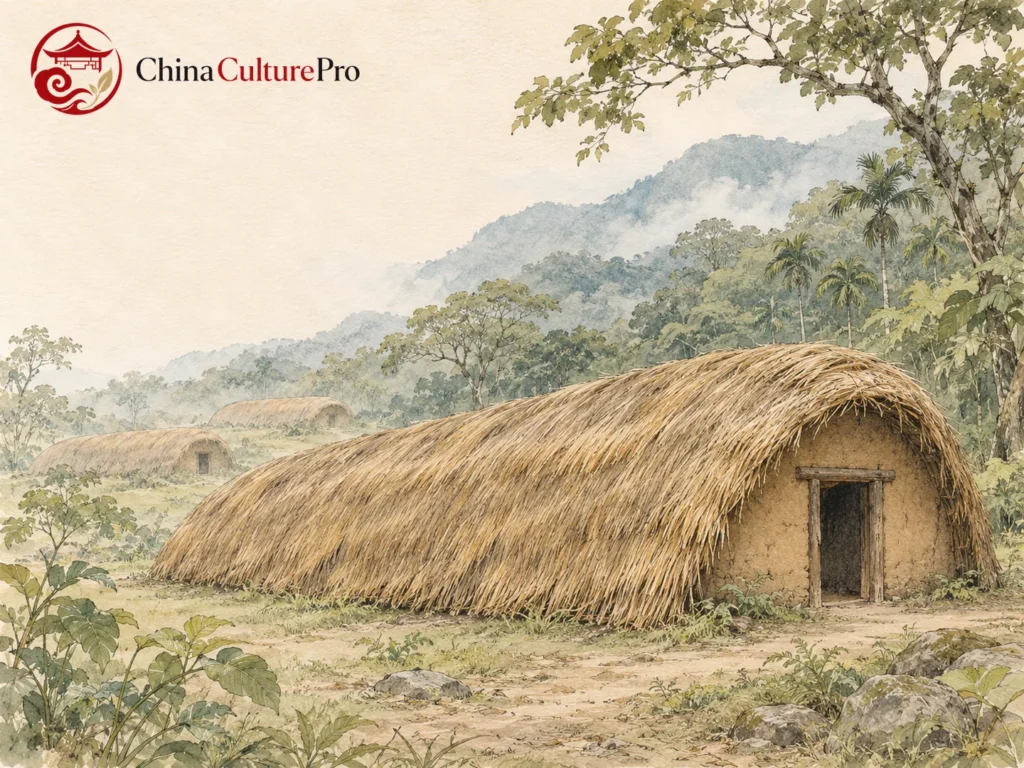
Li boat-shaped houses (船型屋, chuánxíngwū) are traditional buildings on Hainan. Their curved thatched roof and low sides can look like an overturned boat. The same basic outline appears in family dwellings and in some smaller buildings with other uses.[1][2]
- Structure: Timber forms the main frame, while bamboo and vines can bind parts of it together.[2]
- Variation: Researchers recorded mud-walled dwellings in Baicha and wood-walled ones in Chubao.[2]
- Heritage: China listed the building techniques in 2008. Repairs in Baicha help keep the craft in use.[1][3]
The outline tells you how the building got its name. Look at its walls, floor level and interior to work out what it was used for.

The thatch can come so low that roof and wall appear to merge when seen from outside. Inside, the building may reveal a hearth, a sleeping space or a raised floor made to store grain. Those clues connect one of the best-known forms of Li culture with the practical knowledge of people who built and maintained it.
What Gives a Li House Its Boat Shape?
The boat comparison describes a shape, especially the long roof curving down toward the sides. It also gives an idea of the interior. The national heritage record compares the enclosed space to a cabin. In Baicha, in Dongfang on western Hainan, reporting describes a central hearth in the traditional house, where household members cooked and gathered.[1][3]
Each material has a different job. Fieldwork in Baicha and Chubao documented timber trunks used for columns and beams, strong vines used to secure heavier parts, and strips of bamboo used to bind the framework. Plant leaves or grasses form the roof covering. Choosing a material involves knowing how it will behave in a joint or on a wet roof as well as knowing where it can be found.[2]
A comparison with Dai bamboo houses makes those jobs easier to see. Bamboo can have very different roles from one building tradition to another. In a Li boat-shaped house, the curved outline is read alongside the actual frame, bindings and roof covering.
Family Houses and Other Boat-Shaped Buildings
A 2025 study by Guang-Hui Ma and colleagues documented four forms at two Hainan villages. The labels below describe the buildings observed at those sites.[2]
- Mud-walled family house: The study documented this kind of timber-framed residence at Baicha.[2]
- Wood-walled family house: Chubao had examples of boat-shaped residences with walls of wood.[2]
- Small sleeping house: Both villages had a smaller form used by unmarried girls in the practice described by the study. It had a simpler interior without facilities for cooking or a hearth.[2]
- Raised granary: Grain could be kept in a small structure on stilts, sometimes away from the residential area. The floor height and size give it a different use even when the roof outline resembles a house.[2]
The granary illustrates why a photograph of a thatched roof is a poor guide to the use of a whole building. A raised storage structure can appear alongside ground-level homes within the same settlement. Look for the entrance, supports and scale as well as the shape of the roof.
What the Houses Reveal About Climate and Materials
Roof covering, walls and ventilation all affect conditions indoors. The field team took daytime measurements in January and July 2024. In the rainy-season observations, brick houses at both study villages averaged about 0.8°C warmer indoors than the traditional examples. During the dry-season observations at Chubao, brick houses were cooler than the traditional dwellings on average.[2]
The measurements covered daytime readings across short observation periods. The measured difference changed between the two seasons at Chubao. A year-round comparison would require observations beyond those two measurement periods. Orientation, wall material and the purpose of the building all matter when comparing particular examples.[2]
The material evidence is easier to see directly. A tie can flex around pieces of different shapes, while a beam provides a rigid support. Roof plant material needs to shed water, and the ability to renew the outer covering affects the life of the timber underneath.[2]
How Baicha Keeps the Building Skills in Use
Baicha illustrates a shift from everyday housing to conservation through repair. The building craft entered China’s national intangible heritage inventory in 2008. Villagers moved to brick-and-tile housing in a nearby new settlement in 2009, according to Xinhua’s account. The old houses remain in the historic village, where ongoing work keeps their roof covering and structure in repair.[1][3]
Xinhua profiled Baicha builder Fu Dayin, who learned to build the houses from elders as a teenager and later trained others. A repair project can pass on things that photographs cannot show, such as which plant fibers hold a joint securely or how to judge whether a section of old covering can stay. The process also keeps the houses connected with the people who know their uses.[2][3]
Baicha is one architectural tradition within the wider cultural landscape of Hainan. The village helps explain why preserving a roof outline and preserving a building craft involve different kinds of work.
Baicha’s houses are one part of the Li heritage documented in Hainan. Li nose flutes tell a different story through musical instruments, while the history of Li tattooing draws on records of people and communities.
FAQs About Li Boat-Shaped Houses
Are All Li Boat-Shaped Houses Built on Stilts?
No. In Baicha, documented family houses include ground-level buildings. A study of Baicha and Chubao describes granaries on raised supports. Floor height depends in part on the building’s use.[1][2]
Are the Houses a UNESCO World Heritage Site?
Baicha is part of a proposal on China’s Tentative List. The UNESCO World Heritage Centre records the broader Hainan rainforest and traditional Li settlement proposal on that list. The building skills have a separate listing in China’s national intangible heritage inventory.[1][4]
Fuentes
[1] China Intangible Cultural Heritage Network. Traditional techniques for building Li boat-shaped houses
[2] Guang-Hui Ma and colleagues. Boat-shaped houses of the indigenous Li people on Hainan Island
[3] Xinhua. Baicha village and the boat-shaped house tradition
[4] UNESCO World Heritage Centre. Hainan Tropical Rainforest and the Traditional Settlement of Li Ethnic Group