

Quick Answer: When Is Jingzhe?
Jingzhe (惊蛰, Jīngzhé), or Awakening of Insects, is the third of the 24 solar terms. It starts when the Sun’s apparent longitude reaches 345 degrees, generally between March 4 and 6. Hong Kong’s calendar places it on March 5 in 2026 and March 6 in 2027. [1][2][3][4]
- Seasonal image: Spring thunder is said to stir creatures dormant through winter. [5]
- In the fields: The term traditionally points to the return of spring plowing and sowing. [4][6][7]
- Local observances: Eating pears is a seasonal custom in parts of China. Hong Kong has rites associated with the White Tiger. [7][8]
The calendar date follows the Sun. The timing of thunder, blossoms and fieldwork varies by locality.

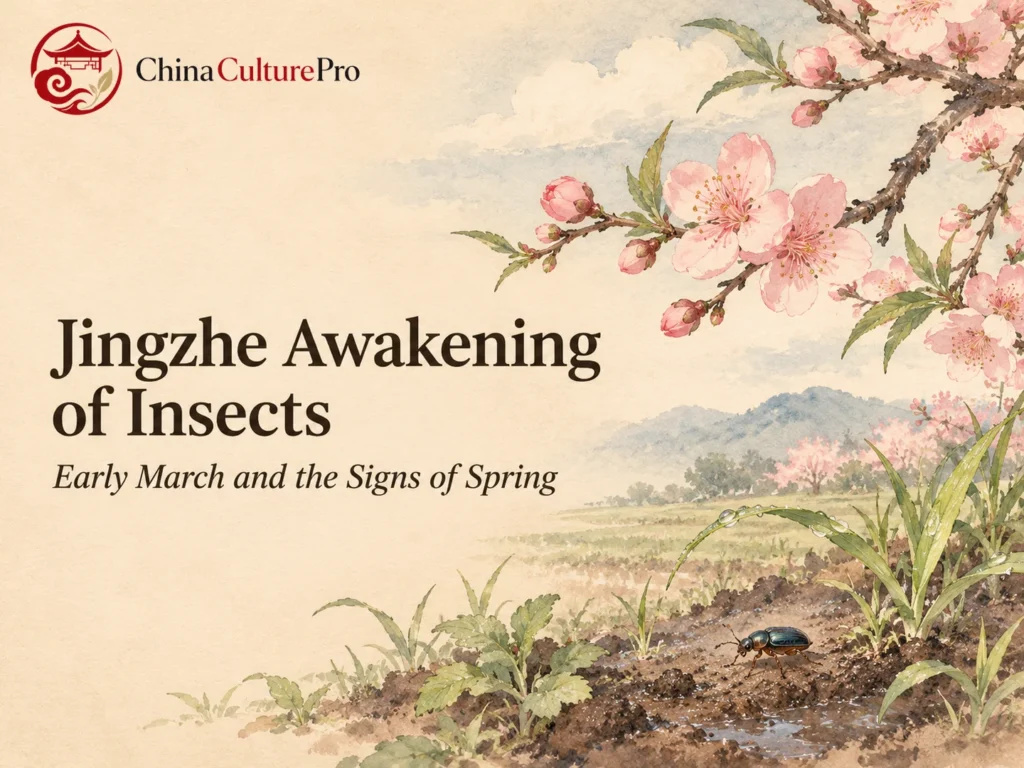
A traditional Jingzhe sequence begins with the opening of peach blossoms. Jingzhe’s best-known image is spring thunder stirring hidden creatures. Together, the blossom and the thunder help explain how a point on the calendar came to stand for changes people could see and hear. [4][5]
How the Sun Sets the Date
Jingzhe comes after Rain Water and before the Spring Equinox in the spring solar terms. The Hong Kong Observatory calls it Insects Waken and classifies it as a minor term. Its longitude is 345 degrees, one 15-degree step before the Spring Equinox at zero degrees. That fixed solar position keeps the Gregorian date in early March, while the lunar day depends on where the new moon fell. [1][2][3]
For example, March 5, 2026 corresponded to day 17 of the first lunar month in Hong Kong’s calendar. March 6, 2027 falls on day 29 of the first lunar month. An almanac can therefore place Jingzhe near the middle of a lunar month in one year and near its end in another. [2][3]
What the Name Says About Spring
Jingzhe evokes creatures stirred from winter dormancy. A Hunan cultural account connects the name with the folkloric idea that spring thunder awakens them. The Yantai municipal portal’s seasonal account also points to thawing ground, rising temperatures and the return of animal activity. [4][5]
UNESCO’s account of the 24 solar terms links the system with practical knowledge of seasonal change and farming. For Jingzhe, the seasonal work can include preparing the soil or sowing. The calendar marks a broad change in season. Soil warmth and moisture help determine when a particular field can be worked. [4][6][7]
Pears and White Tiger Rites
A seasonal feature carried by the Shanghai municipal portal records eating pears around Jingzhe. The custom gives the date a seasonal food association. In Hong Kong, the intangible heritage inventory records a White Tiger rite (祭白虎, Jì Báihǔ) at temples, near road junctions and beneath flyovers. Participants seek protection from bad fortune and blessings for themselves or their families. [7][8]
The same inventory says some people choose Jingzhe for villain beating (打小人, Dǎ Xiǎorén), a symbolic folk rite associated with warding off trouble. Hong Kong Memory documents the area under the Canal Road Flyover in Wan Chai as a site associated with the custom. The White Tiger rite and villain beating are documented separately, even though both can take place on Jingzhe. [8][9]
FAQs About Jingzhe
Is Jingzhe on the same lunar day every year?
Its timing comes from the Sun reaching 345 degrees apparent longitude. The Gregorian date is usually in early March, and the lunar day varies. [1][2][3]
Does the first thunderstorm determine Jingzhe?
The astronomical calculation determines the term. Thunder belongs to the traditional imagery, and the first spring thunder occurs at different times in different places. [1][5][7]
Fuentes
[1] Hong Kong Observatory. The 24 Solar Terms
[2] Hong Kong Observatory. 2026 Gregorian–Lunar Calendar Conversion Table
[3] Hong Kong Observatory. 2027 Gregorian–Lunar Calendar Conversion Table
[4] Yantai Municipal Government. Jingzhe and the Return of Spring
[5] Hunan Official Web Portal. 24 Solar Terms, Jingzhe
[6] UNESCO. The Twenty-Four Solar Terms
[7] Shanghai Municipal Government. Four Things You May Not Know About Awakening of Insects
[8] Hong Kong Intangible Cultural Heritage Office. Hong Kong Intangible Cultural Heritage Inventory
[9] Hong Kong Memory. Villain Beating