


Quick Answer: What Was a Jingdezhen Gourd Kiln?
A Jingdezhen gourd kiln (葫芦窑, húlu yáo) was a porcelain kiln with a waist that narrowed between broader parts of the firing space. Archaeological studies trace early forms to the late Yuan and more developed examples to the Ming.[1][2]
- Shape: The inward curve of the walls gave the kiln its name.[1][3]
- Excavation: Archaeologists documented groups of gourd-shaped kilns at the Imperial Kiln Factory site.[2][3]
- Reconstruction: A Ming-style kiln at the Ancient Kiln Folk Customs Museum was rebuilt and refired as part of a modern program.[4]
Look at the floor plan to identify the form, then check whether you are looking at an excavated kiln or a reconstruction.[2][3][4]
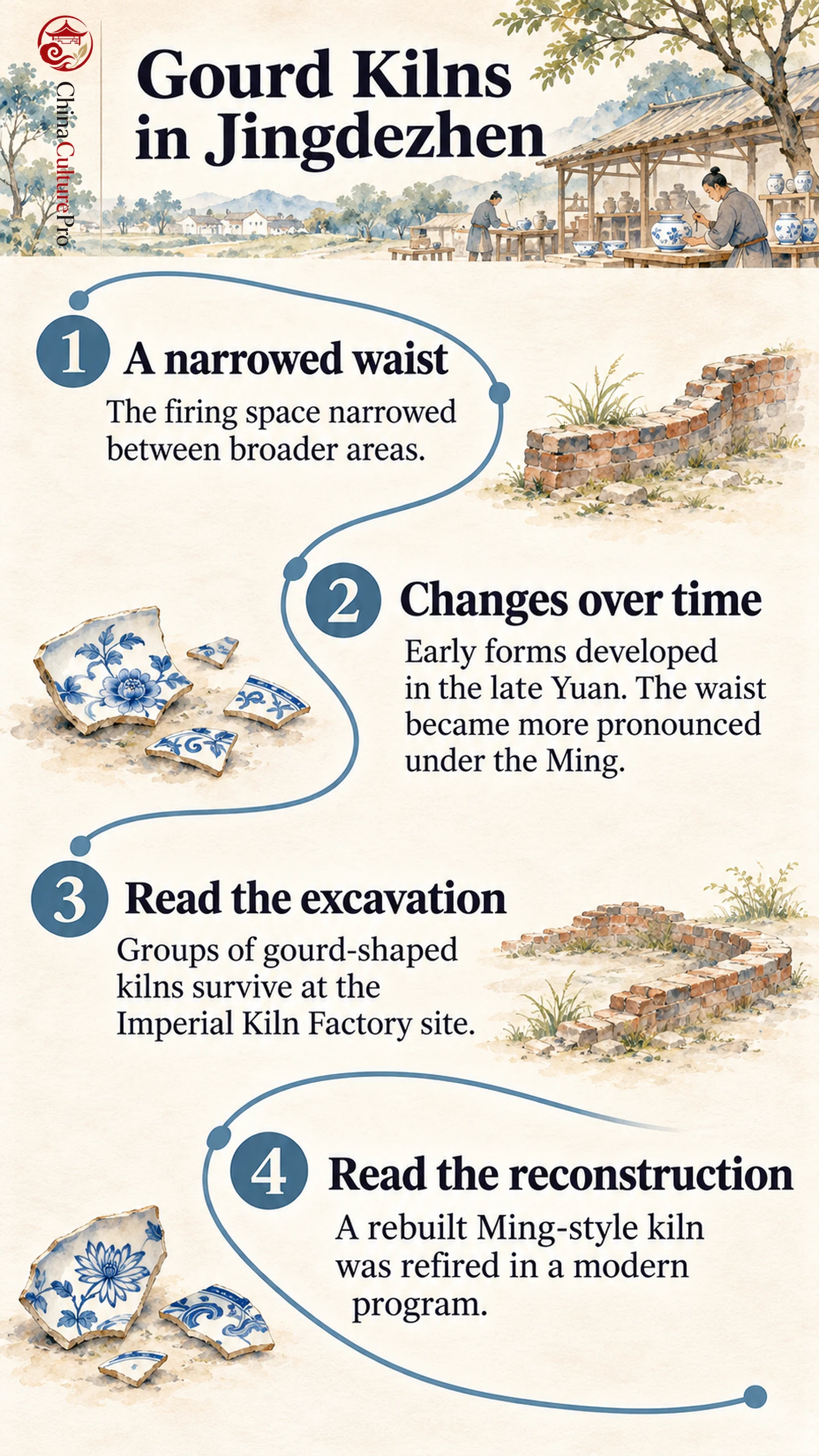
A kiln ruin can be easier to identify from above than from ground level. Where the roof is gone, the surviving walls may show the outline of the firing space. At Jingdezhen, the key clue is the narrowed section between broader areas.[1][2][3]
What the Narrow Waist Changed
One archaeological interpretation traces the early gourd form to local changes to the dragon kiln (龙窑, lóngyáo). Wider late Yuan examples developed a narrower section between parts of the firing space. In the early Ming, the rear section became shorter and the waist more pronounced in some examples.[1][2]
The changing outline has been interpreted as an effort to gain more control during firing. A restriction in the passage changes the relationship between the firing spaces. The published interpretation also considers the cost and speed of building kilns, which mattered in an industry with many workshops. The surviving outlines show several stages of change rather than a single fixed plan.[1]
The local industry produced many kinds of Jingdezhen porcelain. The kiln outline tells you something about the production space. To explain the appearance of a finished piece, you also need evidence about the clay, glaze and firing atmosphere.[1][2]
What the Imperial Kiln Excavations Show
Excavations at the Imperial Kiln Factory identified groups of gourd-shaped remains on the northern side of Zhushan. Archaeologists also found rounded remains farther south, associated with the mantou kiln (馒头窑, mántou yáo) form. A visitor can therefore encounter several kiln types in the archaeological record of one production complex.[2][3]
The excavations also recovered porcelain fragments and workshop deposits. These can reveal how wares were made, selected or discarded. A broken piece may establish the presence of a ware at the site. Its relationship to one particular kiln depends on its context and whether it was found in a layer, a discard pit or a place linked directly to a firing structure.[2]
What the Modern Reconstruction Can Tell You
The Ancient Kiln Folk Customs Museum reconstructed and refired examples of the local kiln types between 2010 and 2012. The program included a Ming-style gourd kiln, a Yuan-style rounded kiln and a Song-style dragon kiln. That sequence belongs to the modern demonstration program. The buildings can make aspects of firing and handling visible that foundations alone cannot show.[4]
A reconstruction reflects choices about how to interpret incomplete evidence. Check which features come from the surviving outline and which were restored to make the kiln work. The same reading habit applies to museum replicas and historical objects.[2][3][4]
The Jingdezhen Handicraft Porcelain Industry Sites were inscribed on the World Heritage List in 2026. The designation applies to a group of sites connected with porcelain production. The date concerns recognition of that industrial landscape.[5]
FAQs About Jingdezhen Gourd Kilns
Is a gourd kiln the same as a dragon kiln?
The gourd kiln developed from local long-kiln forms in one historical interpretation. Its narrowed waist and more clearly differentiated firing spaces help distinguish it from the elongated hillside form.[1][2]
Is every kiln shown at Jingdezhen an original structure?
The Imperial Kiln Factory preserves excavated remains. The Ancient Kiln Folk Customs Museum also displays rebuilt examples, including a modern reconstruction of the Ming gourd type.[2][4]
What did UNESCO inscribe in 2026?
The listing covers the Jingdezhen Handicraft Porcelain Industry Sites, a group of places connected with the city’s historic porcelain production.[5]
Fuentes
[1] Feng Mian. A Study of How the Jingdezhen Gourd Kiln Developed
[2] Palace Museum. Archaeological Discoveries at Jingdezhen’s Ming and Qing Imperial Kilns
[3] UNESCO World Heritage Centre. Gourd-Shaped Kilns at the Imperial Kiln Factory Site
[4] Jingdezhen Municipal Government. Ancient Kiln Folk Customs Museum
[5] World Heritage Committee. Decision 48 COM 8B.16: Jingdezhen Handicraft Porcelain Industry Sites