

Quick Answer: What Is the Difference Between a Replica and a Historical Object?
A museum replica reproduces selected features of another object. The historical object is the item whose past the display interprets. A label can describe both, so check which item the stated date, material and measurements belong to.[1][2]
- Historical object. Its material and documented history belong to the item itself.
- Physical reproduction. A replica or cast can show form, scale or a surface that is difficult to examine on the original.[1]
- Digital display. A projection can enlarge or animate an image of a work.[2]
A reproduction can be valuable for close viewing even when the original object is housed or displayed separately.
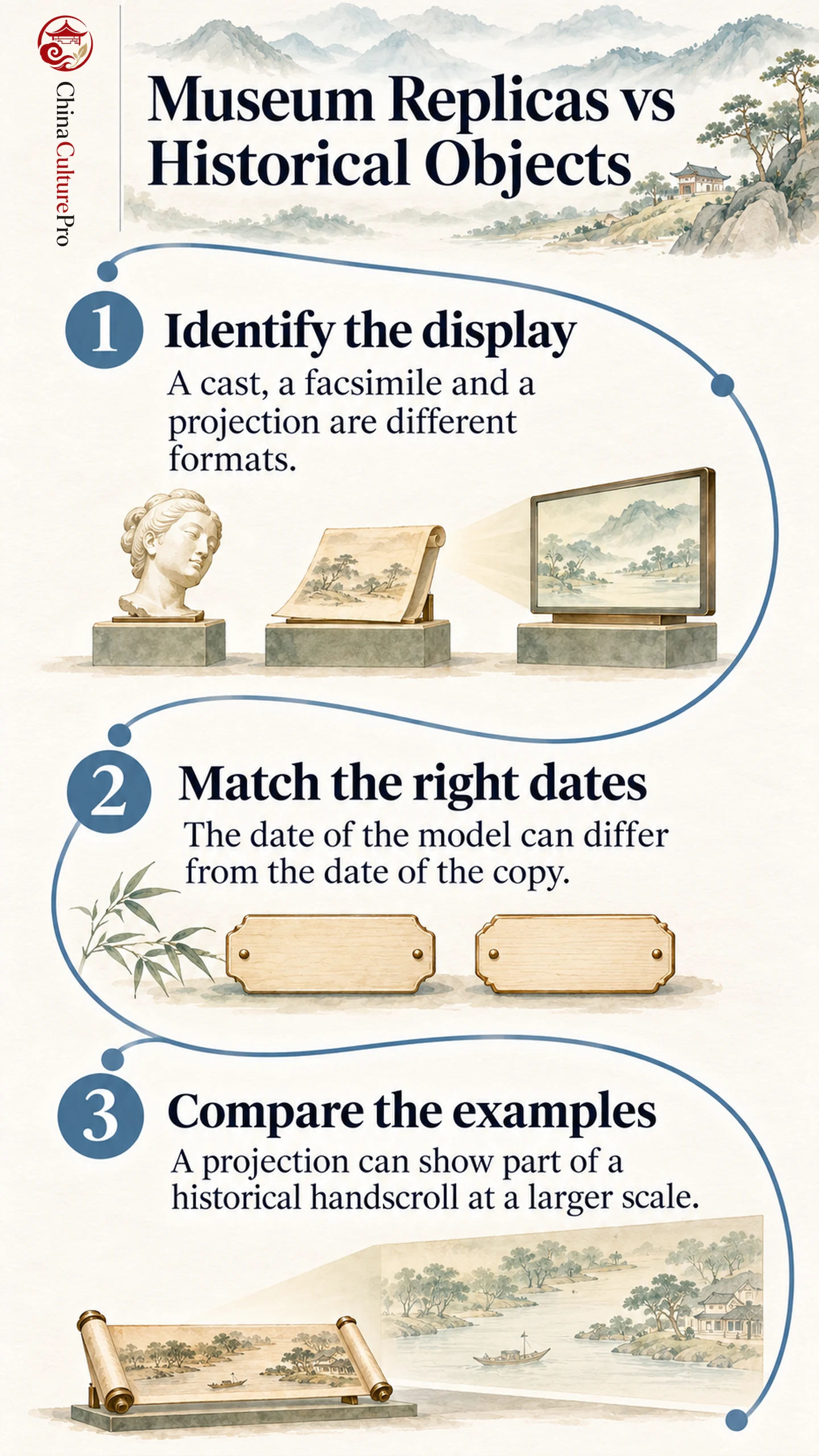
The large date on a label may belong to an object pictured on a screen while the screen installation was made recently. A term such as “projection” tells you what the exhibition actually presents.
What Different Display Labels Mean
| Display description | Qué conviene comprobar |
|---|---|
| Historical object | Which object record supplies the date, material and history? |
| Replica or cast | Which object was copied, and does the reproduction match the original scale and material? |
| Facsimile or rubbing | Which text or surface does it represent, and when was the paper item made? |
| Digital display | Which historical work supplied the image, and how was that image presented? |
A rubbing may itself be a cataloged paper object. A record for a rubbing of the Duke Mao bronze inscription, for instance, lists the rubbing as a work with its own identifier. The historical bronze and the paper item therefore have different catalog records, even when the text links them.[3]
Read a Display in Four Steps
- Find the words that identify the display. Look for a statement such as “replica,” “cast,” “facsimile” or “digital projection.”
- Name the reference object. Record the original title, collection or inventory number if the label provides it.
- Assign each date and material to an item. Keep separate notes for the model and the displayed reproduction. Add scale or material differences if the sources specify them.
- Check an object or exhibition record. Compare images and descriptive fields. Mark separately anything you observed in the gallery and anything you learned from the record.
If several labels are grouped together, use the sequence for reading a Chinese museum label to match each one with the relevant item in the case.
A Qing Scroll and Its Digital Exhibition
The Qing court version of Up the River During Qingming is a historic handscroll dated to 1736. An installation at the National Palace Museum used high-resolution projection to display the scroll as a large moving image. The 1736 date belongs to the Qing painting. The projection is a way of experiencing its imagery at a scale different from the handscroll.[2] To check a detail such as an impressed mark, consult the underlying object record and use the guide to reading Chinese name seals to distinguish an artist’s seal from a collector’s.
A different example shows why the materials can also diverge. A British Museum teaching guide compared a touchable plastic replica of the Rosetta Stone with the original stone protected in a display case. The replica served a handling and teaching purpose. What visitors are permitted to touch depends on the rules of the specific exhibition.[1]
FAQs About Museum Replicas and Historical Objects
Can a replica have the same material as the historical object?
Some reproductions aim to match the historical material, while others use a different one. The museum’s handling replica of the Rosetta Stone was described as plastic. Check the materials listed for both objects.[1]
Does a historical date on the label date what is on display?
It can date the historical model. In the Qing scroll installation, 1736 is the date of the painting represented by the projection.[2]
May visitors touch a museum replica?
Follow the sign or staff instructions for that exhibit. Some reproductions are designed for handling, and others are displayed under the same restrictions as nearby objects.[1]
Fuentes
[1] British Museum. Self-directed visit guide: Rosetta Stone replica and original
[2] National Palace Museum. A Special Exhibition of Paintings on Up the River During Qingming
[3] National Palace Museum. Rubbing of the Mao Gong Ding