

Quick Answer: What Was a Chinese Sworn Sisterhood?
A sworn sisterhood (結金蘭, jié jīnlán) could make women from different families recognize one another as sisters. One documented setting was the Pearl River Delta, where some self-combed women (自梳女, zìshūnǚ) built networks of support while remaining unmarried.[1][2][3]
- The bond. Swearing a tie could give a friendship the obligations of a sibling relationship.[1][2]
- The vow. Some women marked their choice to remain single by putting up their hair.[2][3]
- The support. Women could share housing, work contacts and other help.[2][4]
The kinship bond could exist apart from a vow to remain single.
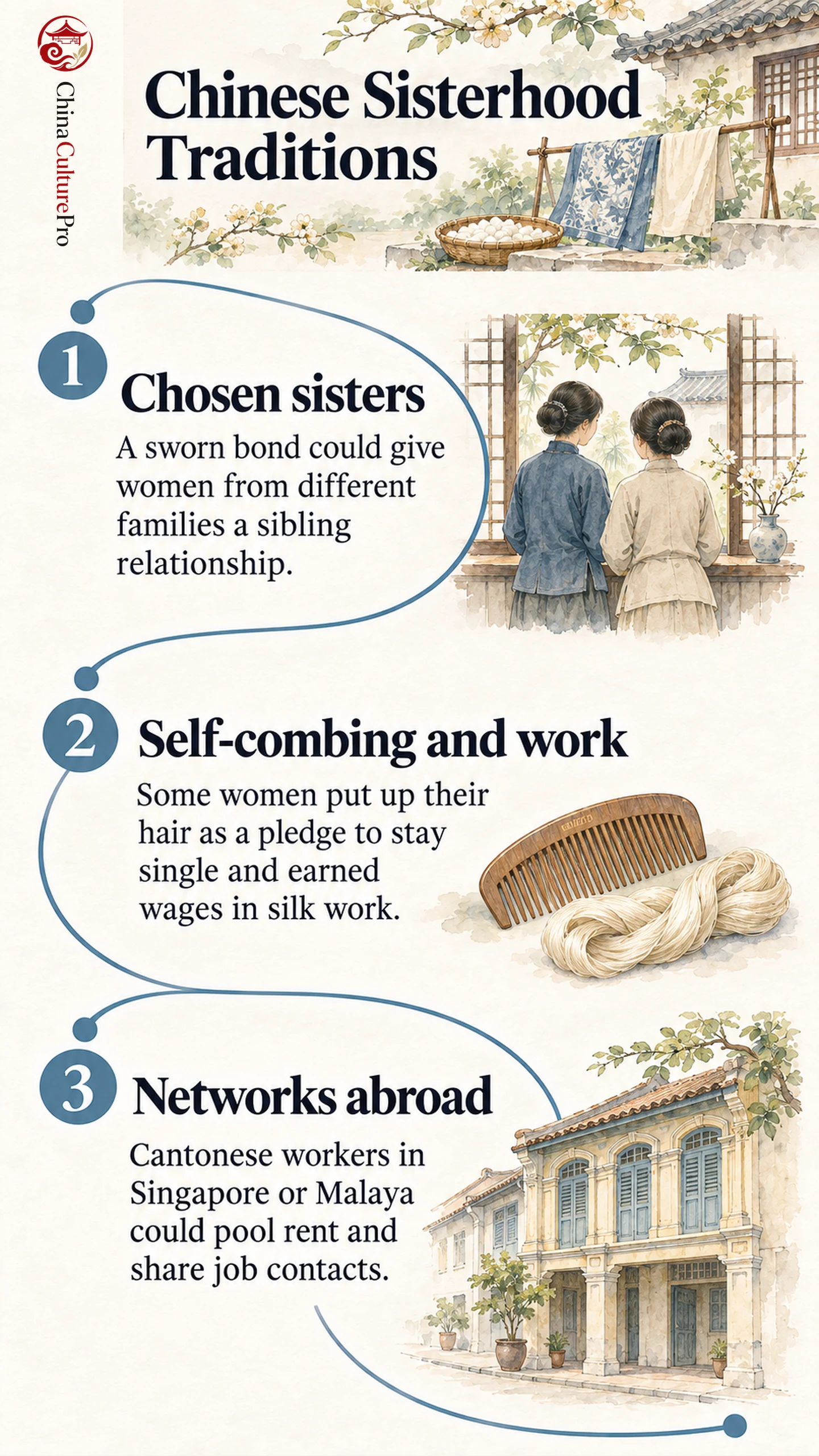
In Singapore, a Cantonese domestic worker might keep her belongings in a room shared with women from her home district. A place to stay between jobs also gave her a way to keep in touch with a network of other workers.[2][4]
What It Meant to Become Sworn Sisters
A Chinese expression for forming a bond of sworn kinship can apply to sisters or brothers from different families. A Qing customs collection uses it for a pact involving women who pledged to remain unmarried. The pledge in that example shows one way people put the bond into practice.[1]
Chinese sworn brotherhood uses a related idea of chosen kinship. The women’s networks in the Pearl River Delta took shape in particular circumstances of work and marriage.[1][2][3]
Self-Combing and the Silk Economy
In parts of the Pearl River Delta, silk work gave some women a way to earn a living outside marriage. Sources describe a ceremony in which the woman’s hair was put up into a bun. The hairstyle marked adult status and, in this context, a pledge to remain unmarried.[2][3]
A banquet could bring relatives and fellow sisters together to witness the decision. Earnings could support the woman herself and contribute to the family she was born into. Self-combing therefore changed the terms of one relationship without ending all her obligations to relatives.[2][5]
How Migrant Women Supported Each Other
Some Cantonese women migrated to Singapore or Malaya for paid domestic work. Women from the same village or district could establish a workers’ association (公司, gōngsī), known locally as a kongsi. They pooled money to rent rooms that could provide beds, storage and contact with prospective employers.[2]
These arrangements were part of wider Cantonese diaspora networks. Some women later received help from district associations or found a place to live in a communal home or a vegetarian hall.[4]
FAQs About Chinese Sisterhood Traditions
Did every sworn sister vow to remain unmarried?
The term for sworn siblinghood has a wider meaning. A vow to remain unmarried was part of the self-combing practice described in some southern Chinese communities.[1][2][3]
Were all Cantonese domestic workers self-combed women?
Self-combing describes a personal pledge and a social practice. Domestic service describes paid work. They overlapped among migrants from places such as Shunde, and the two labels convey different information.[2][4]
Fuentes
[1] Taiwan Ministry of Education. Revised Mandarin Dictionary: Sworn Siblinghood
[2] National Library Board Singapore. A Lifetime of Labour: Cantonese Amahs in Singapore
[3] Lingnan Costume Museum. Self-Combed Women and Sworn Sisters
[4] Singapore Chinese Cultural Centre. Cantonese Clan Associations in Singapore
[5] University of Chicago Hong Kong. Daughters of the Canton Delta