


Quick Answer
A Chinese betrothal letter (聘书, pìnshū) is a traditional document associated with agreeing to an engagement. In the framework called the Three Letters and Six Rites (三书六礼, sān shū liù lǐ), it appears alongside a gift letter (礼书, lǐshū) and a wedding letter (迎书, yíngshū). The Sha Tin record distinguishes these by the purpose and occasion of each document.[1][4]
- Betrothal letter: Records a step in reaching a marriage agreement.[1]
- Gift letter: Can list the items and amounts presented as betrothal gifts.[1]
- Wedding letter: Belongs to the occasion of formally receiving the bride in the documented framework.[1]
Individual family records may use other names or forms.[2][3]
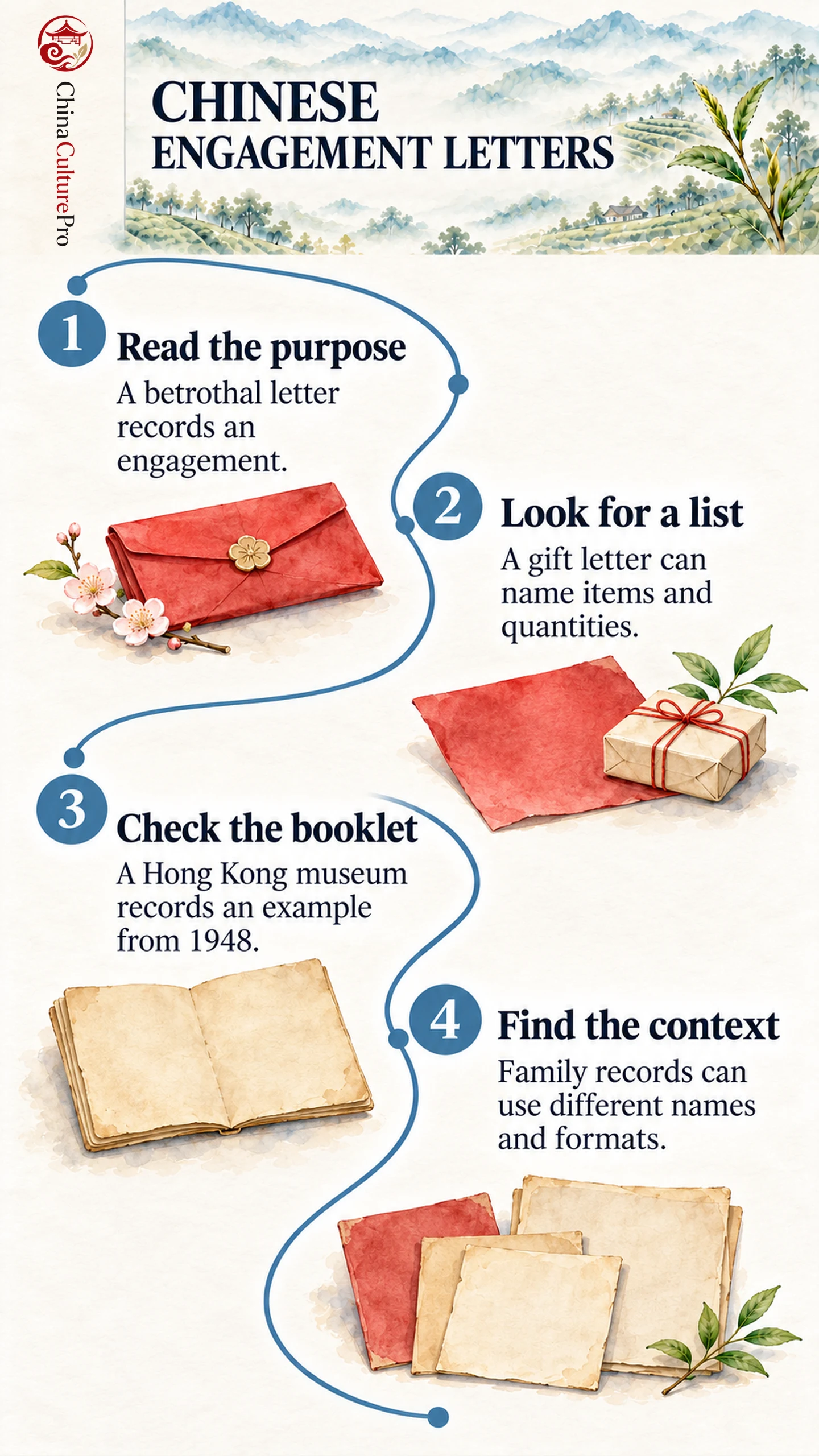
A red paper booklet can be called a marriage document and still leave open a more specific question. Was it used to record an engagement, accompany gifts or mark a later occasion? Its contents and the record of how it was used help answer that question.[1][2][3]
What the Three Letters Describe
A study of traditional Sha Tin weddings distinguishes three types of documents. In its account, the betrothal letter appears during the agreement process, the gift letter accompanies a later presentation of gifts, and the wedding letter belongs to receiving the bride. The letters sit within a wider set of rites. An agreement, an inventory of gifts and a wedding-day document capture different exchanges.[1]
The guide to Chinese regional wedding customs provides context for comparing that local account with other practices. A translated label can name the type of document. The local account explains when it was used.[1][4]
How a Gift List Can Identify the Occasion
The Sha Tin study describes a gift letter as a record of items and quantities. That kind of list gives a reader a clue to the document’s purpose. A formula acknowledging an agreement or naming the couple can point to another function.[1][3]
Read the list with the rest of the document. A heading, sender, recipient or note on an envelope may connect a list to the occasion when the gifts were delivered. The relationship between the document and a specific ceremony matters. At another stage of the wedding, the Chinese wedding tea ceremony marks family relationships through serving tea.[1]
What a Surviving Betrothal Booklet Shows
The Hong Kong Conservation Office describes a 1948 betrothal document called a Luan Shu in the Hong Kong Museum of History. The conservation report describes a booklet with fragile interior pages and identifies bamboo fibre in the paper. It establishes the date, collection and material of this example.[2]
A conservation account can explain how a document was made and why its pages need care. A transcription or historical description can explain what the text says and how the families used it. For the Luan Shu, the conservation office supplies the name and date but does not reproduce the full text.[2]
How to Read an Unidentified Family Document
A Taiwanese folklore dictionary describes paired marriage documents with different names according to which family sent them. The example is useful because two papers from one marriage can carry different headings. Keep the sender and recipient with the record when describing the document.[3]
If a family keeps the paper with other records, ask how it was stored and what relatives called it. Read the date, headings and any item list together. Those details help distinguish a marriage document from Chinese family instructions or other material handed down within a family.[1][2][3]
FAQs About Chinese Engagement Letters
Was Every Wedding Letter an Engagement Letter?
The Sha Tin study distinguishes the betrothal letter from the wedding letter. The former belongs to reaching the agreement. The latter is associated with receiving the bride on the wedding occasion.[1]
Did All Families Use the Same Letter Format?
The sources give several names and types, including the 1948 Luan Shu and the reciprocal documents in a Taiwanese folklore account. The local terms and the contents identify each example.[2][3]
Fuentes
[1] Sha Tin traditional wedding customs study. Three Letters and Six Rites
[2] Hong Kong Conservation Office. The conservation of the Luan Shu
[3] Taiwan Folklore and Material Culture Dictionary. Marriage documents exchanged by families
[4] University of Liverpool Repository. Glossary of Chinese wedding terms