

Quick Answer: What Does Cheng Sincerity Mean?
Cheng (诚, chéng) is usually translated as sincerity in Confucian philosophy. It describes how a moral commitment becomes genuine in conduct. In the Zhongyong (中庸, Zhōngyōng), it also describes the way of Tian (天, tiān), conventionally translated as Heaven.[1][3]
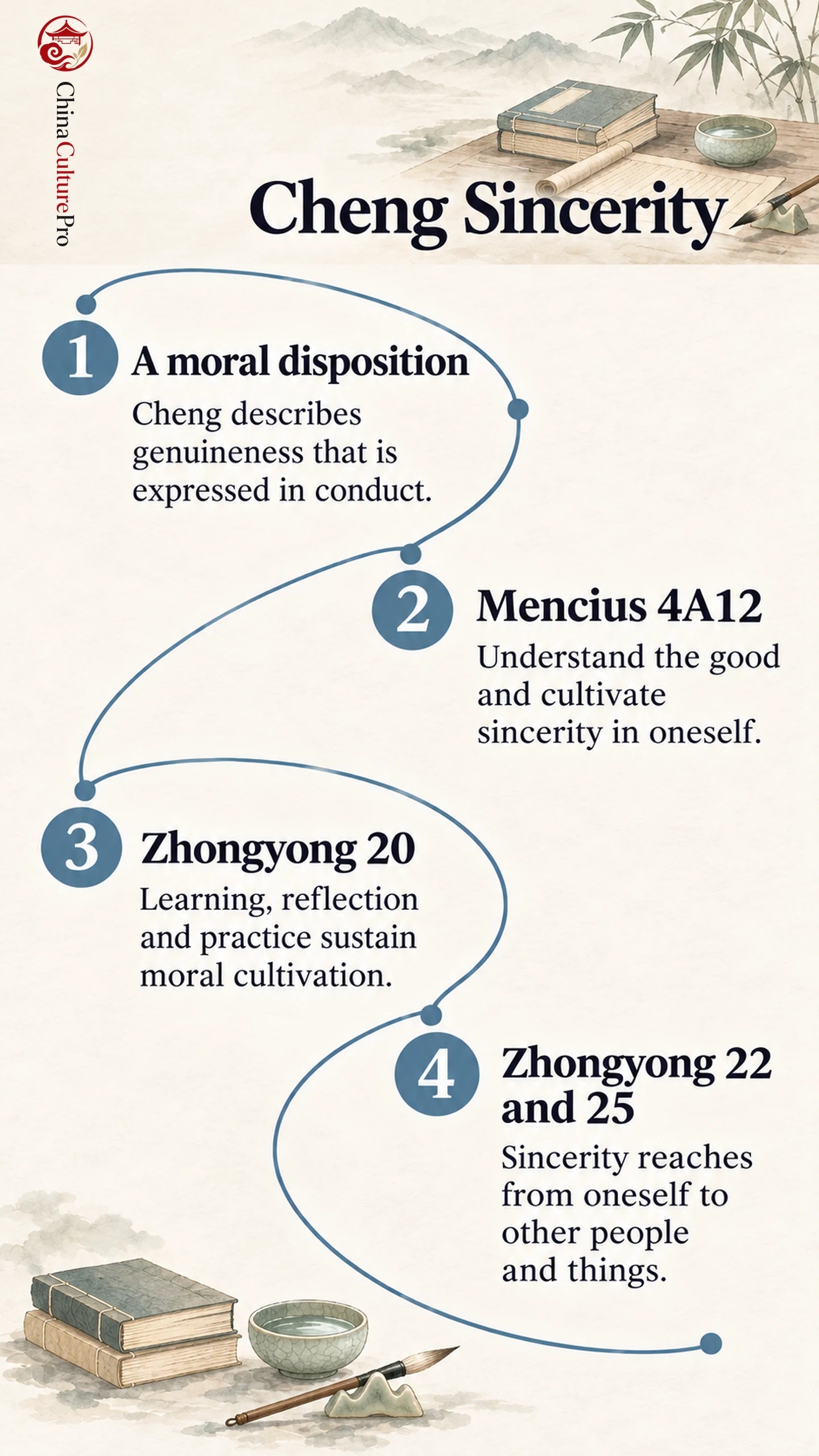
- Understanding: Mencius (孟子, Mèngzǐ) makes a grasp of what is good a condition for becoming sincere.
- Cultivation: The Zhongyong sets out learning, judgment and sustained practice as ways to become sincere.
- Completion: Later chapters extend sincerity from the work of forming oneself to helping other people and things develop.[1][2]
The ordinary English word captures personal genuineness. The passages show why the Chinese term can also describe something broader than a person’s feelings.
Suppose a student repeatedly does what a teacher expects, yet only to appear diligent. The observable behavior may be the same as that of a committed student. Cheng helps explain why the resemblance is incomplete. The Confucian texts ask whether the person understands the good involved and makes it their own in action.
Mencius 4A12: Understanding What Is Good
Mencius 4A12 begins with the difficulty of governing when a person in office lacks the confidence of a superior. It traces that confidence through other relationships, including trust among friends and relations with parents, until it reaches how a person examines themself. The passage places understanding what is good before the attainment of sincerity.[2]
The order matters. If sincerity meant only saying how one feels, an earnest but misguided person would already meet the standard. In this passage the object of commitment matters too. One needs some grasp of the good that the relationship or action calls for, and then the disposition to live by it.[2][3]
The passage connects what seems private, such as reflecting on oneself, with the trust needed for public responsibility. It offers a moral account of how someone becomes credible in those relationships.[2]
Zhongyong 20: Cultivating Sincerity
Chapter 20 shares a close textual parallel with Mencius 4A12. It distinguishes sincerity as the way of Heaven from the human work of becoming sincere. It describes a sage as someone who responds appropriately with ease. A learner needs to recognize what is good, commit to it and persist in carrying it out.[1][4]
The chapter connects study with action through a sequence of activities. A person studies widely, asks questions, reflects, distinguishes among possibilities and follows through in practice. The first four help a learner judge what to do. The last reveals whether the judgment shapes conduct.[1]
For example, learning what fair treatment requires might begin with comparing two cases and asking why the same action is appropriate in one but unfair in the other. Applying the judgment under pressure is a further part of the work. This example illustrates the chapter’s account of sustained cultivation rather than a historical exercise prescribed by the text.
Zhongyong 22 and 25: From the Self to Other Things
Chapter 22 moves from a person fully developing their own nature to helping other people and other beings develop theirs. Its horizon eventually includes participation in the generative work of Heaven and Earth. The movement goes outward from the person rather than ending at personal integrity.[1]
Chapter 25 speaks of sincerity as self-completion and connects that work with completing other things. Consider the difference between performing one’s own role well and doing so in a way that supports someone else’s development. The passage allows readers to ask about both in the same ethical account. Its scope also explains why translations sometimes reach for language of actuality or fulfillment.[1][3]
Why Translators Use Sincerity and Genuineness
“Sincerity” works well in passages about motives, relationships and effort. “Genuineness” draws attention to whether a quality is actually expressed. A passage about Heaven, Earth or the development of things calls for a wider reading than either English word usually carries by itself. The sentence and its subject help determine what the translation needs to explain.[1][3]
Later Neo-Confucian thinkers gave the term further philosophical weight. Cheng Yi and Zhu Xi interpreted sincerity in terms of the actuality of principle. That later vocabulary helps explain one influential reading of the classics. Its presence in a commentary should be distinguished from the argument the classical passage makes on its own.[3]
FAQs About Cheng Sincerity
Is cheng the same as telling the truth?
Truthful speech can express cheng. The classical discussions also ask whether someone understands the good and follows through in conduct.[1][2]
What does sincerity as the way of Heaven mean?
In the Zhongyong, it names a way of being genuinely realized that the text attributes to Heaven. For human beings, chapter 20 describes a task of recognizing the good and carrying it out steadily.[1]
Which passages should I read together?
Start with Mencius 4A12 and Zhongyong 20 for the parallel between moral understanding and cultivation. Then read chapters 22 and 25 to see how the term extends to the completion of other beings and things.[1][2][4]
Fuentes
[1] Robert Eno. The Great Learning and the Doctrine of the Mean
[2] Ruism. Mencius, Book 4A: Li Lou Shang
[3] Religions. Writings, Emotions, and Oblations: The Religious-Ritual Origin of the Classical Confucian Conception of Cheng (Sincerity)
[4] Bryan W. Van Norden. Textual Notes to the Mengzi