

Quick Answer: What Does Zeng Zi Sha Zhu Mean?
Zeng Zi Sha Zhu (曾子杀猪, zēng zǐ shā zhū) means “Zengzi slaughters a pig.” It names a story in which the Confucian disciple Zengzi (曾子, Zēngzǐ) keeps a promise that his wife made to their son. The Han Feizi (韩非子, Hán Fēizǐ) uses the episode to show what children learn when adults’ words do or do not match their actions.[1][2]
- Who makes the promise: The boy’s mother promises to prepare a pig for him when she returns from the market, hoping he will stop following her.[1]
- Who keeps it: Zengzi takes her words seriously and fulfills the promise.[1][2]
- What the allusion means: It can praise keeping your word. In a family setting, it also points to teaching by example.[2][3]
The story’s lesson concerns the adults’ credibility. The pig is what makes the promise concrete in this particular tale.

The market trip is over by the time the adults disagree. The mother thought she had said something to soothe a crying child. Zengzi asks what happens when the child takes her at her word.[1]
What Zengzi’s wife promises before going to market
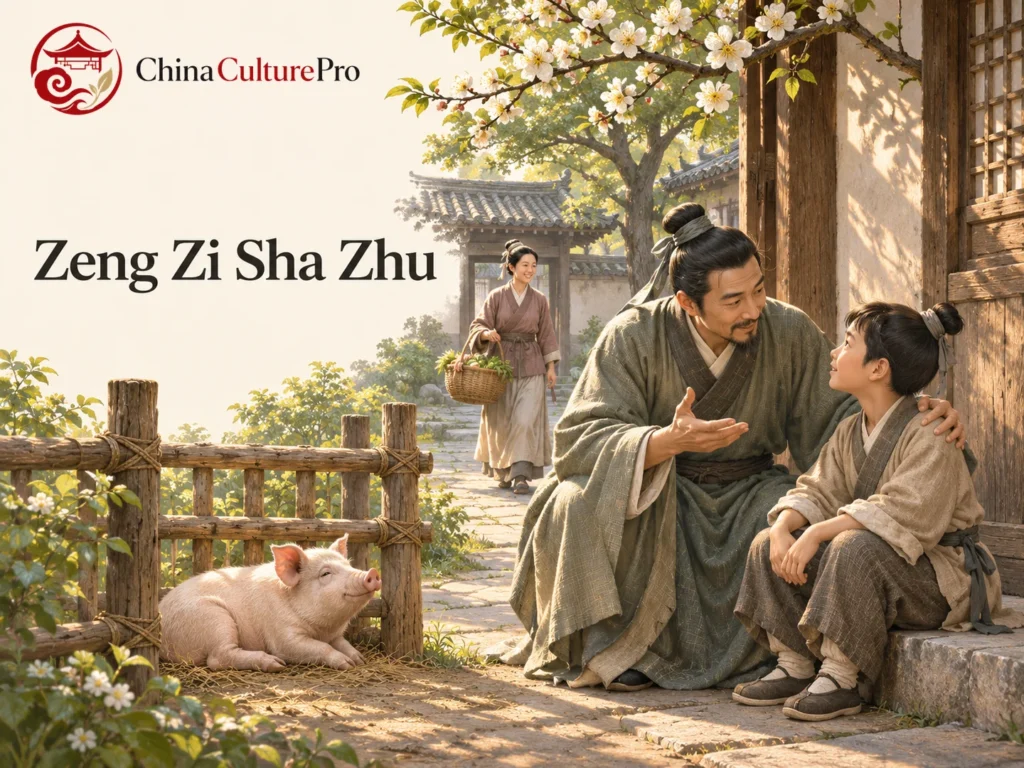
Zengzi’s wife sets out for the market, and her son follows her crying. She asks him to go back and says she will slaughter a pig for him when she returns. The promise is meant to send the child home. When the mother comes back, Zengzi prepares to keep it. She objects that she was only saying it to the child in jest.[1][2]
From Zengzi’s point of view, the boy is learning what promises mean from the adults around him. Zengzi argues that deception teaches the child two lessons at once. It sets an example of misleading other people, and it gives the child a reason to doubt his mother’s word. The text ends by saying that the pig was cooked.[1]
Zeng Zi Sha Zhi (曾子杀彘, zēng zǐ shā zhì) is the classical form recorded in the dictionary. The last character, 彘, is the word for pig used in the received passage. The familiar title with 猪 uses the everyday word for the same animal.[1][2]
Why the Han Feizi tells a household story
The household scene appears in the chapter titled Outer Congeries of Sayings, Upper Left (外储说左上, Wàichǔ Shuō Zuǒshàng). The preceding story describes a ruler who has made an appointment with a gamekeeper. A strong wind arises, but the ruler goes himself to cancel the arrangement. He sees bad weather as a reason to change the plan and still considers it his responsibility to tell the person who was expecting him.[1]
Placed together, the episodes show different ways a person’s word can remain credible. The ruler honors the arrangement by showing up to communicate the change. Zengzi keeps the particular promise because the child has heard a clear assurance. The related expression Sha Zhi Jiao Zi (杀彘教子, shā zhì jiào zǐ) highlights this household lesson and is used about parents teaching through consistency between what they say and what they do.[1][3]
How people refer to the story today
The phrase comes across naturally as a reference to a story. For example, “这让我想起曾子杀猪的故事” means “That reminds me of the story of Zengzi and the pig.” For instance: 答应周末陪孩子去图书馆,就把时间留出来,这让我想起曾子杀猪的故事。 “They promised to take their child to the library over the weekend and set aside the time. It reminds me of the story of Zengzi and the pig.” Mention the story by name when listeners know it. If they have never heard it, say what the adult promised and how they kept it.[2][3]
For an English retelling, “Zengzi keeps his family’s promise” can work as a short description. Keep the literal title if you are introducing the classical story and will explain the animal’s role. In a modern example that only needs the lesson, “children learn whether to trust our promises by watching what we do” makes the point directly. The guide to Chinese chengyu has other examples of a story title becoming an allusion in everyday language.
FAQs About Zeng Zi Sha Zhu
What is the difference between 猪 and 彘?
Both can mean “pig.” 猪 appears in the ordinary modern title, while 彘 preserves the wording in the received story. The pronunciation changes from zhū to zhì.[1][2]
Is Zengzi the same person as Zeng Shen?
Yes. Zeng Shen (曾参, Zēng Shēn) is his personal name. Zengzi is the honorific form, “Master Zeng.”[2][4]
Is it the story about the mother at a loom?
Zeng Shen Sha Ren (曾参杀人, zēng shēn shā rén) is a separate story about rumors shaking his mother’s trust. In Zeng Zi Sha Zhu, the parent is Zengzi himself, and the issue is whether his son can trust a promise.[1][2][4]
Fuentes
[1] Project Gutenberg. Han Feizi, Outer Congeries of Sayings, Upper Left
[2] Ministerio de Educación de Taiwán. Revised Mandarin Chinese Dictionary, Zeng Zi Sha Zhi
[3] Taiwan Ministry of Education. Dictionary of Chinese Idioms, Sha Zhi Jiao Zi
[4] Taiwan Ministry of Education. Dictionary of Chinese Idioms, Zeng Shen Sha Ren