


Quick Answer: What Does Zheng Ren Mai Lv Mean?
Zheng Ren Mai Lv (郑人买履, zhèng rén mǎi lǚ) means “a man from Zheng (郑, Zhèng) buys shoes.” In the Han Feizi (韩非子, Hán Fēizǐ), a shopper misses his chance to buy shoes because he trusts a measurement he left at home more than the feet he brought with him. The idiom pokes fun at applying a rule without attending to the situation in front of you.[1][2]
- The forgotten object: The shopper leaves his foot measurement at home.[1]
- The missed opportunity: He goes back for it. By the time he returns, the market has closed.[1]
- The modern use: It criticizes rigid adherence to rules, records, or precedent when direct evidence is available.[2][3][4]
A measurement can be useful. In this story it becomes a problem when the man treats it as the only way to decide whether the shoes fit.
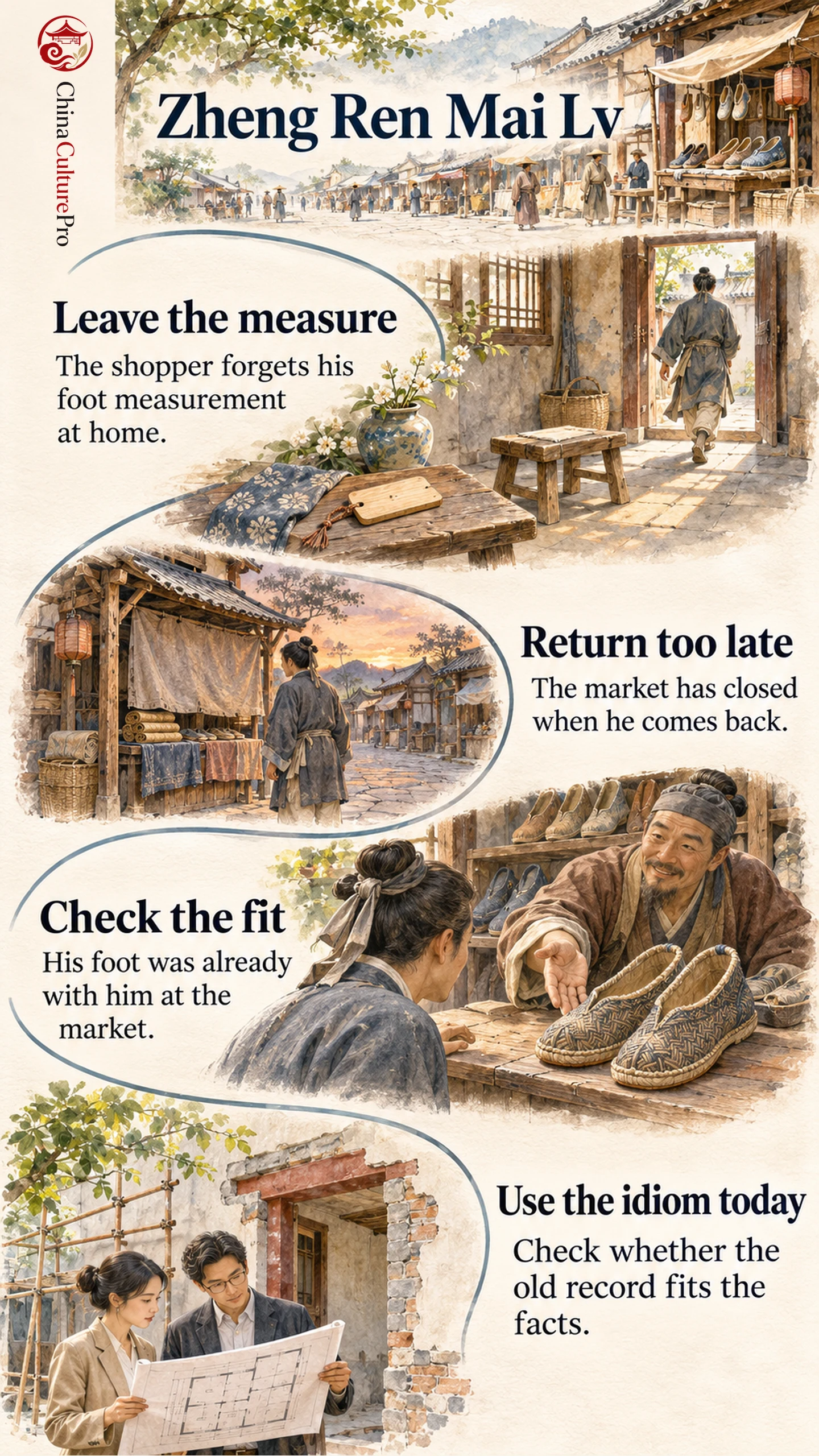
The shopper achieves one thing by going home: he recovers the measurement. He loses the chance to use it. The last exchange supplies a simple alternative. Someone asks why he did not try on the shoes.[1]
Why the man leaves the market without shoes
The man measures his foot at home and sets the measure on his seat. At the market he finds a pair of shoes before realizing that he has left it behind. He goes home to get it, but the market has closed when he returns. The classical wording leaves room for different ways of picturing the measure. Its point is that the record of his size is somewhere else, while his foot is already there.[1][3]
Someone asks why he did not try the shoes on. The man answers that he would rather trust the measurement than himself. The exchange gives the anecdote its humor. The man took his own measurement. His answer gives more authority to the record he made than to his foot.[1][3]
Why the Han Feizi puts the story in a book about governing
The Han Feizi uses short stories to make arguments about governing. In this part of the chapter, a guiding passage compares rulers who turn to the schemes of past kings without adjusting to current affairs to the shopper who goes back for his measure. The past example can be relevant, but the ruler still has to judge whether it fits the situation.[1][3]
The story has two scales. A shopper can solve a small problem by testing the fit. A ruler who invokes a precedent needs to ask what problem it originally solved and whether the same conditions still hold. The shopper’s round trip makes the cost of avoiding that judgment easy to picture.[1][3]
How to use Zheng Ren Mai Lv today
Use the idiom when a checklist, old drawing, or standard practice starts substituting for a straightforward observation. The most natural examples name both the formal reference and what it misses. “照旧规矩办” (“do it by the old rules”) gives the reader only half of the situation until you explain what changed.[2]
- An old drawing: 门洞明明已经改过,还只照旧图纸订门,这不是郑人买履吗? “The opening has already been altered. Why order the door from the old drawing alone?”
- A form applied literally: 学生已经交了作业,却因为系统没打钩就被算作缺交,这有点像郑人买履。 “The student handed it in, but it was marked missing because the box in the system was unchecked. That’s taking the record too literally.”
These examples are original. The first example uses a drawing after the building has changed. The second makes a checkbox stand in for an assignment the teacher can see. In both examples, the easiest way to find out what happened is already at hand. “Going by the book without checking the facts” works in English when the speaker is criticizing that attitude. The guide to Chinese chengyu gives more examples of how a familiar story helps interpret a brief comment.
FAQs About Zheng Ren Mai Lv
Is it pronounced lǚ or lv?
The standard pinyin for 履 is lǚ, with two dots over the u and a third-tone mark. The v in the page’s search spelling serves as a keyboard substitute for ü.[2]
What does 度 mean in the story?
In “measure his foot,” 度 is a verb pronounced duó. When he forgets the measure, it is a noun pronounced dù.[1][3]
How is the story different from Ke Zhou Qiu Jian?
Ke Zhou Qiu Jian (刻舟求剑, kè zhōu qiú jiàn) describes someone using a mark on a boat after the boat has moved. Both idioms criticize rigidity. The shoe story focuses on choosing a record over direct evidence, and the boat story focuses on using a reference point that has moved.[2][5]
Fuentes
[1] Project Gutenberg. Han Feizi, Outer Congeries of Sayings, Upper Left
[2] Ministerio de Educación de Taiwán. Revised Mandarin Chinese Dictionary, Zheng Ren Mai Lv
[3] National Taiwan University OpenCourseWare. Readings in Pre-Qin and Han Literature, the Zheng shoe buyer
[4] Hunan Provincial Government. A man from the state of Zheng buying shoes
[5] Taiwan Ministry of Education. Dictionary of Chinese Idioms, Ke Zhou Qiu Jian