


Quick Answer: What Is Yu Opera?
Yu opera(豫剧,Yùjù) is a form of Chinese theatre associated with Henan. Singing and stylized speech carry the story, while a bowed fiddle can support the melody and wooden percussion can mark rhythmic accents.
The tradition has several regional singing styles and a wide repertoire. It includes historical and legendary subjects as well as modern plays. Listen for how the singer changes pace or phrasing within a scene. The title and cast help identify the version you are hearing.
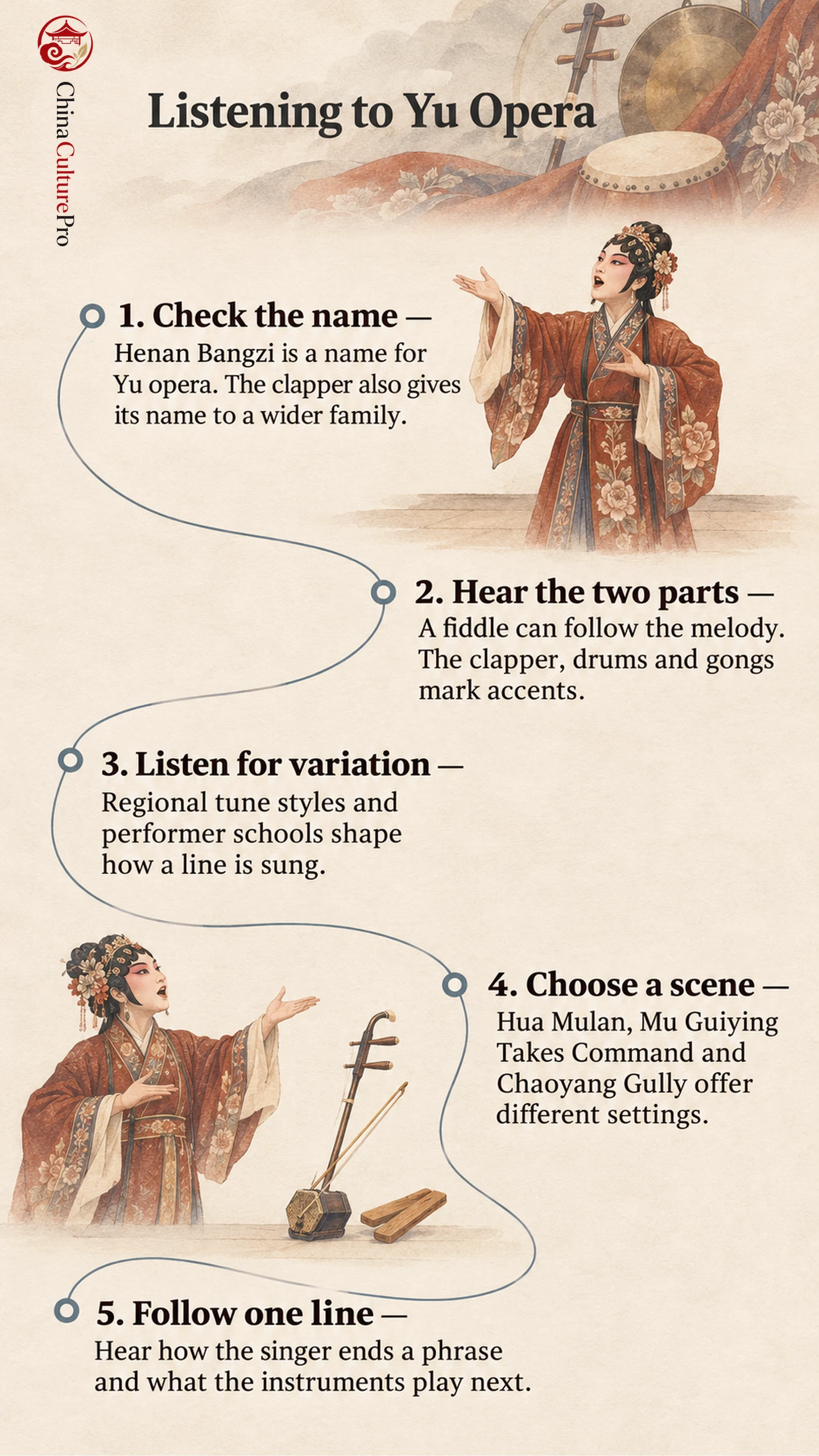
A sung line can change direction when the singer draws out one word and moves quickly through the next. In Yu opera, that contrast lets a listener follow a character’s thought against the accompaniment’s pulse.
Henan Bangzi and the Regional Stage
A bangzi(梆子,bāngzi) is a struck wooden clapper. The word also appears in the names of several opera forms. Henan Bangzi identifies the Henan branch of this wider family. Henan Yu opera developed through exchanges with other kinds of 中国伝統演劇 and through local singing and storytelling. The national inventory records an established presence in Henan by the Qing period. [1]
Henan remains central to the genre’s identity. Performers and audiences also carried the work beyond the province. China’s first national heritage list included the Henan project in 2006, recognizing a practice with local music, repertoire and performance traditions. [1]
Voice, Clapper and Fiddle
The banhu(板胡,bǎnhú), a bowed fiddle, is one instrument in the melodic section. Other bowed or plucked strings and winds can also join the accompaniment. The percussion section can use the wooden clapper, drums and gongs. The two sections can work together around a singer’s phrasing or a movement onstage. [1]
Notice a point where the singer lengthens a syllable. The melodic accompaniment can carry the line while a sharper percussion sound gives the scene a rhythmic edge. The drum and gong parts may become more apparent when the action changes. Hear how those sounds meet the singer’s phrasing or the actor’s movement.
Local Singing Styles and Performer Schools
The Henan record identifies regional styles associated with eastern Henan, western Henan, Xiangfu and other areas. The vocal tradition also includes several rhythmic patterns. A regional style can give a singer a set of ways to shape a line, while a particular scene calls for its own pace. [1]
A regional tune style identifies a musical tradition. A performer’s school can describe a way of delivering the music and acting a part. Chang Xiangyu and Ma Jinfeng are associated with different performances and ways of singing. A filmed lesson by Yu opera performer Li Shujian pairs a discussion of schools with credited excerpts. Use the recordings to hear differences in emphasis and phrasing rather than assuming one voice represents the entire genre. [2]
Three Performances to Start With
CCTV’s opera archive brings together stage and film excerpts from several works. These credits help you locate a performance and focus on a specific voice or dramatic situation. [3]
| Work | A documented performer or version | What to follow |
|---|---|---|
| *Hua Mulan* | Chang Xiangyu in stage and film excerpts | Compare how a sung line establishes the character in each format. |
| *Mu Guiying Takes Command* | Ma Jinfeng in a stage excerpt | Listen for changes in emphasis as the character takes on a public role. |
| *Chaoyang Gully* | Wei Yun and Wang Shanpu in a film excerpt | Watch the exchange between Yinhuan and Shuanbao in a modern setting. |
The table pairs older story material with a modern play. A named cast lets you compare scenes from different decades or media while keeping the work and genre clear.
How to Listen to Yu Opera
Start with one credited passage. Listen for the pulse under the voice and hear how long the singer holds the end of a line. Then notice what the fiddle or clapper does before the next words. If you compare it with Qinqiang, choose identified recordings and listen to local speech and melodic phrasing. Both are associated with the wider bangzi family, and each has its own conventions. [1]
Use the programme’s characters to resolve similar names. The word Yu in Yu opera refers to Henan. 越劇 uses different Chinese characters and belongs to a different regional stage tradition.
FAQs About Yu Opera
Is Yu opera the same as Yue opera?
They are distinct forms. Yu opera is 豫剧, associated with Henan. Yue opera is 越剧, associated with Zhejiang and Shanghai.
What does bangzi mean in Henan Bangzi?
It refers to a wooden percussion instrument and is also used in the names of a family of opera styles. Henan Bangzi is a name for Yu opera.
Is Yu opera always loud and fast?
Its pace and intensity vary with the tune, performer and scene. A recording can include both sustained and quick phrases.
出典
[1] China Intangible Cultural Heritage Digital Museum. Yu Opera, Henan Project
[2] CCTV Opera Channel. Li Shujian on Yu Opera Schools and Repertoire
[3] CCTV Opera Channel. Yu Opera Stage and Film Excerpts