

Quick Answer: Who Was the Wanli Emperor?
The Wanli Emperor (万历皇帝, Wànlì Huángdì; 1563–1620) ruled Ming China from 1572 to 1620. His reign combined early administrative reform, a prolonged succession dispute, major wars and growing obstruction in the relationship between emperor and officials.[1][2][5]
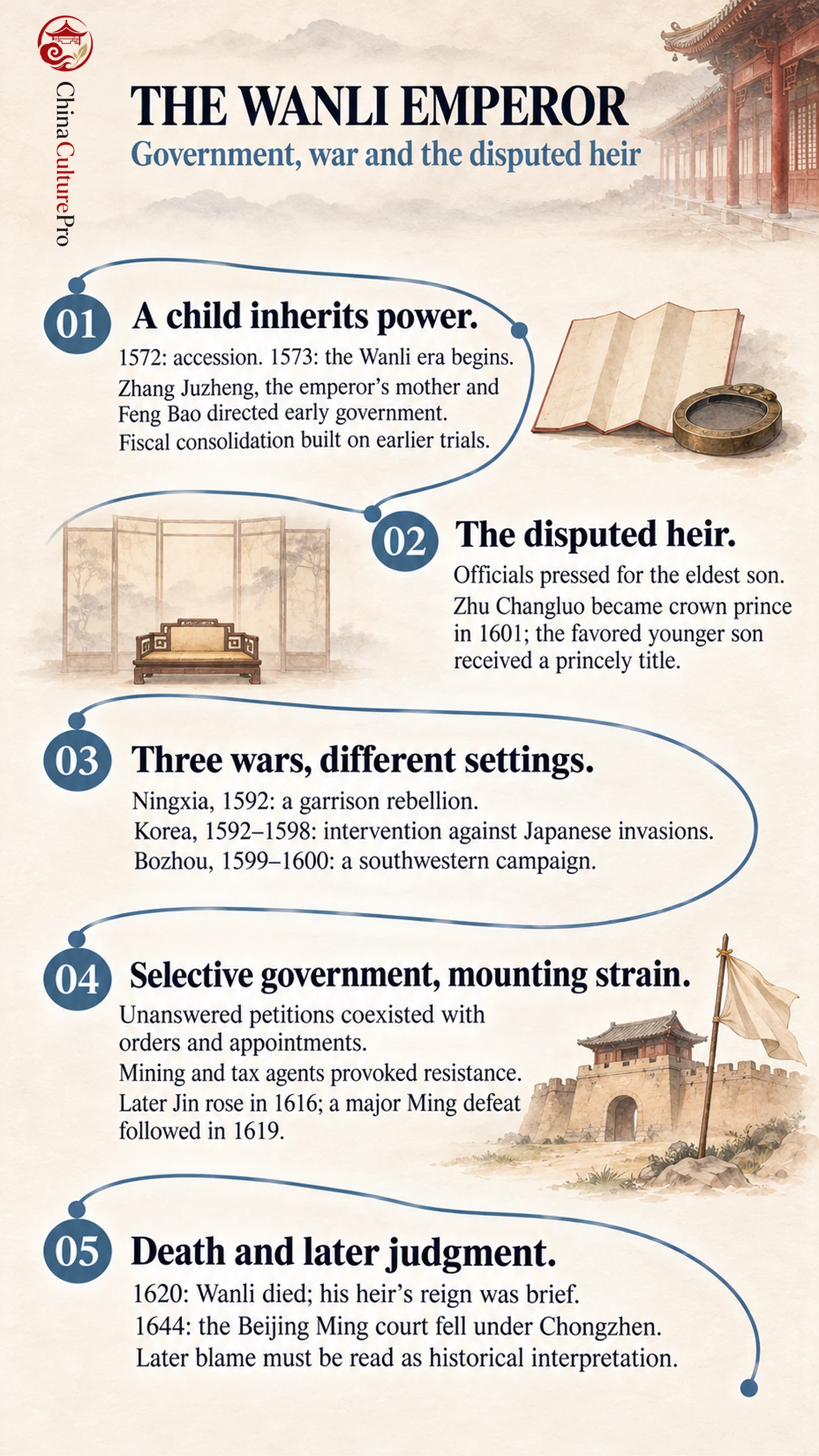
- Beginning: He inherited the throne as a child; the Wanli era began in 1573.
- Government: Strong ministerial direction initially gave way to repeated conflict and delays.
- Legacy: Later historians linked his reign to problems that outlasted him.[1][2]
His absence from many court routines should be distinguished from a complete cessation of imperial decisions.
The familiar image of Wanli refusing to work captures only part of a long reign. Reforms, military commitments, family politics and unanswered petitions followed different trajectories. Reading those records together explains how a powerful monarchy could make decisions while leaving essential business unresolved.
A Child Ruler and Zhang Juzheng’s Government
His personal name was Zhu Yijun (朱翊钧, Zhū Yìjūn), a son of the Longqing Emperor (隆庆皇帝, Lóngqìng Huángdì). He succeeded his father in 1572. The annals explicitly designate the following year as the first of the Wanli era, explaining why 1573 appears in some reign labels.[1][5]
Empress Dowager Li (李太后, Lǐ Tàihòu), senior grand secretary Zhang Juzheng (张居正, Zhāng Jūzhèng) and palace eunuch Feng Bao (冯保, Féng Bǎo) shaped the young ruler’s education and government. Zhang’s program tightened supervision of officials, controlled expenditure and improved collection of overdue revenue.[3]
The Single Whip reform (一条鞭法, yītiáo biān fǎ) consolidated many tax and service obligations into assessed payments, substantially in silver. Broad implementation in 1581 extended earlier experiments; local obligations continued to vary.[4]
Zhang died in 1582. The emperor subsequently stripped his honors and ordered the confiscation of his family’s property. The political settlement of the first decade changed, while the Single Whip framework continued to shape later fiscal administration.[1][3][4]
The Dispute over the Heir
The eldest son, Zhu Changluo (朱常洛, Zhū Chángluò), became the focus of officials’ demands for a settled succession. The emperor’s favored son Zhu Changxun (朱常洵, Zhū Chángxún), born to Consort Zheng (郑贵妃, Zhèng Guìfēi), complicated that expectation. The dispute concerned the public rules of dynastic continuity as well as affection inside the imperial household.[2]
Years of memorials and resistance preceded Zhu Changluo’s appointment as crown prince in 1601. Zhu Changxun received a princely title instead. That settlement resolved the formal designation, although suspicions and confrontations around the heir continued. The annals preserve accusations around later palace incidents without settling every allegation against the favored consort.[2]
For officials, a secure heir promised continuity beyond a particular emperor. For the ruler, repeated pressure over his family exposed the limits on exercising personal preference within the monarchy. This helps explain the intensity of a controversy that could otherwise look like a private household quarrel.
Three Major Campaigns, Three Different Conflicts
The three major campaigns conventionally grouped under Wanli were not one continuous war. Their opponents, geography and political purposes differed.[1][2]
| Campaign | Main fighting | Conflict to distinguish |
|---|---|---|
| Ningxia (宁夏, Níngxià) | 1592 | Suppression of a garrison rebellion in the northwest. |
| 韓国 | 1592–1598 | Ming intervention to assist Korea against Japanese invasions; fighting and negotiations formed separate phases. |
| Bozhou (播州, Bōzhōu) | 1599–1600 | Suppression of Yang Yinglong (杨应龙, Yáng Yìnglóng) and the defeat of his southwestern stronghold. |
In Korea, an initial Ming force was defeated at Pyongyang in 1592; a larger relief force recovered the city in 1593. Negotiations did not prevent renewed fighting in 1597. Bozhou resistance also had earlier phases: the table identifies the concluding campaign.[1][2]
Military success also required men, transport and revenue. The fiscal record describes additional assessments associated with campaigns and their subsequent removal. Victory and financial strain could therefore coexist; neither the result of a battle nor the cost alone explains the condition of the whole Ming state.[4]
Court Withdrawal, Revenue and the Northeast
The palace government continued to generate written decisions even as audiences and responses became irregular. In 1603, requests concerning vacant governorships went unanswered. In 1604, after damage at an imperial tomb, the emperor ordered vacancies filled. Such entries reveal selective intervention alongside damaging delays.[2]
From 1596, eunuchs were dispatched to oversee mining and revenue collection. Officials protested, and resistance in several cities involved attacks on tax agents and their staff. The issue was not merely how much silver the emperor possessed, but who collected it, under what authority and with what consequences for local administration.[1][2]
Meanwhile, Nurhaci (努尔哈赤, Nǔ’ěrhāchì) established Later Jin (后金, Hòu Jīn) in 1616. Ming forces suffered a major northeastern defeat in 1619, followed by urgent disputes over commanders, reinforcements and funding. This Later Jin was a new Jurchen-led regime, distinct from the much earlier Jin dynasty.[2][5]
Death, Succession and Historical Judgment
Wanli died in 1620 and was buried at Dingling (定陵, Dìnglíng). Zhu Changluo succeeded as the Taichang Emperor (泰昌皇帝, Tàichāng Huángdì), but his reign lasted only about a month. The succession therefore introduced a new crisis rather than ending the period’s difficulties.[2][5]
The Beijing court fell in 1644 under the Chongzhen Emperor (崇祯皇帝, Chóngzhēn Huángdì), long after Wanli’s death. The History of Ming (明史, Míng Shǐ) nevertheless places substantial responsibility on Wanli in its concluding assessment. That is a retrospective judgment about accumulated weaknesses, not a claim that Beijing fell during his lifetime.[2][7]
The publisher describes 1587, A Year of No Significance, by Ray Huang (黄仁宇, Huáng Rényǔ), as using ordinary events and individual careers to examine court society and its constraints. Comparing this approach with annalistic judgments helps keep historical interpretation separate from a simple list of a ruler’s supposed virtues or vices.[6]
FAQs About the Wanli Emperor
What was the Wanli Emperor’s personal name?
His personal name was Zhu Yijun. Wanli was the era name associated with his reign.[1][5]
Did his reign begin in 1572 or 1573?
He became emperor in 1572. The first year named Wanli began in 1573, so accession and era dates differ.[1]
Did he completely stop governing?
No. Repeated refusals to attend or answer officials coexisted with appointments, military decisions and revenue orders. The distinction matters for judging how government malfunctioned.[1][2]
Was Wanli the last Ming emperor?
No. His successors continued to rule after 1620. The Beijing Ming court’s collapse came in 1644 under Chongzhen.[2][7]
出典
[1] Zhang Tingyu and other compilers. History of Ming, Chapter 20: Emperor Shenzong, Part One
[2] Zhang Tingyu and other compilers. History of Ming, Chapter 21: Emperor Shenzong, Part Two
[3] Zhang Tingyu and other compilers. History of Ming, Chapter 213: Zhang Juzheng
[4] Zhang Tingyu and other compilers. History of Ming, Chapter 78: Taxation and Service
[5] Palace Museum. The Wanli Emperor
[6] Yale University Press. 1587, A Year of No Significance: Publisher’s Description
[7] Zhang Tingyu and other compilers. History of Ming, Chapter 24: The Chongzhen Emperor, Part Two