

Quick Answer: What Is Tianmu Qingding Tea?
Tianmu Qingding(天目青顶,Tiānmù Qīngdǐng)is a green tea from the Tianmu mountain region of Linan, Hangzhou, in Zhejiang.[1]
- Identity: it is also described as Tianmu Yunwu(天目云雾,Tiānmù Yúnwù), or cloud-and-mist tea.[2]
- Craft: fixing and shaping are followed by staged baking and drying.[1]
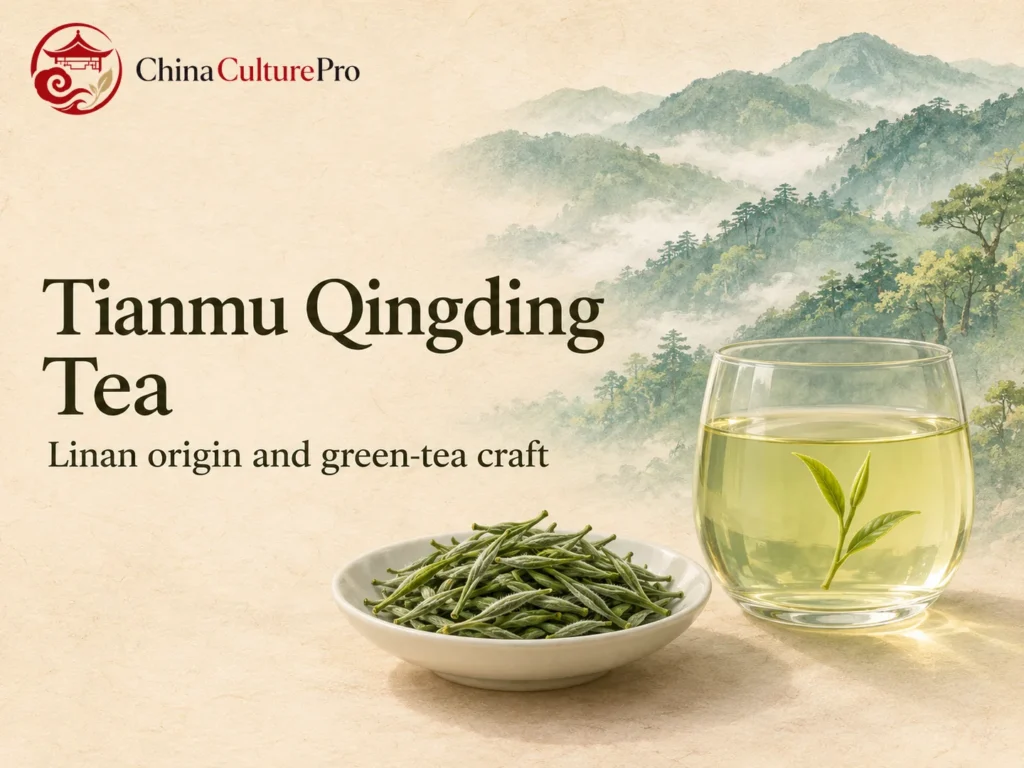
- 外観: expect green, slender leaves and visible buds, with differences between grades.[2]
- Flavor: fresh, savory and fragrant descriptions are common; individual batches differ.[2]
The full name and growing region matter more than the word “Tianmu” alone.

To understand this tea, separate its regional name, green-tea manufacture, grade and the flavor of the actual batch.
Tianmu, Linan and Similar Tea Names
Check the stated locality within the protected Linan area. An East Tianmu garden description does not define the entire growing region.[1]
Tianmu Lake White Tea(天目湖白茶,Tiānmùhú Báichá)is a different name associated with Liyang in Jiangsu. Similar English place names do not make it the same product as Zhejiang’s Tianmu Qingding.[6]
Use our tea origin-label guide to separate a growing-place claim from a company’s address.
How Tianmu Qingding Is Made
The processing sequence starts with spreading the fresh leaves, then heat fixation and shaping. Baking follows in stages, with cooling or moisture equalization between them. The current local standard describes both hand and machine routes. Pan work and baking therefore belong to different stages, rather than competing descriptions of the entire tea.[1]
For the broader terminology, compare tea types and plant material.
What the Leaves and Infusion Are Like
Traditional descriptions emphasize substantial, tightly shaped green leaves, downy buds and a clear infusion. The taste is described as fresh and savory, with a lingering fragrance. Those features give a more useful starting picture than a promise that every packet will taste exactly alike.[2]
One spring 2021 retail batch is described as mild, fruity and floral, with notes reminiscent of mango or papaya. These words describe aroma and taste rather than a recipe for adding fruit. They also do not guarantee that another harvest will give the same cup.[3]
Grade Names and Modern Revival
Older local descriptions use names such as Dinggu(顶谷,dǐnggǔ)and Yuqian(雨前,yǔqián)within a five-grade system, as recorded in the local yearbook.[4]
The current local standard instead specifies special, first and second grades. Ask which scheme a seller is using.[1]
For general harvest language, see Mingqian and Yuqian. A familiar word needs the context in which it appears.
A tea maker’s retrospective describes renewed development of Tianmu Qingding beginning in 1979 and processing trials during 1979–1985. This is a recollection of modern revival, not proof that today’s named product and technique continued unchanged from ancient Tianmu tea. Read regional tea history separately from this account of modern processing.[5]
How to Brew Tianmu Qingding Tea
A documented spring 2021 batch gives a starting method of 10–12 g per litre, water at 75°C and a three-minute infusion. For a smaller cup, that scales to 2.5–3 g per 250 ml. Follow your batch’s instructions first, then adjust to taste.[3]
- Weigh 2.5–3 g of leaves for a 250 ml serving.
- Prepare water at 75°C and add it to the leaves.
- Infuse for about three minutes, then separate the liquor from the leaves.
- Taste before changing the next brew; adjust one factor, such as leaf amount or time, to suit the batch.
These are one published method’s conditions, not a compulsory temperature for all Tianmu Qingding. Brewing water and preparation affect how you experience the tea.
FAQs About Tianmu Qingding
Is Tianmu Qingding a Green Tea?
Yes. Fixation, shaping and baking form its green-tea manufacturing sequence; a baked finish does not mean it is oolong.[1]
Is It the Same as Tianmu Lake White Tea?
No. Tianmu Qingding is associated with Linan in Zhejiang; Tianmu Lake White Tea is associated with Liyang in Jiangsu.[1][6]
Is Tianmu Qingding Always Handmade?
No. The local standard describes hand and machine processing routes. Check the actual producer’s description.[1]
Does Yuqian Always Identify the Same Grade?
No. It appears among older Tianmu Qingding grade names. Ask how the seller uses it rather than assuming it matches a current numbered grade.[4]
出典
[1] Hangzhou Administration for Market Regulation. DB3301/T 1148-2024: 地理标志产品 天目青顶茶
[2] Liao Chang Xing. Tianmu Qingding Tea
[3] ChaWuDu. Tian Mu Qing Ding
[4] Government of Linan District. 2020 Yearbook of Linan: General View of Linan District
[5] Hangzhou Zhiqinghe Tea Tech. The Story Behind Tianmu Qingding
[6] Liyang Municipal People’s Government. 市政府关于划定天目湖白茶产地范围的通知