
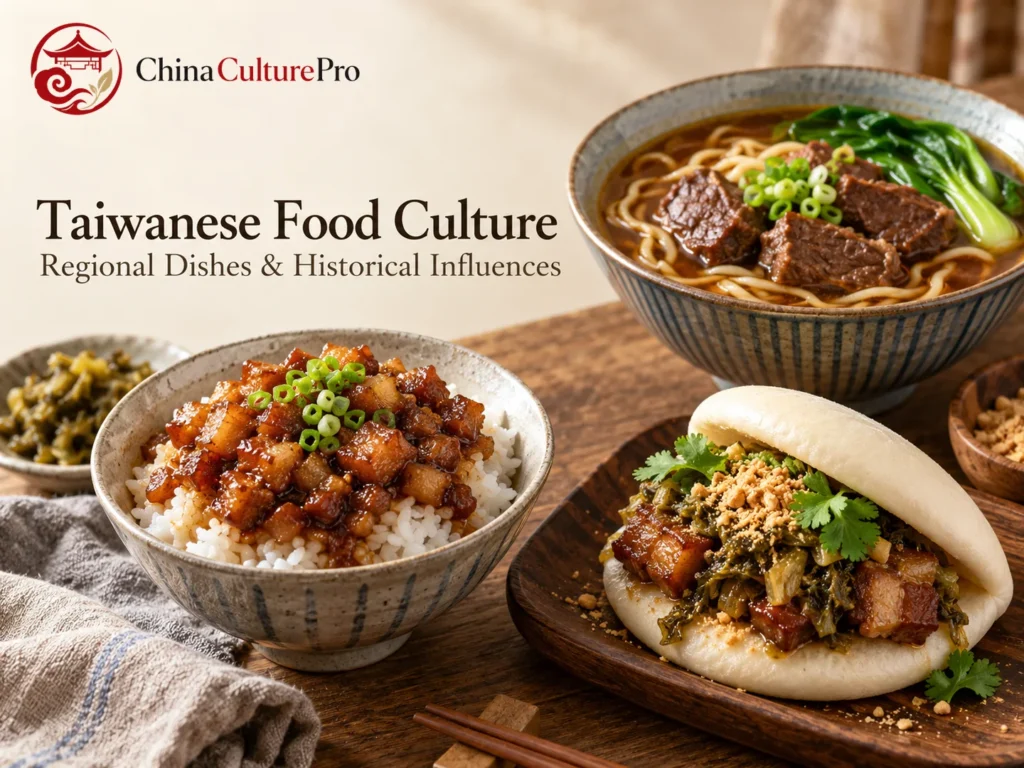

Quick Answer: What Shapes Taiwanese Food Culture?
Taiwanese cuisine (臺灣菜, Táiwān cài) includes regional, community and household food traditions shaped through a long history of exchange. Different periods and communities contributed in different ways.[1][2]
- Histories: Indigenous foodways, Hokkien and Hakka migration, Japanese colonial-era changes and postwar arrivals all matter.
- Ingredients: Rice, seafood, vegetables, pork, soy products and preserved ingredients appear in many familiar preparations.
- Settings: Homes, markets, specialist shops, shared restaurants and banquets offer different ways to eat.
No single dish or taste describes every community. The conventional 中国八大菜系 list is also too narrow to serve as a complete map of these traditions.
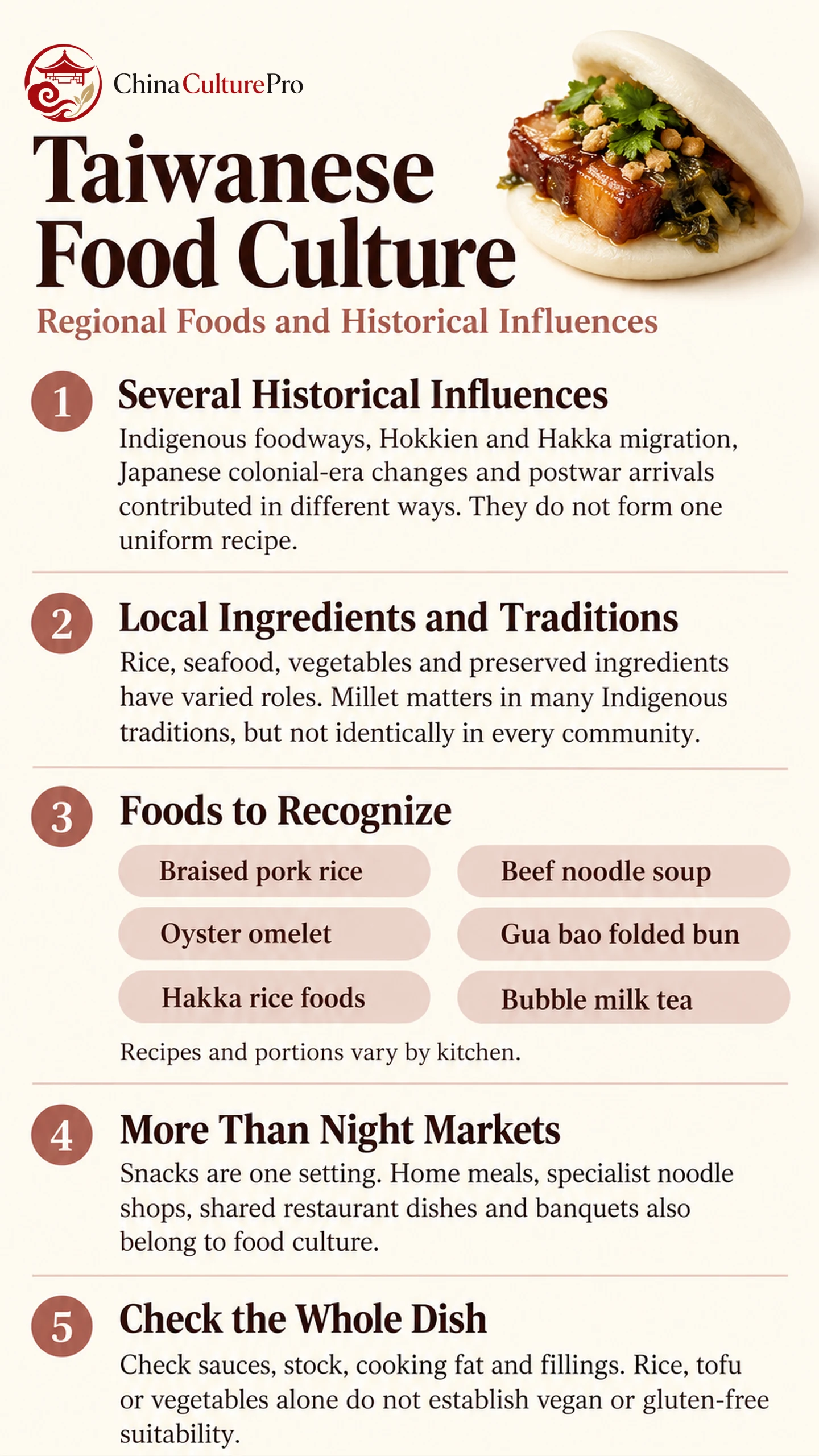
A night-market snack, a family rice meal, a Hakka dish and a carefully arranged restaurant banquet can all express Taiwanese food culture. Each reflects a particular setting and history. Reading those connections helps explain familiar foods without reducing a diverse food landscape to one influence or a list of street snacks.
Historical Influences and Living Community Traditions
Indigenous foodways deserve attention in their own right. They involve different communities, environments and relationships to agriculture, gathering and the sea. They should not appear merely as a decorative introduction before a history that treats everyone else’s food as the main story. Food-history research explicitly draws attention to their frequent marginalization.[2]
Hokkien and Hakka migration contributed ingredients, cooking practices and food names that developed further in local settings. Those connections help explain relationships with southeastern Chinese food traditions without making the present-day foods identical. 福建料理 および Hakka Cuisine provide context for those relationships.
Japanese rule from 1895 to 1945 brought another period of exchange and change. After World War II, arrivals from different parts of mainland China further expanded the restaurant and household food landscape. Museum accounts describe these successive influences alongside later changes in eating out and international food consumption.[1][3]
Those are broad historical processes, not a formula assigning each modern dish one exclusive origin. Restaurant cooking, household cooking and commercial snacks can develop through several influences at once. A familiar invention story should therefore not replace the more complicated history of a cuisine.
Rice, Seafood, Preserved Foods and Local Ingredients
Rice is a useful starting point, but it appears as more than steamed grains. Rice noodles, cakes and other formed foods have different textures and serving roles. Wheat noodles and buns also belong to the contemporary food landscape, so a rice-centered introduction should not imply that wheat is absent.
Seafood, pork, vegetables and soy products contribute different flavors and textures. Preserved vegetables and savory sauces may accompany a gentle staple or become part of a richer dish. A bowl’s visible ingredients do not reveal everything used in its stock, cooking fat or sauce.[3][7]
Local community context matters for staples too. Millet has important food and cultural roles in many Indigenous traditions, but it is not identically central in every community. Agricultural material specifically distinguishes that variation rather than defining all Indigenous food through one grain.[8]
Hakka rice foods offer another example of an ingredient family with several forms. A rice-based exterior can enclose a savory filling, while a sweet preparation uses a different combination. Neither the grain nor the community label determines whether a finished food contains meat, dairy or gluten-bearing condiments.[7]
Taiwanese Dishes and Foods to Recognize
These examples are menu reference points rather than a ranking of foods or a required itinerary.
| 料理 | Structure and common ingredients | What to confirm |
|---|---|---|
| Braised pork rice (滷肉飯, lǔròu fàn) | Cooked pork and its savory sauce spooned over steamed rice | Pork form, accompaniments and portion vary; the rice is not necessarily stir-fried |
| Beef noodle soup (牛肉麵, niúròu miàn) | Wheat noodles with beef and a seasoned broth | Clear, braised and other broth styles differ; ask about chili and meat cuts |
| Oyster omelet (蚵仔煎, ézǐ jiān) | Oysters with a starch mixture, commonly egg and greens, cooked as a pancake-like snack | Shellfish, egg and sauce ingredients; the English word omelet does not mean egg alone |
| Gua bao (刈包, guàbāo) | A folded steamed bun commonly filled with pork, preserved vegetables, peanut powder and herbs | Filling and peanut garnish; it differs from a sealed bun steamed with filling inside |
| Ban (粄, bǎn) | A family of Hakka rice-based foods with different shapes and fillings | Ask which kind, whether sweet or savory, and what is inside |
| Bubble milk tea (珍珠奶茶, zhēnzhū nǎichá) | Tea combined with a milk component and chewy starch pearls in a familiar version | Milk or creamer, toppings, sweetness and serving options differ |
Official food guides document these structures and several variations, but a tourism description is not a compulsory recipe for every shop. In particular, different accounts of a food’s invention should not be turned into a universal historical certainty.[4][5][7]
The Mandarin annotation for the oyster snack is separate from its Taiwanese-language pronunciation. English menus can use regional spellings, Mandarin transliteration or descriptive names; those are different naming systems, rather than evidence of different ingredients.[9]
Gua bao (刈包, guàbāo) is a folded steamed bun filled after the bread is cooked. That construction is more useful for recognition than translating every food called “bao” as an identical sealed dumpling.
Night Markets, Home Meals and Shared Banquets
Night markets make snacks highly visible. They bring together small portions, specialist stalls and foods associated with different places. The tourism authority describes variation between markets, which is a useful reminder that there is no one standard night-market menu.[6]
They are also only one setting. A weekday meal at home, a specialist noodle shop and a shared restaurant table answer different needs. A visitor who eats only snacks encounters real food culture, but not its entire range. A single bowl can be a meal; several small purchases can also be combined according to appetite.
Shared banquets have their own social history and organization. Museum material considers the relationships between formal restaurants, home tables and everyday memory. This wider perspective keeps culinary culture from becoming only an inventory of things sold to visitors.[1]
The same food can move between settings. A drink can become an international commercial product, while a locally familiar staple can appear in a modern restaurant. Change does not erase historical connections, and an old association does not require a dish to remain frozen in one form.
Ordering and Checking Ingredients
First establish the food’s structure and serving size. Is the rice topped with a sauce or fried with ingredients? Is the bun open and filled afterward or sealed before cooking? Is a noodle soup clear or braised? These questions lead to more useful answers than assuming a famous dish has one fixed form.
Next confirm components that may be hidden. Pork or dried seafood can season vegetables; stock and cooking fat can contain animal ingredients; peanut powder and sesame may appear in garnishes or sauces. Soy-based condiments may also contain wheat. Rice, tofu or vegetables alone do not establish a vegan or gluten-free finished meal.
For drinks, ask about the milk component and toppings as well as sweetness. A menu offering adjustment does not mean every premixed component can be changed. For food, explain any restriction before ordering and check what the kitchen can prepare with its current ingredients.
Chinese Food Names helps distinguish ingredients from preparation names. Chinese Vegetarian Food explains why vegetarian and vegan requirements need separate checks. Neither a regional label nor the absence of visible meat supplies the complete answer.
FAQs About Taiwanese Food Culture
Is Taiwanese food just Fujian food?
No. Fujian connections are important, alongside Indigenous, Hakka, Japanese-era and postwar influences and continuing local development. Related food histories do not make every present-day dish identical.[1][2]
Is Taiwanese food only street food?
No. Night markets and stalls are visible parts of it, alongside family meals, specialist shops, shared restaurant dishes and formal banquets. Each setting shows a different part of the food culture.
Are all Taiwanese dishes sweet?
No. Sweetness varies by dish, sauce, locality and kitchen. A sweetened drink or a particular sauce cannot define the flavor of every soup, rice meal, seafood preparation or vegetable dish.
Can Taiwanese food be vegetarian?
Yes, where the complete recipe supports it. Confirm meat, seafood, stock, cooking fat and sauces; vegan requirements also exclude egg and dairy. A vegetable main ingredient does not establish the whole preparation.
出典
[1] National Museum of Taiwan History. 好好吃 臺灣飲食文化特展
[2] Yujen Chen / NTNU. Revisiting Taiwanese Food Culture
[3] National Sun Yat-sen University. Food in Taiwan
[4] Tourism Administration Taiwan. Taiwan Snacks
[5] Taipei Tourism Department. A Taster’s Guide to Taipei
[6] Tourism Administration Taiwan. Night Markets
[7] Hakka Affairs Council. Characteristics of Hakka delicacies
[8] Ministry of Agriculture Food Education. 小米 粟
[9] Ministry of Education. 蚵仔煎