


Quick Answer: What Defines Shanxi Cuisine?
Jin cuisine (晋菜, Jìncài) refers to the regional cooking traditions of Shanxi Province. Grain-based staples, varied noodle-making methods and aged vinegar (老陈醋, lǎo chéncù) are prominent associations, alongside pork, beef, vegetable dishes and local snacks.[1][2][3][5]
- Grains: Wheat is important, while oats and other grains broaden the repertoire.
- Techniques: Shaving, pulling, flicking and steaming produce different textures rather than interchangeable names for one noodle.
- Seasoning: Vinegar can accompany a meal or enter a recipe; its presence and amount depend on the dish.
Shanxi is outside the conventional 中国八大菜系 list. That classification does not limit the province’s culinary range or the importance of its everyday food traditions.
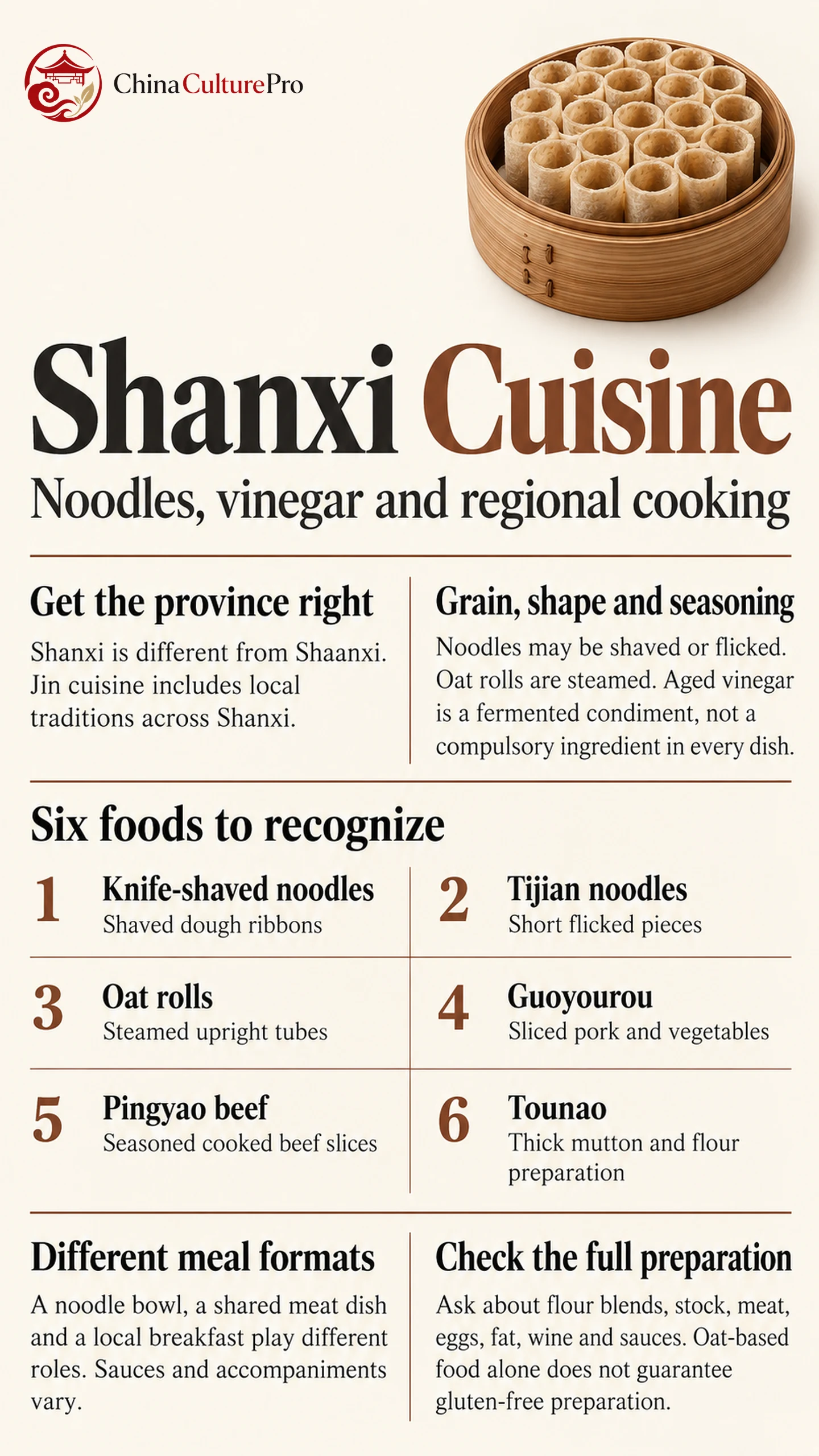
A bowl of shaved noodles and a basket of upright oat rolls (莜面栲栳栳, yóumiàn kǎolǎolǎo) show two different sides of Shanxi cooking. Both are grain foods, but their ingredients, shaping and serving methods differ. Understanding those differences makes a menu more useful than the broad description “noodles with vinegar.”
Shanxi, Shaanxi and the Meaning of Jin Cuisine
Shanxi and Shaanxi are neighboring provinces with similar English spellings. This article concerns Shanxi, east of the Yellow River, rather than the province associated with Xi’an. Their food traditions overlap without becoming the same cuisine.
The provincial name also covers more than one city’s menu. Taiyuan, Datong, the central Shanxi area and mountain communities contribute different examples. A local heritage account associates particular oat preparations with northern and mountain areas, while identifying a separate noodle technique with Taiyuan and Jinzhong.[2]
A published provincial food-promotion list includes meat dishes, vegetable preparations, soups and many noodle forms. It shows the breadth of the repertoire, rather than establishing that every household eats the same selection. A noodle specialist and a restaurant serving shared dishes may therefore provide quite different introductions.[5]
For the neighboring province’s breads and noodles, see Shaanxi Cuisine.
Shaping Grain Foods and Understanding Aged Vinegar
Start with the grain, then identify the shaping method. Knife-shaved noodles (刀削面, dāoxiāomiàn) are formed by shaving pieces directly from a block of dough. They differ from strips cut from a rolled sheet or strands stretched by hand. The thicker center and thinner edges create a different bite from an evenly narrow noodle.[1]
Tijian noodles (剔尖, tījiān) use a separate technique: small portions of softer dough are flicked from a supporting surface into cooking water. The name refers to shaping and the pointed form. It does not specify one compulsory topping, and the local heritage account records several possible grain ingredients.[2]
Oat rolls (莜面栲栳栳, yóumiàn kǎolǎolǎo) are another structure entirely. Thin pieces are formed into upright tubes, arranged together and steamed. Their resemblance to a clustered honeycomb is a useful visual cue, but they are not hollow pasta extruded from wheat dough. Accompaniments may include meat-and-mushroom sauces or simpler onion, oil and vinegar seasonings.[4]
Aged vinegar (老陈醋, lǎo chéncù) belongs to the seasoning layer. The documented Meiheju tradition includes fermentation, treatment of the fermented grain mixture and aging. It is a developed condiment, rather than dark coloring. That record describes a particular production tradition, not every bottle sold under a general black-vinegar label.[3]
A dark condiment cannot identify a noodle’s grain or shaping method, and its presence is not a test of regional authenticity. Likewise, a grain-based dish does not become one fixed recipe because vinegar is offered beside it. 中国の麺料理 provides the broader ingredient-and-technique framework.
Shanxi Dishes to Recognize
These examples span staple foods and accompanying dishes. A translated name may identify a technique, a place or a familiar local preparation.
| 料理 | 見分け方 | Menu question |
|---|---|---|
| Knife-shaved noodles | Irregular ribbons shaved from dough, commonly served with broth or sauce | Which topping and stock accompany them? |
| Tijian noodles | Short tapered pieces formed by flicking softer dough | Which flour or grain blend is used? |
| Oat rolls | Thin upright tubes clustered in a steamer | What is in the accompanying sauce? |
| Guoyourou (过油肉, guòyóuròu) | Sliced pork coated and cooked through oil before combining with vegetables | Does the coating contain egg, and which vegetables and sauces are included? |
| Pingyao beef (平遥牛肉, Píngyáo niúròu) | Seasoned cooked beef served in slices | Is it a separate cold plate or part of another dish? |
| Tounao (头脑, tóunǎo) | A thick Taiyuan preparation with mutton, yam, lotus root and a flour-based liquid | Does this version contain wine or other ingredients you avoid? |
The meat dishes and thick breakfast preparation make clear that the cuisine extends beyond noodles. Local descriptions document their ingredients, while the recipe and portion remain matters for the kitchen.[6][7][8]
Noodle Meals, Shared Dishes and Local Breakfasts
A noodle bowl can provide an individual meal. Its character comes from the combination of noodle, broth or gravy, and topping. Choosing a shape answers only the first part of the order; the same general shape can arrive with a different sauce or meat component.
Steamed grain foods create another format. A separate accompaniment can be spooned over the food or used as a dip, changing the balance of texture and seasoning. Meat-free-looking rolls do not establish the ingredients of the sauce served beside them.[4]
Shared meals can combine a meat dish, vegetables and a staple, rather than presenting a succession of noodle courses. The published repertoire includes stir-fried pork, mixed braises and other dishes suitable for a shared table. It should not be reduced to one compulsory serving order.[5]
Local breakfast foods offer still another entry point. Tounao is a thick preparation associated with Taiyuan, not a generic word for all northern breakfast soup. Its unusual translated name is less informative than its actual ingredients.[8]
Ordering and Checking Ingredients
Ask three separate questions: what grain is used, how is it shaped or cooked, and what accompanies it? A noodle name may answer the method while leaving stock, fat and toppings unspecified.
For meat restrictions, check pork, beef, mutton, offal and any stock or sauce. For vegan requirements, add eggs and cooking fat to the questions. A vegetable topping does not settle the contents of a gravy, and a plain-looking steamed staple can be paired with meat.
For gluten-free requirements, ask about the actual flour blend and the preparation environment. An oat-based name does not establish certified gluten-free oats, absence of wheat or freedom from cross-contact. Vinegar and seasoning labels also need to be checked rather than inferred from color.
Confirm whether vinegar and chili arrive separately, what the portion includes, and whether rice, bread or noodles are an additional order. No regional label supplies a universal bowl size. Chinese Food Names および Chinese Vegetarian Food explain the relevant menu distinctions.
FAQs About Shanxi Cuisine
Is Shanxi cuisine the same as Shaanxi cuisine?
No. They refer to different provinces. Similar grains and some shared techniques do not make the local cuisines identical; check the spelling and the dish name.
Does every Shanxi dish contain vinegar?
No. Vinegar is an important regional condiment, but the recipe and serving arrangement determine its role. It may be included, offered separately or absent. Taste and ask rather than treating sourness as a requirement.
Are oat rolls gluten-free?
The name alone cannot establish that. Check grain blends, the status of the oats, sauces and cross-contact. A non-wheat ingredient is only one part of assessing the complete preparation.
Does tounao contain animal brain?
The documented Taiyuan preparation uses mutton, yam, lotus root and other ingredients; its name should not be read as an ingredient list. Ask about the actual version, including wine and flour.[8]
出典
[1] ChinaCulture.org. Wheaten food of Shanxi
[2] Taiyuan Broadcasting / local heritage office. 锦绣太原 云上非遗:剔尖面和莜面栲栳栳制作技艺
[3] Ministry of Culture. 山西老陈醋集团有限公司
[4] Lüliang Municipal Government. 交城莜面栲栳栳
[5] Jincheng Municipal Government / Shanxi Evening News. 十大晋菜名单公示
[6] Shanxi Culture and Tourism portal. 太原过油肉
[7] Shanxi Culture and Tourism portal. 晋中平遥牛肉
[8] Shanxi Culture and Tourism portal. 美食特产:太原头脑