
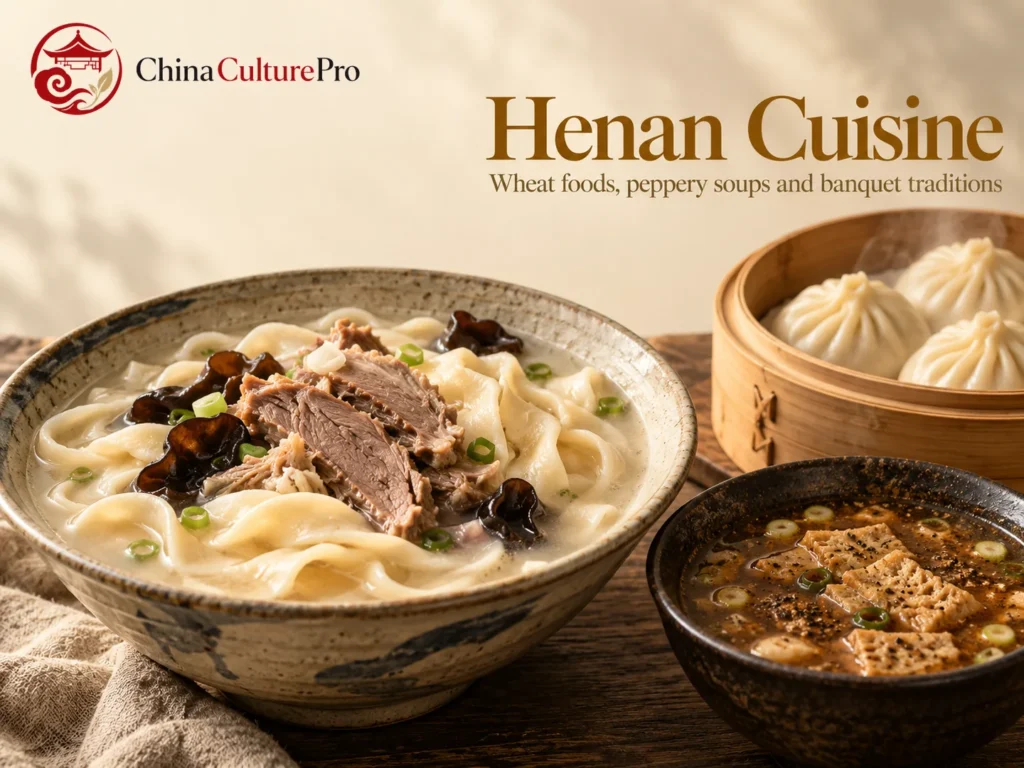

Quick Answer: What Defines Henan Cuisine?
Yu cuisine (豫菜, Yùcài) refers to Henan’s regional culinary tradition. Wheat foods and savory broths are important entry points, alongside fish, poultry, vegetables and established banquet preparations.[1][2][7]
- Staples: Stretched noodles, filled wheat foods and breads appear in different meal settings.
- Flavor: Pepper, aromatic stock, sweet-sour sauces and other seasonings create varied tastes, rather than one compulsory heat level.
- Meals: A breakfast bowl, an individual noodle meal and a formal sequence of shared dishes are distinct experiences.
Henan is outside the conventional 中国八大菜系 list. Its regional importance does not depend on assigning it an unverifiable single invention date or declaring it the origin of all Chinese cooking.
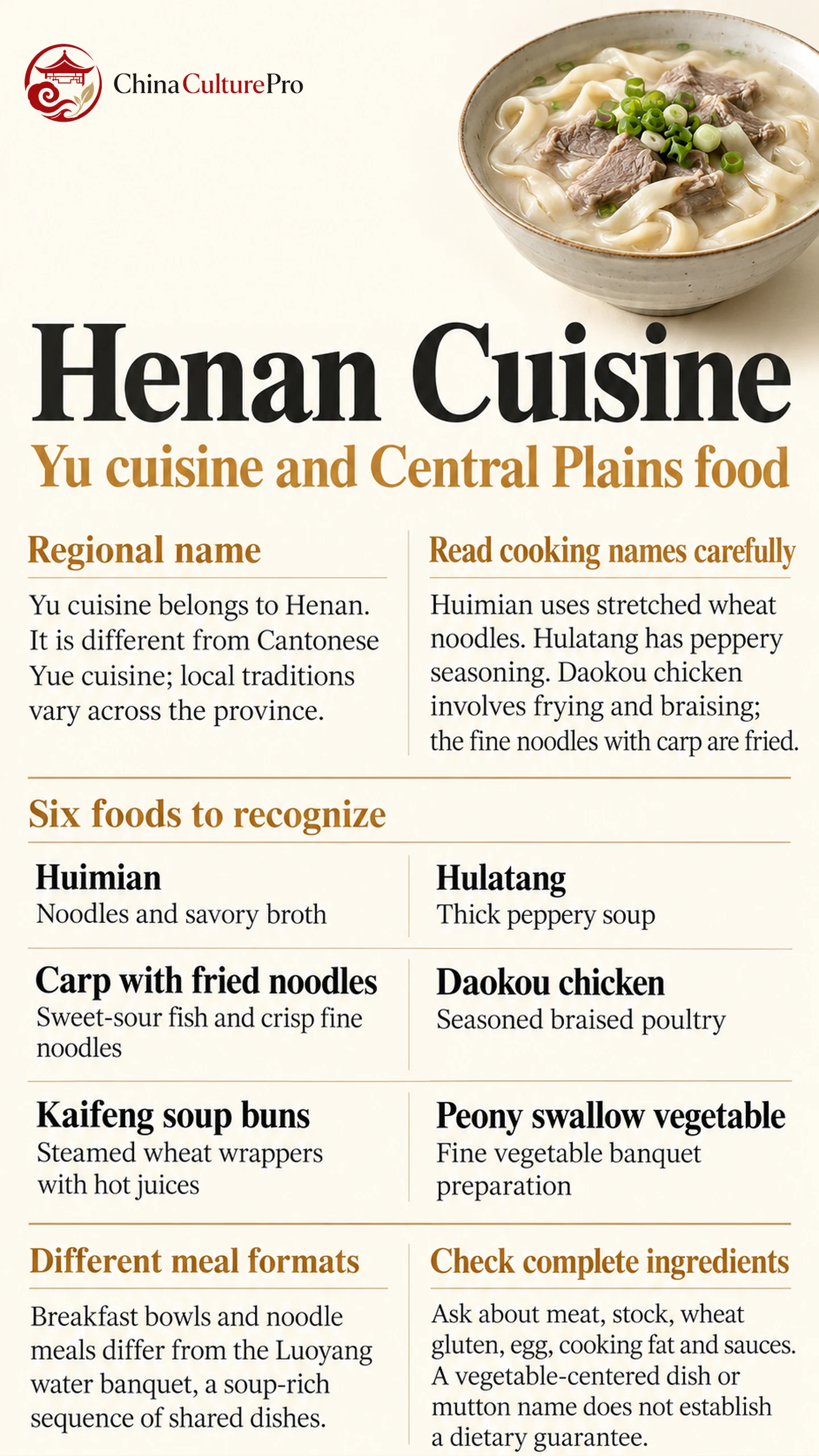
Henan menus bring together broad noodles, peppery breakfast soup, steamed buns and elaborate shared dishes. Similar English cooking words can conceal different methods: a chicken translated as “roast” may be braised, while “baked noodles” may be fried. Reading those names carefully reveals more than a general description of hearty northern food.
Yu Cuisine and the Central Plains
The regional name belongs to Henan in central China. It should not be confused with the similar-sounding Cantonese cuisine name, which uses a different Chinese character and pronunciation. English romanization can obscure distinctions that are clearer on a Chinese menu.
Henan’s cities provide different food examples. Zhengzhou is closely associated with noodle meals, Kaifeng with distinctive buns and fish preparations, and Luoyang with a recognizable banquet format. These associations are useful guides, not exclusive ownership claims or a complete account of what residents eat.[1][3][5][6]
The province’s historic cities give food an important cultural setting, but a present-day menu is not automatically an unchanged court menu from an earlier dynasty. Documented methods and ingredients provide firmer recognition clues than colorful emperor or accidental-invention stories.
A published repertoire of traditional regional dishes includes fried, braised, soup-based and wheat-food preparations. That breadth is why Henan cooking deserves an introduction extending beyond one noodle bowl.[7]
Wheat Foods, Pepper and Cooking Names
Huimian (烩面, huìmiàn) combines stretched wheat noodles with a seasoned soup. A documented Zhengzhou preparation uses mutton and bone stock, with vegetables and other additions. The noodle is formed by stretching a piece of dough; it is not simply the name for every broad noodle served anywhere in China.[1]
Hulatang (胡辣汤, húlàtāng) has another structure: a thick, peppery soup with a range of solid ingredients. The documented Xiaoyao tradition includes meat, wheat gluten, starch noodles and other ingredients in a developed stock. Pepper contributes characteristic pungency, while recipes and spice mixtures vary. Neither a brown color nor visible vegetables reveals the full broth composition.[2]
Cooking translations need equal care. Carp with fried noodles (鲤鱼焙面, lǐyú bèimiàn) combines sweet-sour fish with very fine noodles fried until crisp. Those noodles then take up sauce; the word sometimes translated as “baked” does not mean that the finished garnish must come from an oven.[3]
Daokou chicken (道口烧鸡, Dàokǒu shāojī) presents a similar naming problem. A producer’s account describes frying and braising as parts of the craft. The familiar English “roast chicken” translation therefore should not lead a diner to expect the dry roasted skin of a different poultry preparation.[4]
Chinese Cooking Methods helps separate the cooking action from a translated dish label.
Henan Dishes to Recognize
The examples below cover several textures and table roles. Their names do not prescribe one restaurant’s exact portion or ingredient mixture.
| 料理 | What identifies it | What to confirm |
|---|---|---|
| Huimian | Stretched wheat noodles in savory broth, commonly associated with mutton preparations | Stock, meat, vegetables and extra toppings |
| Hulatang | Thick peppery soup with meat, gluten or other additions according to the version | Meat broth, wheat gluten, spice mixture and accompaniments |
| Carp with fried noodles | Sweet-sour fish paired with a fine crisp noodle garnish | Fish bones, sauce ingredients and serving size |
| Daokou chicken | Seasoned cooked poultry whose traditional craft includes frying and braising | Bones, portion and seasoning ingredients |
| Kaifeng soup buns (开封灌汤包, Kāifēng guàntāngbāo) | Thin wheat wrappers enclosing meat and hot juices, cooked by steaming | Pork or another filling, basket size and hot liquid inside |
| Peony swallow vegetable (牡丹燕菜, mǔdān yàncài) | A finely prepared vegetable dish associated with Luoyang’s banquet repertoire | Radish, stock and any meat or seafood additions |
Vegetable-based imitation dishes can still use meat stock or animal toppings, so their central ingredient does not establish vegetarian suitability. Likewise, soup inside a bun differs from noodles surrounded by broth in a bowl.[5][6]
Breakfast Tables and the Luoyang Water Banquet
Breakfast can center on a soup accompanied by a separate wheat food. The recorded pepper-soup tradition includes pan-fried buns or fried breads as accompaniments. That is one established pairing, rather than a requirement that everyone in Henan eat the same breakfast.[2]
A noodle bowl offers a different individual meal. Broth, noodles and toppings arrive together, while small accompaniments may be separate. Confirm what comes with the order instead of assuming every photographed side plate is included.[1]
A water banquet (水席, shuǐxí) is a Luoyang meal tradition associated with soup-rich dishes and successive service. A traditional full version is described as a 24-course arrangement, including cold dishes and successive groups of hot preparations. It is a structured meal, not a bowl containing only water or one particular soup.[6]
That full format is also different from ordering an individual dish associated with the tradition. Ask whether a menu offers a set banquet, a smaller selection or separate dishes. The historical full-course description does not determine every modern restaurant’s service.
Ordering and Checking Ingredients
Choose the meal format first. A noodle bowl, a basket of buns, a whole-fish preparation and a banquet set have different sharing needs. Confirm portion size and whether accompaniments are included; no provincial rule supplies a fixed number of diners for each order.
Then check the components that translated names can omit: pork, beef, mutton, fish, stock, wheat gluten, egg, cooking fat and sauces. A flour-based food may contain animal stock, while a vegetable-centered dish may use a meat broth. A beef or mutton name alone cannot establish halal preparation.
For vegan or gluten-free requirements, ask about the complete preparation and shared equipment. Removing meat pieces does not remove their stock, and wheat gluten can occur in a soup that contains no obvious wheat noodles.
For buns holding hot liquid, use a spoon for support and take small bites after allowing the contents to cool. For fish and chopped poultry, expect bones unless the restaurant confirms otherwise. Chinese Food Names および Chinese Vegetarian Food explain useful menu checks.
FAQs About Henan Cuisine
Is Yu cuisine the same as Cantonese Yue cuisine?
No. The similar English spellings refer to different Chinese names and different regional traditions. Yu here identifies Henan; Cantonese food belongs to another regional context.
Is hulatang the same as hot and sour soup?
No. The Henan peppery soup has its own ingredients and local traditions. A spicy taste alone does not make two soups interchangeable; check stock, solids and seasonings.[2]
Is Daokou chicken roasted in an oven?
The documented traditional process includes frying and braising. Its common English translation does not establish an oven-roasted method or crisp roast-poultry texture.[4]
Do you need to order a full water banquet?
Confirm the menu. A full traditional sequence and individual dishes associated with it are different orders. The well-known 24-course description does not mean every diner must order that format.[6]
出典
[1] Zhengzhou Culture and Tourism Bureau. 烩面
[2] China Intangible Cultural Heritage Network. 小吃制作技艺:逍遥胡辣汤制作技艺
[3] Zhengzhou Culture and Tourism Bureau. 黄河鲤鱼焙面
[4] Dahe Daily / Dahe Finance. 道口烧鸡求叫座,老字号传承人对直播电商憧憬且忐忑
[5] CRI Henan. 寻味开封非遗美食灌汤包
[6] Ministry of Culture. 洛阳水席
[7] China National Radio. 首批豫菜传统菜点出炉