


Quick Answer: What Was the Self-Strengthening Movement?
The Self-Strengthening Movement (洋务运动, Yángwù Yùndòng) was a group of late Qing reforms from the 1860s to the mid-1890s. Officials set up arsenals, shipyards, schools and commercial enterprises to strengthen the empire. They adopted foreign equipment and techniques while working through Qing institutions. Defeat in the First Sino-Japanese War of 1894–1895 exposed limits in the military reforms. [1][3][4][5][7][8]
- Military production: Arsenals and shipyards made weapons, machinery and ships.
- Education: Schools and translation offices trained people and circulated technical knowledge.
- Enterprise: Officials and merchants worked together on ventures such as steamship lines. [3][4][5][6][7]
Many projects continued after 1895. The date marks a defeat and a shift in debate about reform. [5][7][8]
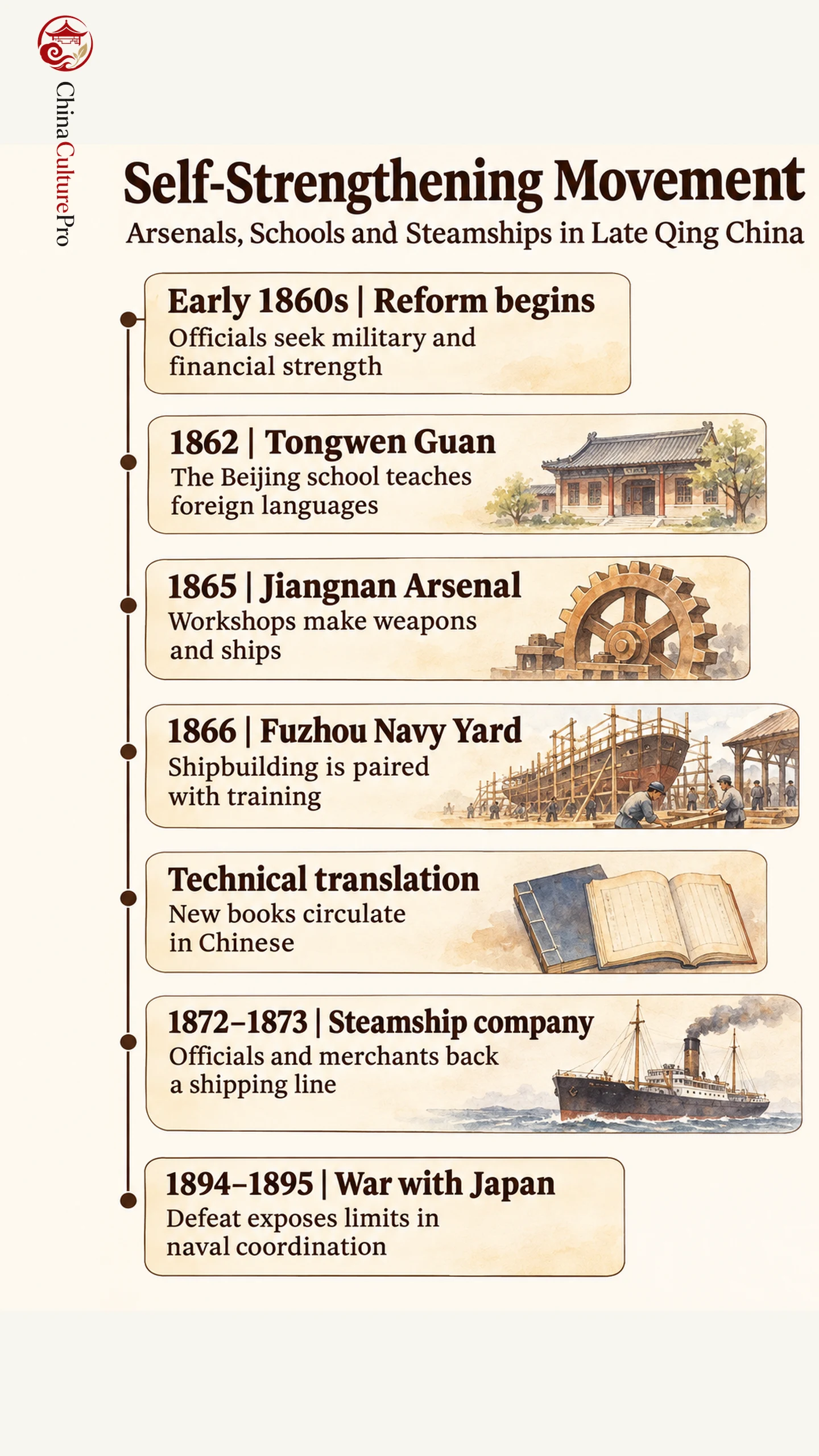
The late Qing needed translators as well as rifles. Buying a steamship, building one and training its crew were different tasks, and reformers set up different institutions to handle them.
Why Qing Officials Sought New Skills
The Qing dynasty faced the aftermath of the Second Opium War and the ongoing Taiping Rebellion when reformers began these projects. Foreign armies had reached Beijing in 1860. The court and provincial leaders sought military and financial strength to defend against outside powers and preserve order at home. From 1861, the language of self-strengthening became common in official discussions. [1][5][8]
The scholar and official Feng Guifen (冯桂芬, Féng Guìfēn) proposed learning the languages and practical techniques that supported Western power. He treated these as skills Chinese scholars and officials could acquire while retaining their own moral and political traditions. His essay placed language study and translation among the means of learning how foreign institutions and machines worked. [1][2]
What the Arsenals and Shipyards Built
The Jiangnan Arsenal (江南制造局, Jiāngnán Zhìzàojú), founded in Shanghai in 1865, made guns, ammunition, machinery and ships. It expanded its workshops but still imported equipment and important raw materials. A ship list preserved by the National Museum of China documents output from the arsenal’s first two decades. That record can establish what the arsenal built. It cannot tell us how well the navy deployed the ships. [3][5]
The Fuzhou Navy Yard (福州船政局, Fúzhōu Chuánzhèngjú) developed at Mawei from 1866. Zuo Zongtang initiated the project, and Shen Baozhen led its early development. It paired shipbuilding with instruction in engineering and navigation. French specialists helped procure machinery, supervise work and train students. Fuzhou’s navigation students learned to use trigonometry and astronomy to find a ship’s position and to work with compasses. Other students went on to train in Europe. During the yard’s early years, fifteen ships were launched between 1869 and early 1874. Funding and administrative difficulties then slowed production. [4][5]
How Schools, Translation and Shipping Worked
The Qing founded the Beijing Tongwen Guan (同文馆, Tóngwén Guǎn) in 1862 to teach foreign languages. When the school added mathematics and astronomy in the late 1860s, it also made room for subjects such as chemistry, physics and mechanics. The new courses gave the Qing a place to teach material that a traditional examination candidate would not normally have studied. Shanghai’s arsenal translation office had a different task. It produced Chinese editions of books on science and technology. A collaborator such as John Fryer explained the foreign-language text while Chinese colleagues helped turn it into readable written Chinese. Topics included navigation and engineering. [1][3][5]
The China Merchants Steam Navigation Company (轮船招商局, Lúnchuán Zhāoshāngjú) was authorized in 1872 and opened for business in Shanghai in 1873. Its model combined official supervision and merchant participation. The state could encourage a Chinese competitor in coastal steam shipping, while merchants brought capital and commercial experience. The company began carrying cargo between Shanghai and Hong Kong in 1873. It needed paying customers and ships in regular service, unlike an arsenal commissioned to make weapons. [6][7]
What the Defeat of 1895 Revealed
The First Sino-Japanese War tested whether the Qing could turn ships, weapons and training into an effective fleet in combat. Defeat in 1895 sharpened arguments about financing, training and coordination. For example, the Beiyang Fleet did much of the fighting against a unified Japanese navy with limited help from the other regional fleets. Benjamin Elman’s study of naval reform warns against taking that outcome as a verdict on all the scientific and industrial work done since the 1860s. [5]
The war exposed a problem the separate reform projects could not solve by themselves. An arsenal might build ships and a school train officers, but fleet commands still needed to operate together. It had establishments capable of building ships, publishing technical works and training specialists. Technical books and schools could serve readers and students after the defeat. The steamship company also outlasted the war and continued to operate under the Qing. [3][4][5][6][7]
FAQs About the Self-Strengthening Movement
Was this also called the Westernization Movement?
Yes. The same group of late Qing projects is also called the Westernization Movement or Foreign Affairs Movement. Self-strengthening was a term reformers used for increasing the empire’s own capabilities. [1][5][8]
Was Self-Strengthening a single government program?
No. Court officials and provincial leaders started and supported different projects. They shared broad concerns about defense and resources, but their institutions differed in purpose and management. [1][3][4][7]
Did the movement end immediately in 1895?
No. The defeat of 1895 is a conventional endpoint for the movement, but arsenals, schools and companies could continue afterward. [5][6][7][8]
出典
[1] Ting-yee Kuo and Kwang-Ching Liu. Self-Strengthening: The Pursuit of Western Technology
[2] Feng Guifen, excerpt published by Columbia University’s Asia for Educators. On the Adoption of Western Learning
[3] National Museum of China. List of Ships Built at the Jiangnan Arsenal, 1865–1885
[4] Fuzhou Municipal Government. People in the History of the Fuzhou Navy Yard
[5] Benjamin A. Elman. Naval Warfare and the Refraction of China’s Self-Strengthening Reforms into Scientific and Technological Failure, 1865–1895
[6] China Merchants Group. Company History: Late Qing Dynasty
[7] Chi-kong Lai. China’s First Modern Corporation and the State
[8] Academy of Chinese Studies. Westernization Movement