

Quick Answer: How Did Tang China and Japan Exchange Culture?
The Tang dynasty (唐朝, Táng Cháo) and early Japan were connected by embassies, Buddhist travelers and merchant ships. Japan’s official missions brought people to study and collect books and objects. Monks also carried teachings from China to Japan, and Japanese rulers used continental models when building cities such as Nara. [1][2][3][4][5][7]
- Embassies: Japan sent envoys, students and monks to the Tang court.
- Buddhism: Travelers studied texts, rituals and ordination practices.
- Local adoption: Japan used what travelers brought back in its own institutions and workshops. [1][2][3][4][8][9]
The last official mission to sail left in 838. Contact continued through other routes. [1][7]
The voyages carried people in both directions. A Japanese monk might spend years studying in China, while a Chinese teacher could spend the rest of his life teaching in Japan.
What the Japanese Missions to Tang China Did
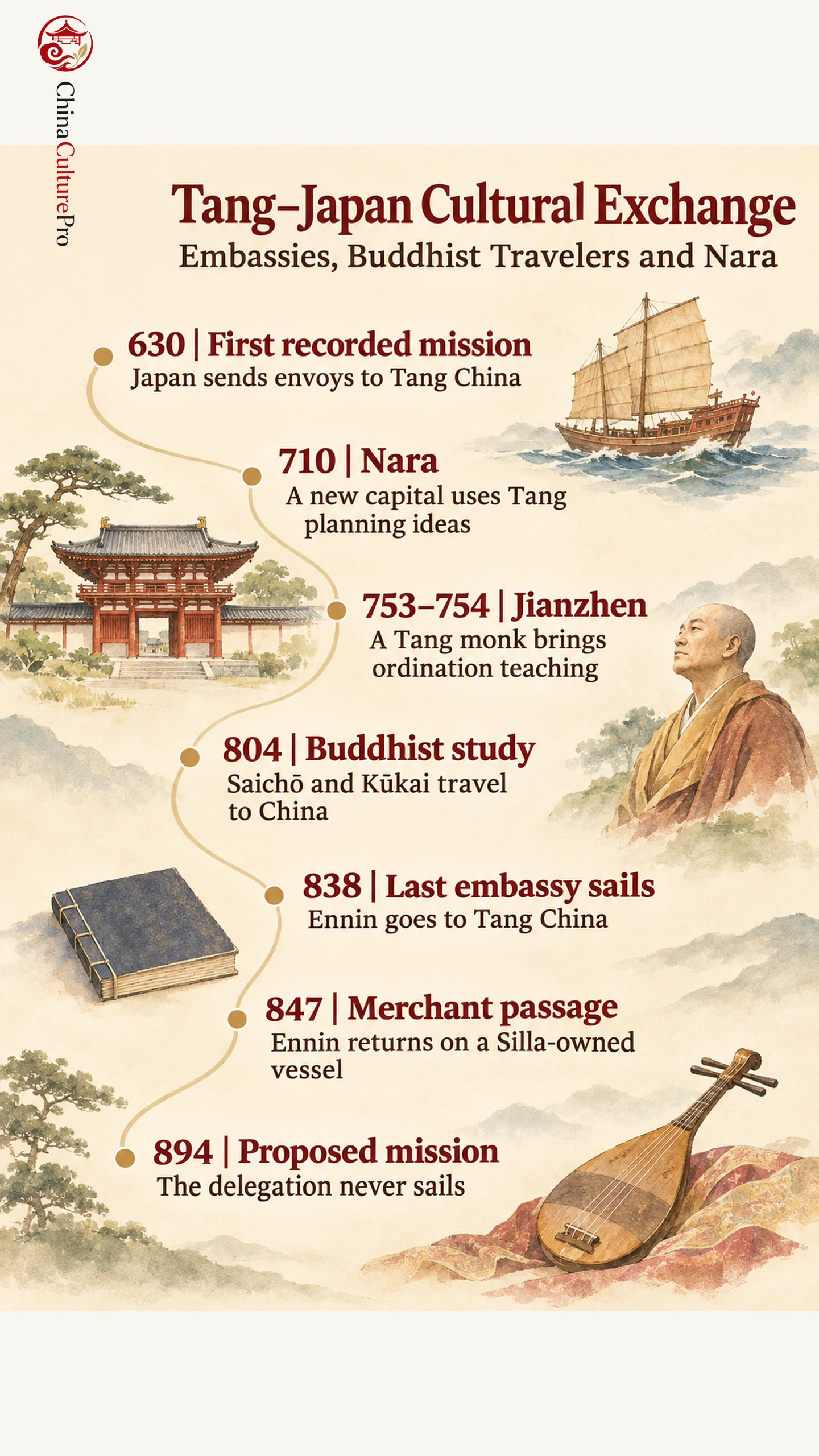
Japan called the envoys it sent to the Tang dynasty kentōshi (遣唐使, Qiǎn Táng Shǐ). The Japanese word refers to envoys dispatched to the Tang court. The Nihon Shoki records a mission dispatched in 630. Later groups included diplomats, sailors, students and monks. Their tasks ranged from representing the Japanese court to studying institutions and obtaining books or other materials. [1][2]
Routes changed over time. Early missions passed the Korean Peninsula and landed in Shandong. Later missions crossed the East China Sea from the Gotō Islands toward the mouth of the Yangzi, making more of the voyage on open water. The last one to make the crossing departed in 838. The Japanese court named envoys for another mission in 894, but that delegation never sailed. The two dates mark different events. [1][7]
What Monks Carried in Both Directions
The 804 mission carried Saichō and Kūkai, who studied in China and returned to Japan. Saichō used teachings he studied abroad to establish Japanese Tendai. Kūkai returned with esoteric teachings that he used to establish Shingon. Their work gave the same voyage different results in Japanese religious life. Their travels show the role of the missions in connecting Japanese practitioners with Buddhist teachers in China. [2]
The Chinese monk Jianzhen (鉴真, Jiànzhēn), known in Japan as Ganjin, crossed to Japan in 753 and entered Nara in 754. He conducted ordinations at Tōdai-ji and later established Tōshōdai-ji. His work brought instruction in monastic rules and the procedures for ordaining monks and nuns. It depended on his presence as a teacher as well as on the materials he brought. [3][5]
How Tang Models Were Adapted in Nara
Japan established its capital at Heijō-kyō, now Nara, in 710. Its planners used a grid and a central north–south avenue, following precedents that included the Tang capital Chang’an (长安, Cháng’ān). At Nara the main avenue ran north from the Rajō Gate and divided the city into eastern and western sectors. Empress Genmei moved the government there from Fujiwara to administer Japan under its own legal code. [2][4][5]
At Nara, excavations give historians one kind of evidence. The outline of the government district and the remains of the avenue can be compared with written descriptions, while surviving temples and shrines show different institutions operating in the same city. Archaeology can establish the orientation of streets and the arrangement of a capital. The grid organized the space around the palace and administration. It is evidence for a shared approach to urban design, with local decisions about how to use it. [4][5]
What the Objects and Diaries Tell Us
The Japanese monk Ennin (圆仁, Yuánrén) sailed to Tang China with the mission of 838. His diary describes his religious travels and the conditions he encountered. He returned to Japan in 847 on a trading vessel owned by a man from Silla, on the Korean Peninsula. Ennin’s return shows that transport for religious travel was available outside the Japanese court’s fleet. It also shows a role for Korean merchants in a journey often described in terms of Japan and China alone. Other records preserve letters between a Chinese monk who went to Japan and two maritime traders, showing that religious travelers and merchants maintained connections outside the embassies. [6][7]
The Shōsō-in (正仓院, Zhèngcāngyuàn) treasury at Nara records another side of exchange. Part of the collection came from possessions of Emperor Shōmu that Empress Kōmyō began donating to Tōdai-ji in 756. A five-string biwa lute with mother-of-pearl decoration is thought to have been imported from Tang China. Its construction and decoration give conservators clues about where it was made. The donation record documents how a group of objects came to be kept at Tōdai-ji, a different question from where they were produced. [8][9]
FAQs About Tang–Japan Cultural Exchange
When did the Japanese missions to Tang China end?
The last official mission to reach Tang China sailed in 838. A delegation was appointed in 894, but it was never sent. [1][7]
Was Nara an exact copy of Chang’an?
No. Heijō-kyō used features associated with Tang capital planning, including a grid and a main avenue, in a city built for a Japanese court and legal system. [4][5]
Did cultural exchange stop when the missions ended?
No. Monks and merchants continued to travel. Ennin’s return from China in 847 on a merchant vessel provides one recorded example of exchange outside the official missions. [6][7]
出典
[1] Nara Prefectural Complex of Man’yō Culture. Japanese Missions to Tang China
[2] Japan Ministry of Land, Infrastructure, Transport and Tourism. Japanese Missions to Tang China
[3] Nara National Museum. Ganjin: National Treasures Exhibition
[4] Nara National Research Institute for Cultural Properties. The Nara Capital and Palace
[5] UNESCO World Heritage Centre. Historic Monuments of Ancient Nara
[6] Ennin, translated by Edwin O. Reischauer. Ennin’s Diary: The Record of a Pilgrimage to China in Search of the Law
[7] Acta Asiatica. Research on the History of Japan’s Contacts with Other Countries
[8] Nara National Museum and exhibition partners. About the Exhibition of Shōsō-in Treasures
[9] Suntory Museum of Art. The Reproduction of Shosoin Treasures