

Quick Answer: What Was the Tumu Crisis?
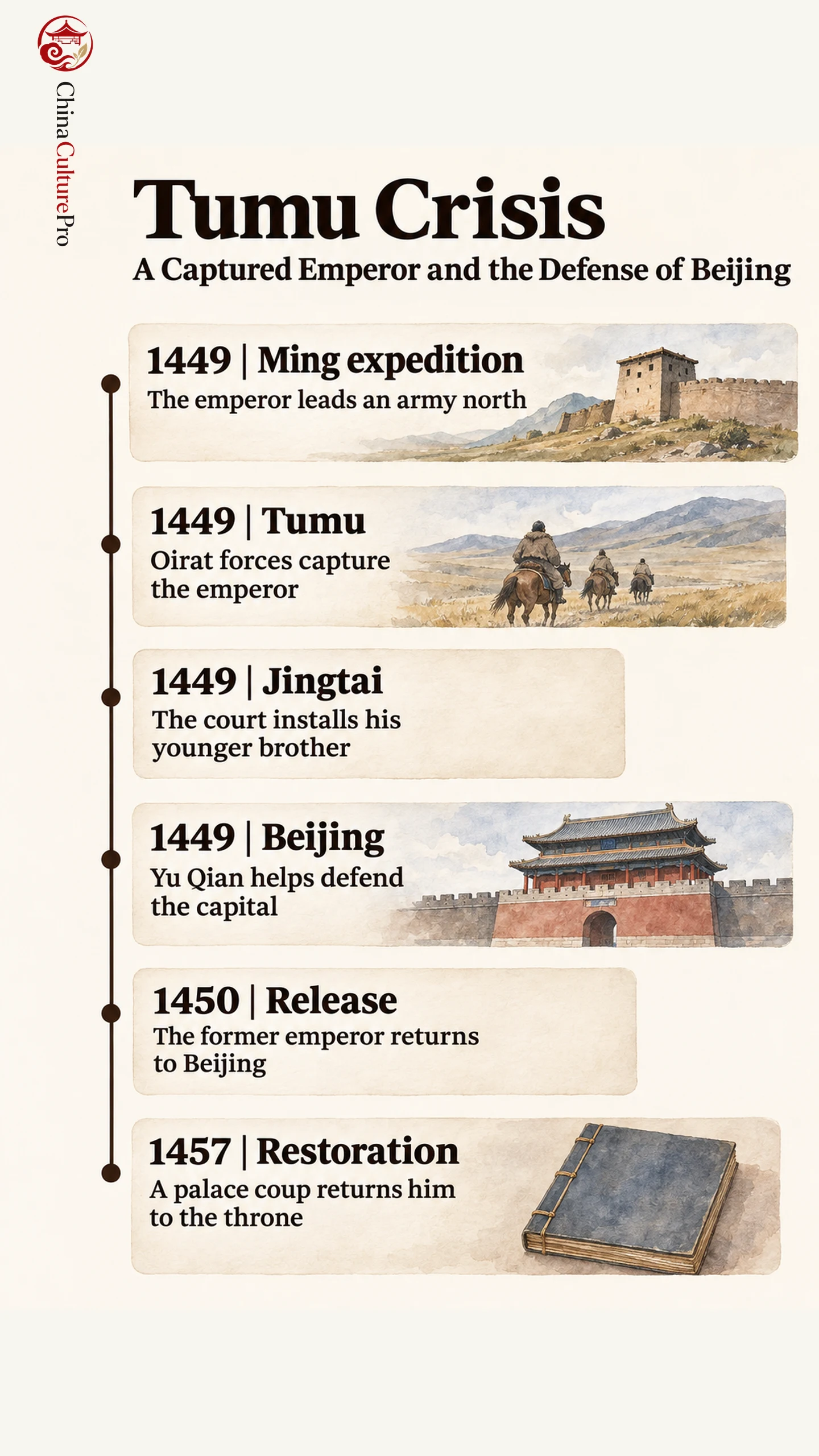
The Tumu Crisis (土木之变, Tǔmù Zhī Biàn) began with a Ming defeat in 1449 at Tumu, northwest of Beijing. The Oirat leader Esen Taishi (也先, Yěxiān) captured the Zhengtong Emperor (正统帝, Zhèngtǒng Dì). The Ming court installed his younger brother and defended Beijing. The captive emperor returned in 1450 and recovered the throne in 1457. [1][2][3][4][6][7]
- Defeat: A retreating Ming army collapsed near Tumu.
- Response: The court appointed a new emperor and held the capital.
- Aftermath: Release from captivity came years before restoration to power. [1][2][3][4][5][6][7]
The field defeat forced a succession decision before the capital itself was attacked. [2][3][5][6]
When news of the emperor’s capture reached Beijing, officials faced two decisions at once. They had to defend the capital and determine who could govern while the reigning emperor was a prisoner.
Why the Ming Emperor Led an Expedition in 1449
Esen had consolidated power among the Oirats and extended his influence among other Mongol groups. Trade and tribute missions linked his followers to the Ming dynasty even when raids and frontier fighting strained relations. The Ming used access to trade to manage its frontier relationships. Esen needed goods to reward followers and maintain his position. Disputes over missions and their compensation sharpened the conflict as his power grew. [2][3][4]
In 1449 the emperor set out with an army against Esen’s forces. The palace eunuch Wang Zhen (王振, Wáng Zhèn) had considerable influence over the young ruler and the conduct of the campaign. Wang pushed for the expedition despite objections at court. The army was assembled in haste. Heavy rain and reports of previous defeats put further strain on the troops as they advanced. [1][2][3][4]
How the Ming Army Collapsed at Tumu
The Ming army advanced toward Datong and then turned back. Oirat forces struck at the units covering the retreat before they reached the emperor’s main force. By the time the imperial army reached Tumu, its men were tired and short of water. The retreating troops could no longer maintain order when the attack came. Many soldiers and officials died, including Wang Zhen, and Esen’s men captured the emperor. [1][2][4]
Sources record changes to the route and a stop at Tumu. Later accounts offer stories about why Wang wanted a particular route or refused to leave the baggage behind. These stories are harder to verify than the broad sequence. The defeat left the capital short of troops and deprived it of its reigning emperor. [1][2][4]
How Beijing Held and the Court Chose Another Emperor
Zhu Qiyu, the captive emperor’s younger brother, first took charge as regent. The court then enthroned him as the Jingtai Emperor (景泰帝, Jǐngtài Dì). With a ruler in Beijing, officials could continue issuing orders and organizing the defense. The captive remained an imperial figure, but Esen could no longer assume that bargaining with him meant bargaining with the ruler who directed the government. [2][3][4][6]
The official Yu Qian (于谦, Yú Qiān) opposed moving the court south. As minister of war, he helped bring in troops, move grain and organize the production and distribution of weapons. The court backed preparations around the city rather than withdrawing from it. Esen brought the captive emperor toward Beijing and sought talks when he reached the capital later in 1449. The court refused demands to send its senior officials out to meet him. The Ming held the city and the Oirats withdrew. The forces defending Beijing could draw on people and supplies the Ming still controlled after the field army’s defeat. [2][5][6]
From Captivity to the 1457 Restoration
Esen released the captive emperor in 1450. Jingtai continued to reign and confined his brother in the Southern Palace. He later displaced his brother’s son as heir and installed his own son, changing a succession the court had initially preserved. In 1457, while Jingtai was ill, a palace coup restored his brother to the throne. The restored emperor used the reign title Tianshun. Yu Qian was executed after the change of power. In the intervening years his work had extended beyond the defense of the capital. The dynastic history records proposals to reorganize Beijing’s military units and strengthen the frontier, even as the Oirats resumed sending missions. [3][5][6][7]
The History of the Ming annals record appointments, the loss of the emperor and the later change of reign. Yu Qian’s biography focuses on the decision to defend the capital and his role in it. The official history was compiled under the Qing. Its accounts let readers compare the succession recorded in the annals with the actions attributed to Yu in his biography. Neither resolves every claim about Wang Zhen’s motives during the retreat. [2][3][4][5]
FAQs About the Tumu Crisis
Where did the Tumu Crisis take place?
The Ming army was defeated at Tumu, near present-day Huailai in Hebei, northwest of Beijing. The later defense of the capital took place at Beijing. [1][2][5]
Did the Oirats capture Beijing?
No. Oirat forces attacked Beijing, but Ming defenders held the capital. [2][5][6]
Did the emperor return to the throne as soon as he was released?
No. He returned from captivity in 1450, and Jingtai remained emperor. A palace coup brought him back to power in 1457. [3][6][7]
出典
[1] Palace Museum, Beijing. The Tumu Crisis
[2] Peter Lorge. War, Politics and Society in Early Modern China, 900–1795: The Tumu Incident
[3] Denis Twitchett and Tilemann Grimm. The Zhengtong, Jingtai and Tianshun Reigns, 1436–1464
[4] Zhang Tingyu and other Qing court compilers. History of the Ming, chapter 10: Annals of Yingzong
[5] Zhang Tingyu and other Qing court compilers. History of the Ming, chapter 170: Biography of Yu Qian
[6] Palace Museum, Beijing. The Jingtai Emperor
[7] Palace Museum, Beijing. The Zhengtong Emperor