


Quick Answer: What Shapes Chinese Rural Culture Today?
Chinese rural culture today includes livelihoods, household relationships, local traditions and the uses people make of shared places. Villages are connected to towns, cities and digital networks, while remaining important places of work, memory and belonging. Their lives cannot be understood through farming or preserved architecture alone.[1][3]
- Work: Farming, local employment and jobs elsewhere can contribute to the same household.
- Community: Family obligations, gathering places and particular traditions connect people.
- Change: Technology, new leisure and development projects reshape village life.
The examples here concern particular mainland communities and periods; rural culture differs across regions and social groups.
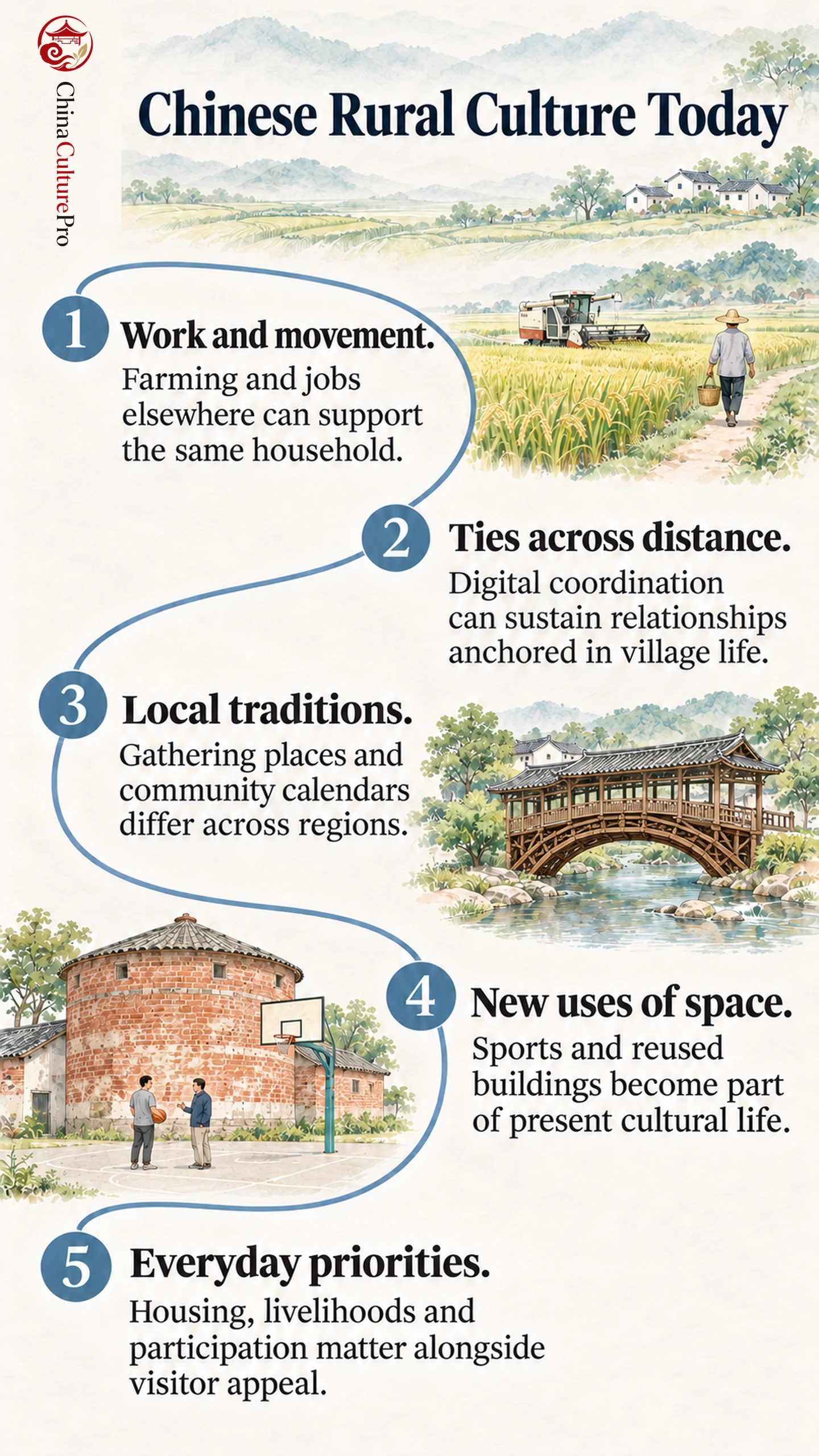
A village may connect a working field, a family group chat, a local ceremony and a basketball court. Reading these activities together reveals how people sustain relationships and make choices within the changing countryside of modern China.
Work, Land and Connections with Towns and Cities
Rural life is linked to more than agricultural employment. The 2025 national monitoring report, released in April 2026, counted 301.15 million nongmingong (农民工, nóngmíngōng). This category covers workers whose hukou (户口, hùkǒu), or household registration, remains rural and who work for at least six months during the year, either locally in nonagricultural industries or away from their registered township.[2]
The total included 121.09 million working within their registered township area and 180.06 million working outside it. Thus, the English label “rural migrant workers” does not mean everyone counted moved to a distant city. Nor is it a count of all rural residents or all people engaged in farming.[2]
Farming itself involves changing skills and arrangements. A 2025 study of a Hunan village used fieldwork in 2011 and 2024 to examine how households maintained rice fields while members worked elsewhere. People combined hired machinery services with manual techniques according to terrain, costs, available labor and family circumstances.[3]
Women who remained in the village made practical choices about managing fields and household responsibilities. Money sent by migrants could help pay for machine services, making work elsewhere part of the farming arrangement. Manual knowledge and mechanization were resources people combined, rather than two separate stages everyone passed through in order.[3]
Family Ties Across Distance
A household’s relationships can extend across several places. Leaving for work need not end obligations to relatives or participation in a home community. Family life therefore includes coordination among people who may not share the same daily residence.
A lineage (宗族, zōngzú) links relatives through shared descent. One Anhui case shows how such a group worked across distance. Research published in 2026 drew on 2018–2019 fieldwork in Zhuye Village, following an ancestral-tomb reconstruction project. WeChat helped dispersed members communicate, mobilize resources and organize participation. Migrant coordinators handled communication, while elders based in the village retained important decision-making roles.[4]
The project still required local negotiation, physical work and ritual participation. Messaging did not make the village irrelevant or transfer every decision online. This case shows how new communication tools can operate within older relationships of authority and responsibility.[4]
Such activities connect with ancestral remembrance, but a lineage project is one form of community organization. It does not establish that every village is organized around the same kinship structure.
Local Traditions and Places to Gather
Shared places acquire meaning through what people do there. Ancestral halls (祠堂, cítáng) can connect ritual with community activities. In the Hunan farming case, some women used time freed by changing agricultural arrangements for dancing, singing and playing instruments in an ancestral hall.[3]
Elsewhere, a different structure can help sustain local connections. Wooden arch bridges in Fujian and Zhejiang are routes, places of cultural activity and sources of livelihood for woodworkers. Their construction, maintenance and use involve local communities as well as craft specialists.[5]
The guides to ancestral halls および wooden arch bridges examine these particular forms. A building’s social life includes the skills, gatherings and relationships that keep it in use, alongside its appearance.
Calendars also differ. Qiang New Year (羌年, qiāngnián), celebrated by Qiang communities in Sichuan on the first day of the tenth lunar month, expresses gratitude, relationships with nature and social bonds. It is a particular community tradition, rather than a date or ceremony shared by every Chinese village.[5]
These are examples of living cultural heritage: knowledge and practices continued by people. Preserving a structure alone cannot explain how a community uses it or passes on its traditions.
New Leisure and Reused Village Spaces
Contemporary recreation belongs to rural culture too. Village BA (村BA, cūn BA) refers to village basketball competitions. In September 2026, a former grain depot in Xinfeng town, Jiaxing, opened as the Feng BA Basketball Gymnasium and hosted provincial tournament finals. Markets and cultural itineraries accompanied the event.[6]
The building combined traces of an earlier agricultural function with a new sports use. This example from 浙江 shows culture being made through present-day activities as well as inherited customs. A newly established gathering can become part of a community’s cultural life alongside longstanding customs.
The tournament linked a gathering with a place being put to a new use. The example also raises a practical question about cultural spaces: how can an old building serve people’s present activities?
Revitalization, Housing and Everyday Needs
Rural revitalization (乡村振兴, xiāngcūn zhènxīng) can involve culture alongside livelihoods and changes to the built environment. A 2026 study of culture-led village projects compared Nandong Art Valley in Zhejiang with Dahe Social Work Village in Shenzhen. Its contrasting settings illustrated approaches ranging from tourism-oriented development to community-based practices, rather than one national rural model.[8]
The distinction matters: attracting visitors and supporting residents’ daily lives are related but different purposes. A restored facade, an arts project and a community service need to be assessed by what they do for the people involved, rather than by appearance alone.
Change can also create uncertainty. Research published in a 2024 journal issue examined two Anhui villages designated for redesign, including life-history interviews conducted in 2015. Unresolved redevelopment plans affected housing decisions and the security of households whose members lived and worked across locations. These were specific cases, not a verdict on every rural project.[7]
A useful reading of rural culture asks who works, who stays, who participates and who makes decisions. Village life includes opportunities and pressures that can be missed when the countryside is treated only as scenery, a development slogan or a record of vanishing customs.
FAQs About Chinese Rural Culture
Does everyone living in a Chinese village farm?
No. Village households can combine agriculture with local nonfarm jobs and employment elsewhere. A rural home or registration does not identify one occupation.
Does migration always end someone’s connection with a village?
No. People may continue supporting relatives, financing work or joining community projects from elsewhere. The extent of that involvement depends on the household and circumstances.
Are village traditions the same throughout China?
No. Building traditions, festivals, languages and forms of community organization differ. A Qiang celebration in Sichuan or a Zhejiang bridge community is a specific example.
Can digital communication replace local participation?
It can organize communication and resources across distance, but activities may still depend on local work, face-to-face decisions and physical gatherings.
Is a successful tourist village a model for every community?
No. Communities differ in resources and priorities. Visitor activity is one consideration alongside housing, livelihoods, services and residents’ participation.
出典
[1] University of Washington Press. Chinese Village Life Today: Building Families in an Age of Transition
[2] National Bureau of Statistics of China. 2025 Rural Migrant Workers Monitoring Survey Report
[3] Population, Space and Place. Farming Technologies, Migration and Left-Behind Women in China: A Socio-Technical Perspective
[4] Transactions in Space, Place, and Culture. Digital Mediation of Lineage Practices: The Role of WeChat in Facilitating Cultural Continuity amid China’s Rural-to-Urban Migration
[5] UNESCO. Intangible Cultural Heritage Committee 2024: Qiang New Year and Chinese Wooden Arch Bridges
[6] Information Office of Jiaxing Municipal People’s Government. Grain Depot Reborn to Host Zhejiang Village BA
[7] Journal of International Development. Rural Modernization and the Remaking of the Rural Citizen in China: Village Redevelopment, Migration and Precarity
[8] Sociologia Ruralis. Culture-Led Village Revitalisation as a Chinese Form of Endogenous Rural Development