


Quick Answer: What Shapes Chinese Youth Culture?
Chinese youth culture includes the ways younger people express identity, develop interests and build relationships. This guide focuses on mainland China, where digital participation, education, employment and family expectations intersect with changing leisure practices. Birth decade, personal circumstances and membership of a particular interest group explain different things.[3][5]
- Participation: People create, share, practice and organize as well as consume.
- Belonging: Interests can connect peers with local traditions and wider cultural worlds.
- Difference: A fashionable style or online slogan does not describe every young person.
Read specific communities and experiences alongside generational labels, rather than treating one trend as a complete national portrait.
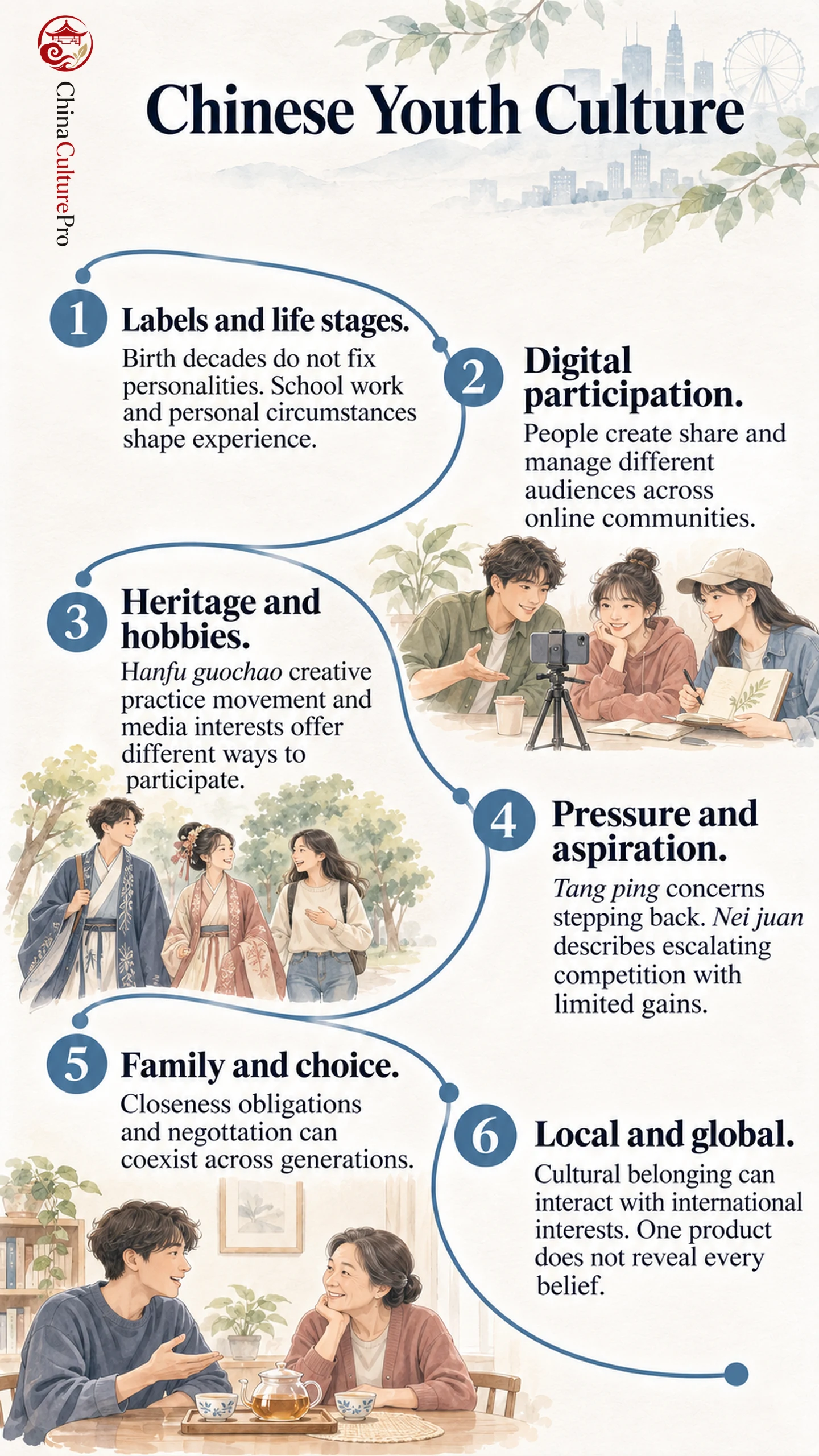
A video edit, a dance class and a discussion about career choices can each reveal part of young people’s lives. Following these activities shows how personal expression connects with peers, family and the wider changes within modern Chinese culture.
Generational Labels and Different Life Stages
The labels post-90s (90后, jiǔlínghòu) and post-00s (00后, línglínghòu) refer to people born in the 1990s and 2000s respectively. They identify birth decades, not fixed personalities. The post-90s cohort grew up during the expansion of computers, mobile phones and the internet, but its members have not shared identical opportunities.[1]
Life stage is another distinction. A secondary-school pupil, a university student and a working adult may organize time and relationships very differently, even when a report places them within a broad youth or Gen Z category. Check the ages and definition used before comparing research.
Digital self-expression also has a history. A study published in 2010 examined identity construction among Chinese bloggers, using content analysis and interviews. That earlier work helps show why personal expression online should not be treated as something invented by today’s short-video platforms.[2]
Digital Communities and Creative Participation
Online communities give interests a social setting. Someone may share creative work, discuss stories, follow performers or learn an unfamiliar skill. Participation can involve producing material and maintaining relationships, not simply viewing a feed.
A 2025 qualitative study interviewed 14 young people who moved between social-media platforms. Their accounts connected platform choices with self-expression, boundaries and control over who could see their posts.[3]
Communities can form around pop music, animation および online fiction. Interest in a work and membership of a fan community are different levels of engagement. Shared internet language can signal familiarity, while its meaning still depends on the conversation.
A highly visible online group is also only one part of its participants’ lives. A public post cannot show everything someone does at school, at work or with relatives.
Heritage, Style and Everyday Leisure
Hanfu (汉服, hànfú) offers one example of heritage becoming a contemporary social practice. A 2023 study of five Beijing associations, based on fieldwork in 2020–2021, followed online chats and offline gatherings involving clothing, photographs and shared meals. Participants connected historical narratives with personal and collective belonging.[4]
Guochao (国潮, guócháo) concerns contemporary Chinese cultural style and branding. Fashion research examines combinations of historical references and street-style influences. Its focus on design and branding overlaps with, but differs from, the clothing-centered hanfu revival.[9]
Ordinary hobbies matter alongside conspicuous styles. A June 2026 online poll of 1,334 young respondents recorded varied interests, including:
- Creative practice: Handcrafts, music, dance and photography.
- Movement: Cycling, walking and other outdoor or sporting activities.
- Media and play: Reading, films, board games and learning through documentaries.
In that poll, 80.1 percent reported maintaining a hobby for at least six months. The figure describes the respondents, not a verified share of all Chinese youth. It nevertheless illustrates why youth leisure should not be reduced to shopping or screen time.[5]
Competition, Ambition and the Language of Pressure
Cultural expression also responds to demands on time and opportunity. School life および working life provide different settings for achievement, deadlines and decisions about the future. A slogan can communicate frustration without giving a complete account of someone’s ambitions.
Tang ping (躺平, tǎngpíng), commonly translated as “lying flat,” names a stance of stepping back from demanding expectations. Nei juan (内卷, nèijuǎn), often translated as “involution,” is used in discussions of escalating competition with limited gains. These social expressions describe different ideas; neither is a diagnosis or a census category.[6][11]
A 2026 study surveyed 2,317 young people across 270 cities and examined lying flat through the tension between personal aspirations and inherited moral expectations. Its analysis moves beyond a simple story of refusing work. The term’s circulation is not evidence that an entire generation has abandoned effort.[6]
Family Ties and Personal Choices
Personal choices can develop within continuing family connections. In a study published in 2022, 95 life-history interviews across 25 urban families showed greater expressive closeness between parents and the only-child generation alongside continuing obligations and parental organization of childhood. Affection, dependence and negotiation can coexist.[7]
This gives context to conversations about study, careers and relationships. Different generations may attach different meanings to security or a fulfilling life. A disagreement need not imply that family ties have disappeared, while continuing support does not mean everyone agrees.
The wider picture of family life today includes different households and care arrangements. An account of one urban family should not stand for young people in every region, or for those with different economic resources and responsibilities.
Local Belonging and Global Interests
Interest in local heritage and international popular culture need not be mutually exclusive. A study published in a 2026 journal issue surveyed 264 university students in Jiangsu and Sichuan about transnational sports fandom. Social connections helped explain access to international cultural interests, while participants negotiated local and global identities.[8]
The case concerns particular students and sporting interests. It does not prove that everyone combines these influences in the same way, or that enjoying a cultural product reveals a complete political worldview. Clothing, music and sport can carry different meanings for different people.
Participation also extends beyond leisure consumption. The 2022 youth white paper describes volunteering, community activities and diverse career pathways. As a dated official account, it documents how youth participation is publicly framed; it should be read alongside specific research on young people’s own experiences.[10]
FAQs About Chinese Youth Culture
Do post-90s and post-00s refer to birth decades?
Yes. They refer to births in the 1990s and 2000s respectively. They do not guarantee the same interests, income or attitudes.
Does Chinese youth culture exist only online?
No. Online contacts can connect with clothing gatherings, music, sport, crafts and other activities outside the screen.
Are all young Chinese people lying flat?
No. It is a term within debates about pressure and aspiration, not a description of every young person’s behavior.
Does wearing hanfu reveal someone’s political views?
No. Particular communities may connect clothing with collective identity, but an outfit alone cannot establish every wearer’s beliefs or reasons.
Is buying fashionable products the only way to participate?
No. Practicing a hobby, making something, sharing knowledge, organizing a group and volunteering are also forms of participation.
出典
[1] Cheng Li, Brookings Institution. China’s Digital Natives: How the Post-90s Generation Is Transforming the Country
[2] Yangzi Sima and Peter C Pugsley, International Communication Gazette. The Rise of a Me Culture in Postsocialist China: Youth, Individualism and Identity Creation in the Blogosphere
[3] Hongxun Zhao, Jiahui Wang and Xurui Hu, Social Media and Society. A Wandering Existence: Social Media Practices of Chinese Youth in the Context of Platform-Swinging
[4] Yan Jia, Language Culture and Society. Modern Ancient Chinese: A Discursive Construction of Hanfu Identity across Spatiotemporal Scales
[5] China Youth Daily Social Survey Center. 55.6%受访青年认为坚持一项爱好能愉悦自我
[6] Xiaoying Han and Taiping Ding, Journal of Youth Studies. Beyond Withdrawal: Chinese Personhood and the Lying Flat Movement among Urban Youth
[7] Jieyu Liu, Current Sociology. Childhood in Urban China: A Three-Generation Portrait
[8] Joaquín Estrader, Journal of Consumer Culture. Negotiating Patriotic Cosmopolitanism in Post-Reform China: Identity Social Capital and Transnational Sport Fandom among Chinese College Students
[9] Zhe Wang, Fashion Style and Popular Culture. Implementation of Chinese-Styled Branding in Global Fashion: Guochao as a Rising Cultural Identity
[10] State Council Information Office of China. Youth of China in the New Era
[11] Lyle Fearnley and Chen Sun, Cultural Anthropology. Green Involution: Mediating Plant Times and Lifetimes in a Chinese Rice Genetics Laboratory