

Quick Answer: What Is Chinese Ancestor Worship?
Chinese ancestor worship, also called ancestor veneration, includes practices through which living relatives honor deceased family members. It can involve tablets, portraits, food, incense, grave visits and shared family gatherings, with different meanings for different participants.
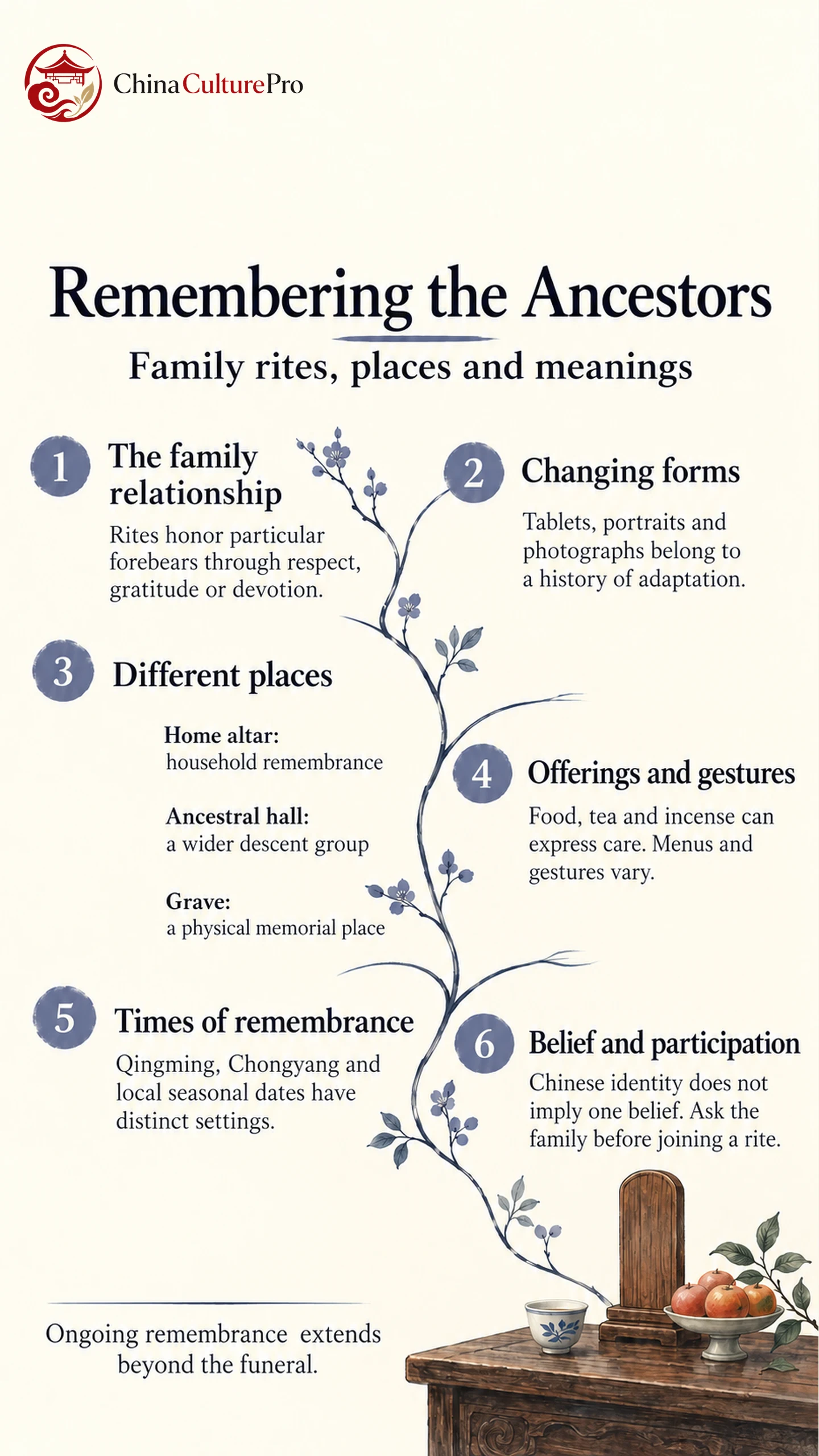
- Family relationship: The focus is a continuing connection with earlier generations, expressed through respect, gratitude or religious devotion.
- Places: Remembrance may occur at a home altar, an ancestral hall or a grave.
- Offerings: Food, drink, incense and paper items appear in some traditions, with no universal set required by every family.
- Variation: Religious belief, region, household history and personal choice shape participation.
Chinese identity does not imply one belief about the dead. A person can honor relatives without making offerings, and a guest should not assume that everyone present interprets a rite in the same way.
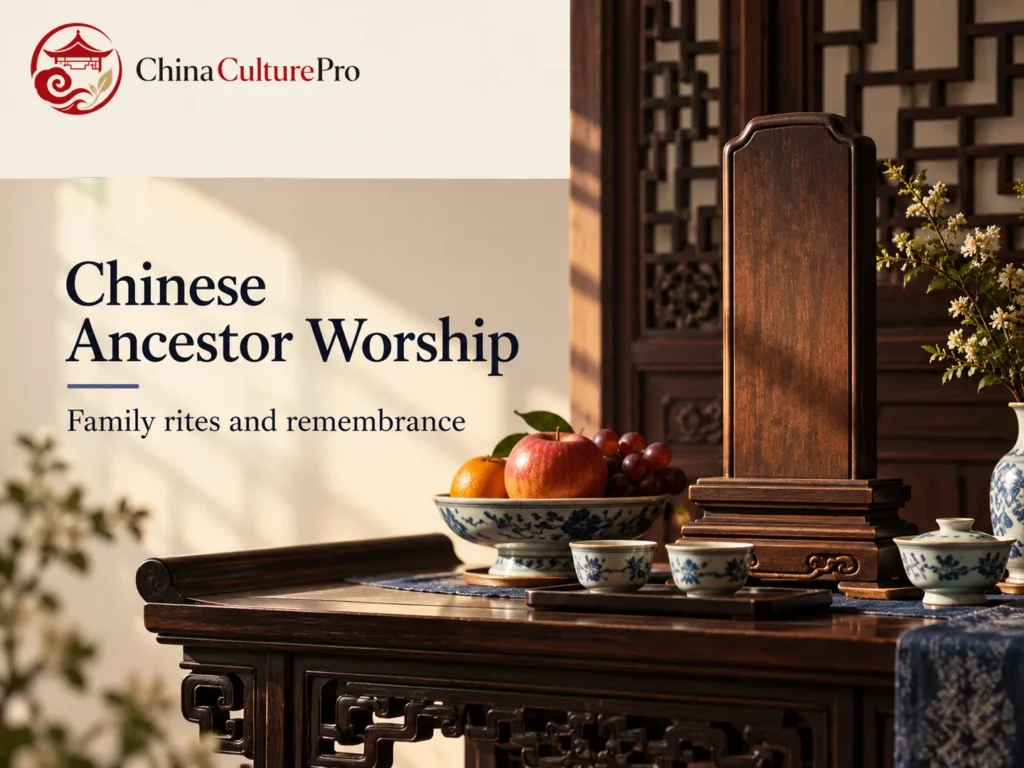
A bowl of fruit before an ancestral tablet and a family cleaning a grave can belong to the same broad practice of remembering earlier generations. Yet the objects, setting and beliefs are not interchangeable.
The term “ancestor worship” is familiar in English, but “ancestor veneration” can better communicate the respect and family obligation involved for some participants. Neither phrase should flatten a diverse tradition into a claim that all Chinese people pray to their ancestors in the same way.
Ancestor Veneration and the Family Relationship
Jizu (祭祖, jìzǔ) means rites honoring ancestors. The relationship matters: these are particular deceased relatives or forebears connected with the people performing the observance, rather than an undifferentiated category of spirits.
For a family member, the act may express gratitude for care received, recognition of origins or a belief that ancestors remain present in family life. Another participant may emphasize memory and respect without sharing a literal belief about spiritual presence. Those possibilities explain why the English boundary between “religious” and “cultural” is not always a good fit.
Pew Research Center’s 2023 report discusses this difficulty when interpreting Chinese survey data. Grave visits and other customs can have spiritual dimensions, but the available survey categories do not show that every person performing a visible act shares the same belief. Its analysis draws on surveys by academic groups in China, rather than a new Pew survey conducted there.[1]
The practice sits within Chinese family traditions, but it should not be used as a test of whether a person is sufficiently Chinese or appropriately devoted to their family.
A Long History with Changing Forms
Ancestor rites have a long history, but the form seen in a modern home should not be projected unchanged into antiquity. Objects, images and the spaces used for ceremonies developed over time.
Research by Peng Mei-ling examines ancestral tablets and ancestor images as related forms with a history of coexistence. The study discusses the importance of image halls in the Song period, the flourishing of portraits in the Ming and Qing periods and the later impact of photography. This is a history of changing media and practices, rather than a simple sequence in which every family replaced the same object at once.[5]
A Qing-period family scroll in the Metropolitan Museum of Art makes those connections concrete. It contains nineteen portraits from seven generations, with tablet-shaped labels recording family relationships and names. The object joins the representation of individuals with a larger account of descent.[2]
Such records also reflect the hierarchies and conventions of the communities that made them. They are valuable historical evidence without serving as a complete portrait of every Chinese household. The related guide to family genealogy and clan books explains another way names and relationships were preserved.
Home Altars, Ancestral Halls and Graves
An ancestral spirit tablet, Shenzhu (神主, shénzhǔ), can give remembrance a named physical focus. The McClung Museum’s rosewood example, dated around 1900, has an inscribed panel supported by a decorated wooden housing. Its interpretation explains how the tablet could represent the deceased within family ritual.[3]
| 用語 | 本記事での意味 |
|---|---|
| Jizu | Rites honoring ancestors |
| Shenzhu | A spirit tablet used as a focus of ancestral remembrance and ritual |
A home altar relates the deceased to a household. An ancestral hall can gather a larger descent group. A grave marks a place associated with a burial or other physical memorial. These settings can be connected, but owning or visiting one does not mean a family necessarily maintains all three.
Hong Kong’s Intangible Cultural Heritage Office documents clans gathering at ancestral halls or visiting hillside graves for seasonal observances. It describes the ceremonies as important clan and village activities in the New Territories. That local example shows how remembrance can also bring living relatives together.[4]
A tablet should not be treated as a decorative souvenir while a family is using it ritually. Likewise, an ancestral hall may be a functioning community space rather than simply an architectural attraction. The separate guide to Chinese grave traditions considers tombs, inscriptions and the memory attached to a place.
What Offerings and Gestures Can Mean
Food and drink can express care through the familiar language of hospitality. The McClung Museum describes fruit, tea and pastries offered before tablets, with incense understood by believers as a means of communication. These are explanations of ritual meaning, not evidence that every household uses the same menu or understands incense identically.[3]
Some traditions also use paper offerings, while others do not. Their presence should not be assumed from the word “ancestor” alone. Even a family that shares food afterward may distinguish what is presented during the rite from what is prepared for the living gathering.
The Hong Kong heritage record describes particular Punti clans cooking and eating on the hillside after offerings, distributing pork and using the Wai Tau dialect during ceremonies. The food connects the ancestral observance with the living community; the details remain specific to those clans.[4]
Bowing, standing quietly or following a family member’s lead may all appear in different settings. There is no single number of bows or incense sticks that an unfamiliar guest should impose on a household. Ask what is appropriate, and do not move a tablet, rearrange offerings or begin eating ceremonial food without guidance.
Qingming and Other Times of Remembrance
Qingming (清明, qīngmíng) is strongly associated with visiting and tending family graves. The related Qingming traditions guide explains that occasion in more detail.
It is not the only time ancestors are remembered. Hong Kong’s heritage account also identifies Chongyang (重阳, chóngyáng), the ninth day of the ninth lunar month, with grave visits. It records additional seasonal dates and observances at home, in halls and at graves. The calendar therefore varies by community and setting.[6]
The Chongyang Festival and a clan’s spring or autumn ceremony should not automatically be called another version of the same event. Each can have its own local history and participants.
Similarly, Hungry Ghost Festival offerings require attention to who is being addressed. Family ancestors, deities and other spirits are different categories within many practices. An offering seen during a wider community festival should not automatically be described as a family ancestor rite.
Belief, Participation and Modern Family Choices
An observance may carry religious, cultural or overlapping meanings. Pew’s report notes, for example, that some Chinese Christians visit graves to honor relatives while avoiding wishes directed to ancestors, paper burning or offerings. A grave visit alone cannot establish the visitor’s theology.[1]
For an invited guest, useful questions concern the particular event: who is being remembered, where to stand, whether photographs are welcome and whether any participation is expected. A respectful observer need not claim beliefs they do not hold. If an action conflicts with personal religion, explain that gently and ask to remain present in another way.
For relatives, remembrance can also include preserving a photograph, checking the spelling of a name or recording a story told by an older family member. These actions do not reproduce every ritual, but can keep the person’s life visible to another generation.
Ongoing remembrance is distinct from the immediate sequence of Chinese funeral traditions. Ancestor veneration may continue long after mourning has changed. Understanding that continuing relationship is more useful than trying to find one correct altar, menu or calendar for every family.
FAQs About Chinese Ancestor Worship
Do all Chinese people worship ancestors?
No. Participation and belief vary. Some people make ritual offerings, some emphasize remembrance and others do not observe ancestor rites.
Is an ancestor the same as a god or a wandering ghost?
No. These categories should not be treated as interchangeable. A family ancestor is connected with particular living relatives, while the meaning of deities and other spirits depends on the tradition.
Must ancestor remembrance involve burning paper?
No. Paper offerings belong to some practices, but remembrance can take other forms, including grave care, flowers, photographs or quiet respect.
Is ancestor veneration only part of a funeral?
No. Funeral rites concern a death and its immediate observances; ancestor remembrance can continue through later family occasions and recurring visits or ceremonies.
出典
[1] Pew Research Center. Measuring Religion in China
[2] Metropolitan Museum of Art. Portrait scroll of seven generations of the same family
[3] McClung Museum of Natural History and Culture. Ancestral Tablet
[4] Hong Kong Intangible Cultural Heritage Office. Spring and Autumn Ancestral Worship of Clans
[5] Peng Mei-ling, National Taiwan University. Ancestral Tablets and Ancestor Images: The Origin and Development of Chinese Traditional Means of Ancestor Worship
[6] Hong Kong Memory. Ancestral Worship