

Quick Answer: What Do Chinese Funeral Traditions Involve?
Chinese funeral traditions help a family mark a death, say farewell and continue remembering the deceased. A wake, offerings, prayers, mourning clothes and later memorial observances may be included, but no single programme applies to every family.
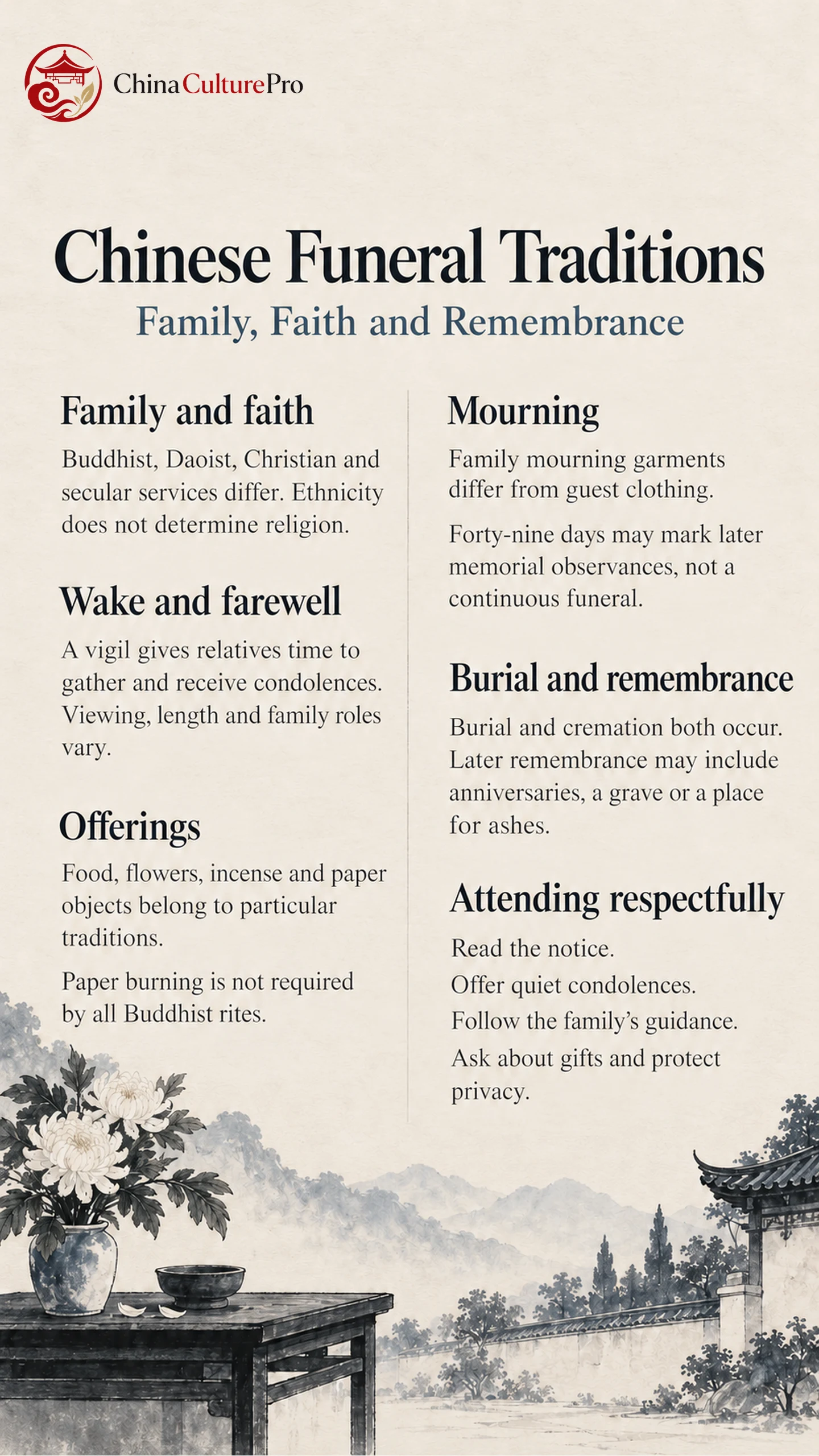
- Family farewell: Relatives may keep a vigil, receive visitors and take part in the final departure.
- Religious or secular observance: Buddhist, Daoist, Christian and nonreligious services have different forms.
- Mourning: Clothing and periods of observance depend on relationships, local practice and family choice.
- Remembrance: Later prayers, anniversaries or grave visits can continue after burial or cremation.
For an actual funeral, the family’s notice and designated contact are the best guides to attendance and participation.
The phrase “Chinese funeral” describes a cultural setting, not one religion or a fixed series of rites. A visitor may encounter quiet prayers, a busy family vigil, specialist chanting or a secular memorial. Understanding the purpose of each part is more useful than assuming every household must follow the same rules.
Family, Faith and Local Practice Shape the Funeral
Family relationships are central to many Chinese death observances. Historical accounts connect funeral actions with the responsibilities of descendants and the deceased person’s continuing place in family memory. They also describe Buddhist and Daoist specialists participating in a wider social ritual.[1]
That historical framework should not turn into a modern religious label for every Chinese person. A Buddhist monastic and a Daoist priest have different roles and religious traditions. A family may combine inherited customs with one religious service, or choose a nonreligious farewell.
Hong Kong provides a clear Christian counterexample: Anglican funeral worship can include scripture, hymns, prayer and a committal. Its meaning is expressed through Christian beliefs about death and resurrection, rather than a requirement to reproduce Daoist funeral rites.[2]
Even within a religious tradition, local practice and the person’s wishes matter. Ask who is leading the service and which parts guests are invited to join. The wider guide to religion in China helps distinguish traditions that can overlap in social life without becoming interchangeable.
The Wake, Farewell and Family Roles
Shou Ling (守灵, shǒu líng) means keeping vigil with the person who has died. A wake can give relatives a place to remain together, receive condolences and prepare for the farewell. The length, location and whether there is a viewing vary; an open coffin is not something a guest should assume.[6]
A memorial tablet (灵位, língwèi) is an object identifying and representing the deceased in certain ritual settings. It may appear with a photograph or other arrangements, but it is not a compulsory object at every contemporary funeral. Research on Singapore practices records a range of objects and rites rather than one exhaustive mandatory list.[3]
Different people may manage different tasks: a close relative receives visitors, someone coordinates the service, and a ritual specialist or officiant leads the religious part. Follow their directions instead of copying another mourner whose family role may be different from yours.
Historical accounts include preparing the body, offerings, a spirit tablet, music and a procession as connected parts of a funeral. These descriptions explain an older ritual structure; they do not authorize visitors to handle objects or perform actions without invitation.[1]
For relatives, the most useful practical distinction is between the private arrangements and the public times listed for guests. A wake, funeral service and later family ceremony may have separate attendance expectations. Confirm the event you are attending before arriving.
Offerings, Incense and Paper Objects
Food, flowers, incense and paper objects can express care for the deceased or represent beliefs about continued relationships after death. Paper money and models of everyday goods belong to particular folk and ritual traditions. Their presence does not establish that all Chinese people share the same account of the afterlife.
A Buddhist institutional explanation distinguishes paper houses, furniture and similar burning practices from Buddhist ritual itself, while recognizing their place as folk customs and expressions of consolation.[4] This distinction matters: an observance can be culturally familiar without being a requirement of Buddhism.
Daoist services may have their own specialist rites. Hong Kong heritage documentation names chanting, buying water, encircling the coffin and “breaking hell gate” among traditional funeral practices, with Daoist priests playing a central role.[5] The English name of a rite describes its ritual setting; it should not be presented as an observable journey of every deceased person.
As a guest, ask before bringing offerings, lighting incense or moving anything near the memorial arrangement. A family may request flowers, a donation or no gifts. If you prefer not to perform a religious action, quietly ask how else to show respect. A brief bow, a moment of silence or another gesture can be discussed with the host without interrupting the service.
The broader ancestor-worship guide explains why remembrance and offerings can continue beyond the immediate funeral.
Mourning Clothing and Memorial Periods
Shou Sang (守丧, shǒu sāng) means observing mourning after a death. It describes a period and set of responsibilities, rather than the duration of the public service. Clothing, social activities and memorial dates may be part of it.
White mourning clothing has a long history in Chinese family rites. Contemporary families may also use black, plain clothes, armbands or other markers, with different expectations for close relatives and ordinary guests.[1][6] Do not assume that a visitor should put on the same garment as a son, daughter or spouse of the deceased. The mourning-clothing guide explains these distinctions; white in Chinese culture gives the wider color context.
The often-mentioned forty-nine days usually concerns memorial observance after death, not forty-nine days of continuous visitation. Some Chinese Buddhist practice marks seven-day intervals across seven weeks. The form may be adapted to daily, weekly or fewer services within the tradition being followed.[4]
Other households observe different intervals, anniversaries or periods of reduced social activity. A historical three-year mourning ideal, a contemporary memorial schedule and a person’s emotional grief are not the same thing. Avoid telling someone that grief must finish when the ritual calendar ends.
Confirm memorial dates with the family or officiant, especially where the household uses a particular counting convention. A generic online timeline should not override arrangements already agreed for that funeral.
Burial, Cremation and Later Remembrance
Burial and cremation can both appear within Chinese cultural settings. Geography, facilities, religion and family wishes shape the choice. Hong Kong heritage documentation contrasts continuing ground-burial practice in some New Territories communities with cremation and funeral-parlour services commonly used in urban areas.[5]
The way the body or ashes are placed also differs from the way the family remembers the person. Later remembrance may focus on a grave, a place for ashes, a household memorial or a religious service. Choosing cremation does not by itself mean abandoning family remembrance.
Death anniversaries and Qingming can bring relatives together again. Chinese grave traditions cover tombs, inscriptions and visits in more detail. Keep those longer-term observances separate from the immediate funeral schedule.
Avoid turning a historical description of burial into current legal instructions. For an actual arrangement, the family needs the relevant local service providers and authorities as well as any religious guidance it chooses.
Attending with Respect
Read the notice for the time, place, dress guidance and any request about gifts or donations. If instructions are missing, ask a designated family contact a short practical question rather than asking several grieving relatives to explain the whole tradition.
- Offer simple condolences: “I am sorry for your loss” is sufficient; a personal memory may be welcome when the family has time.
- Follow the service leader: Join only the actions you understand and are comfortable performing.
- Ask about gifts: Condolence money in a plain or white envelope appears in some customs, but packaging and amount are not universal.[6]
- Protect privacy: Ask before taking photographs or sharing details of the ceremony.
- Support the living: A concrete offer of transport, food or help with a task can matter after visitors have left.
The separate funeral guest etiquette guide addresses clothing, condolences and gifts. The wider family traditions place these acts within continuing relationships of care.
FAQs About Chinese Funeral Traditions
Are all Chinese funerals Buddhist or Daoist?
No. Chinese families may hold Christian, Buddhist, Daoist, mixed customary or nonreligious funerals. Ask about the actual service rather than assigning a religion from ethnicity.
Does a Chinese funeral last forty-nine days?
Not necessarily. Forty-nine days commonly refers to a period of later memorial observance in some Buddhist or blended customs. It does not mean the public funeral service runs continuously for that period.
Must guests burn incense or paper offerings?
No universal rule requires it. Follow the family’s arrangements and ask about another respectful gesture if you do not wish to join a religious action.
Is white always the correct color for a guest?
No. White has an important mourning history, but family mourning garments and guest clothing can differ. Follow the notice or ask about plain, subdued clothing before attending.
出典
[1] Columbia University, Asia for Educators. The Afterlife: Journey to the Underworld
[2] Hong Kong Sheng Kung Hui. Funeral and the Burial of the Dead
[3] Chinese Funeral Practices in Singapore research project. Documenting Funeral Rituals
[4] Dharma Drum Mountain. Common Questions
[5] Hong Kong Government. ICHO launches “Fun in ICH” Series to introduce traditional funeral rite “Breaking Hell Gate” and Nanyin
[6] Child Bereavement UK. Chinese communities