

Quick Answer: What Are Chinese Pregnancy and Birth Beliefs?
Chinese pregnancy and birth beliefs include family customs, symbolic restrictions and celebrations surrounding a new child. They vary across regions, generations and individual households.
- Before birth: Some families observe household or food taboos intended to protect the pregnancy.
- After birth: Rest, help from relatives and a period of postpartum care may accompany welcoming celebrations.
- Modern perspective: A custom can express concern or belonging without providing medical evidence for its explanation.
There is no single set of rules followed by every Chinese family. Understand a belief’s cultural meaning separately from decisions about pregnancy care, which belong with the person receiving care and qualified health professionals. [1]
A relative may suggest leaving the furniture untouched, avoiding a particular food or saving a celebration until after the birth. Another family may recognize none of these rules. The useful question is not simply whether a practice is “Chinese,” but who follows it, what it means and how it fits the parents’ preferences.
Why Family Care and Folk Rules Overlap
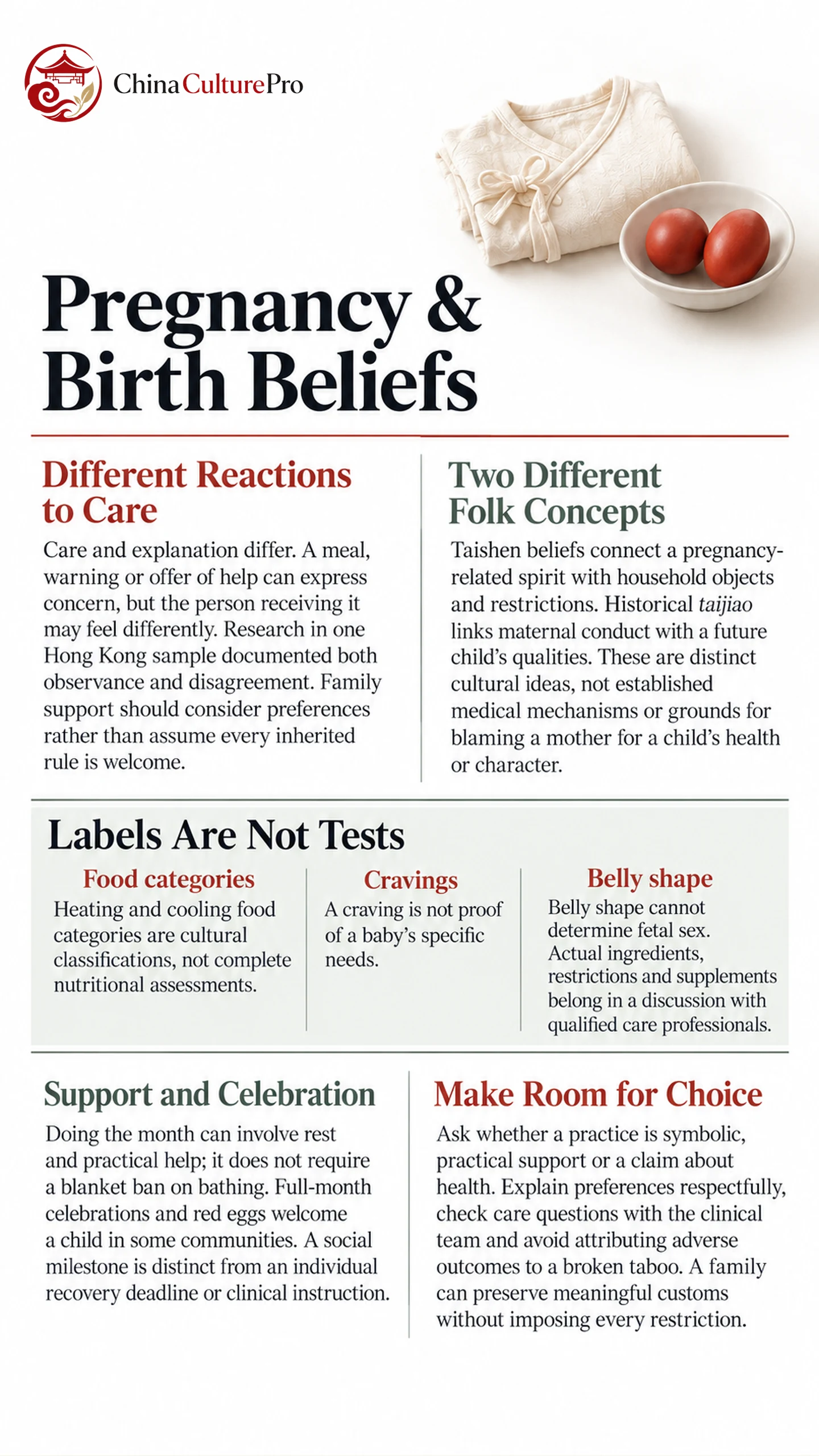
Pregnancy can draw an extended family into everyday decisions. A meal, a warning or an offer to take over household work may communicate affection, experience and concern. The same gesture can also feel intrusive if the pregnant person has not asked for it.
Research with pregnant women in Hong Kong documented both continuing observance of antenatal taboos and disagreements about them. The findings describe a particular clinical sample, not the attitude of all Chinese women. They nevertheless show why cultural understanding needs to include the person’s response, rather than listing restrictions as though everyone welcomes them. [1]
Within Chinese family traditions, support can be negotiated across generations. A grandmother’s experience may matter emotionally without becoming the only authority for present care. Equally, declining one restriction does not mean rejecting the family or its wish for a safe birth.
The distinction is practical: helping with shopping is an action; claiming that a household object controls fetal development is an explanation. The two should be assessed separately.
Taishen, Prenatal Influence and Household Taboos
Taishen(胎神,tāishén)is a pregnancy-related spirit in some folk traditions. Museum documentation from Taiwan describes beliefs that this presence may occupy parts of the home or its objects. Restrictions on moving furniture, using scissors or hammering nails can be connected to fears of disturbing it. These are descriptions of supernatural beliefs, not established mechanisms of fetal injury. [2]
A different concept is taijiao(胎教,tāijiào), often translated as prenatal education. A historical account in Biographies of Exemplary Women links a mother’s conduct, what she sees and what she hears with the future qualities of her child. Its purpose belongs to a moral and cultural account of exemplary motherhood, rather than a controlled test of child development. [3]
These ideas should not be merged into one theory. Taishen concerns a supernatural presence and household restrictions; historical taijiao concerns prenatal moral influence. Neither justifies blaming a woman for a child’s appearance, temperament or health.
When a family uses the word taijiao today, ask what activity it means. A personal routine, an inherited ideal and a commercial promise about a future child’s abilities are different claims. The label alone proves none of those promised outcomes.
Food Meanings and Predictions About the Baby
Food advice can mix preference, symbolism and claims about health. A relative may call a dish “heating” or “cooling”; such a classification should not be read automatically as its serving temperature or a complete nutritional assessment. The proposed food and its actual ingredients still matter; the cultural category does not decide whether it suits an individual pregnancy. [4]
Likewise, an interpretation of a craving should not be treated as a reliable test of the baby’s needs. Clinical guidance distinguishes cravings from a requirement to satisfy every desired food. Belly shape also does not establish fetal sex. [5]
| Belief or custom | What it can express | Essential boundary |
|---|---|---|
| Avoiding disturbance of taishen | A wish to protect the pregnancy | A supernatural explanation is not a medical mechanism |
| Historical taijiao | An ideal of maternal conduct and influence | A moral narrative does not establish a child-development outcome |
| Guessing from belly shape | Family curiosity about the baby | Abdominal shape is not a fetal-sex test |
| Sharing symbolic foods after birth | Welcome and congratulations | A celebratory meaning is not a health effect |
For a real dietary decision, discuss the actual restriction or product with the care team instead of relying on an inherited label. This includes supplements and herbal preparations: familiar use does not replace checking the particular ingredients and circumstances. [5]
After Birth: Recovery and Welcoming the Child
Zuo yuezi(坐月子,zuò yuèzi), often called “doing the month,” refers to a postpartum period associated with rest and support. Its practices vary, and its familiar name should not be turned into a universal recovery deadline. The history of postpartum confinement is a related subject with its own regional detail.
Practical help remains distinct from restrictive explanations. Family members can support a mother through meals, household tasks, infant care and attentive listening, while respecting her preferences. Care should address the mother’s needs as well as everyone’s excitement about the baby. [6]
A blanket ban on bathing or hair washing is not required by modern postnatal care. Hygiene and the individual’s recovery circumstances matter; instructions following a birth or procedure should come from the clinical team, rather than an all-purpose folk prohibition. [7]
Welcoming the child is another layer. Manyue(满月,mǎnyuè), the full-month milestone, may involve a gathering and gifts. In documented Singapore Chinese customs, red eggs help announce and celebrate a new baby. This is a community example, not a requirement that every family host a banquet on one exact day. [8]
The full-month celebration and broader Chinese baby traditions explain these social milestones in more detail.
Discussing Traditions Without Blame
Begin with a specific question: is this a symbolic gesture, a practical offer of help, or a claim about health? A family can preserve a congratulatory food or a meaningful gathering while asking a clinician about a proposed restriction.
Useful conversations leave room for choice. A parent might say, “We appreciate the wish to protect the baby; we will check the care question with our midwife.” Relatives can ask what help is wanted instead of assuming that more rules provide more reassurance.
Avoid using a broken taboo to explain an adverse outcome or demanding that a pregnant person appear cheerful at all times. Respectful support includes listening, reducing unwanted pressure and making it easier to ask for professional help. The aim is to understand a tradition and the person living with it, without turning either into a stereotype.
FAQs About Chinese Pregnancy and Birth Beliefs
Do all Chinese families follow the same pregnancy taboos?
No. Region, generation, religion and personal preference all affect which beliefs a family recognizes or follows.
Can belly shape predict the baby’s sex?
No. The shape of the abdomen is not a reliable way to determine fetal sex.
Is doing the month the same as avoiding all bathing?
No. Postpartum support and rest should be distinguished from a blanket prohibition on hygiene. Individual recovery instructions belong with the care team.
Must a family abandon every tradition to follow modern care?
No. Symbolic celebrations and practical support can coexist with evidence-based care. Health claims and restrictions need separate assessment.
出典
[1] Lee and colleagues, Midwifery. Antenatal taboos among Chinese women in Hong Kong
[2] National Museum of Taiwan History. Taishen in Taiwanese birth customs
[3] Liu Xiang, via Shidian Guji. Biographies of Exemplary Women: The Three Mothers of Zhou
[4] KK Women’s and Children’s Hospital, via HealthXchange. Confinement myths and facts
[5] HealthHub Singapore. Pregnancy myths
[6] Hong Kong Family Health Service. Needs of postnatal mothers
[7] Hong Kong Family Health Service. Postnatal care
[8] Singapore Federation of Chinese Clan Associations. Birth rituals and celebrations