

Quick Answer: What Is Middle Chinese?
Middle Chinese(中古漢語,Zhōnggǔ Hànyǔ)is a label used in studying medieval Chinese pronunciation, especially the evidence preserved in the Qieyun(切韻,Qièyùn)rhyme dictionary of 601 and its later tradition.[1]
- Evidence: Rhyme books and rhyme tables organize historical character readings.
- Analysis: Scholars use that evidence to identify sound categories and propose phonetic interpretations.
- Limit: A written category system is not a recording of one person’s everyday speech.
Keep the source and notation system with any Middle Chinese reading.[2]
A poem may stop rhyming when read in modern Mandarin, while a historical dictionary groups its final words together. Middle Chinese helps explain the evidence behind that difference. It also explains what unfamiliar transcription symbols can tell you about a historical reading.
The Medieval Reference Behind the Label
The Qieyun anchors the discussion because it arranged character readings into a literary rhyme framework. Its influence continued through later revisions and the requirements of literary composition. “Middle Chinese” is therefore especially useful when discussing historical phonology: the term tells you to investigate sound evidence, rather than simply read medieval characters with present-day pronunciation.[1]
The later Guangyun(廣韻,Guǎngyùn)belongs to this rhyme-book tradition. Rhyme tables add a different kind of organization, placing syllables in grids according to analytical categories. The sources served learned character reading; they were not originally designed as transcripts of ordinary conversation.[2]
Early and Late Middle Chinese distinguish historical targets. Do not automatically project a later table’s categories back onto the earliest rhyme-book period.[2] The guides to the Guangyun rhyme dictionary および Chinese rhyme tables explain those two reference formats separately.
How Sound Evidence Is Recovered
Fanqie(反切,fǎnqiè)indicates a reading through two other characters: one supplies the initial, while the other supplies the remainder of the syllable and its tone category. Linking many such spellings reveals shared initials and finals. It does not work by cutting up the modern Mandarin pronunciations of the spelling characters.[3]
The traditional categories are level(平聲,píngshēng), rising(上聲,shǎngshēng), departing(去聲,qùshēng)and entering(入聲,rùshēng). Entering syllables are the stop-final category, with -p, -t or -k endings in the analysis; the four labels are not four prescribed modern Mandarin pitch contours.[3]
Modern Chinese varieties and Chinese-derived readings in other languages help interpret the categories phonetically. Their different correspondences must be compared.[3]
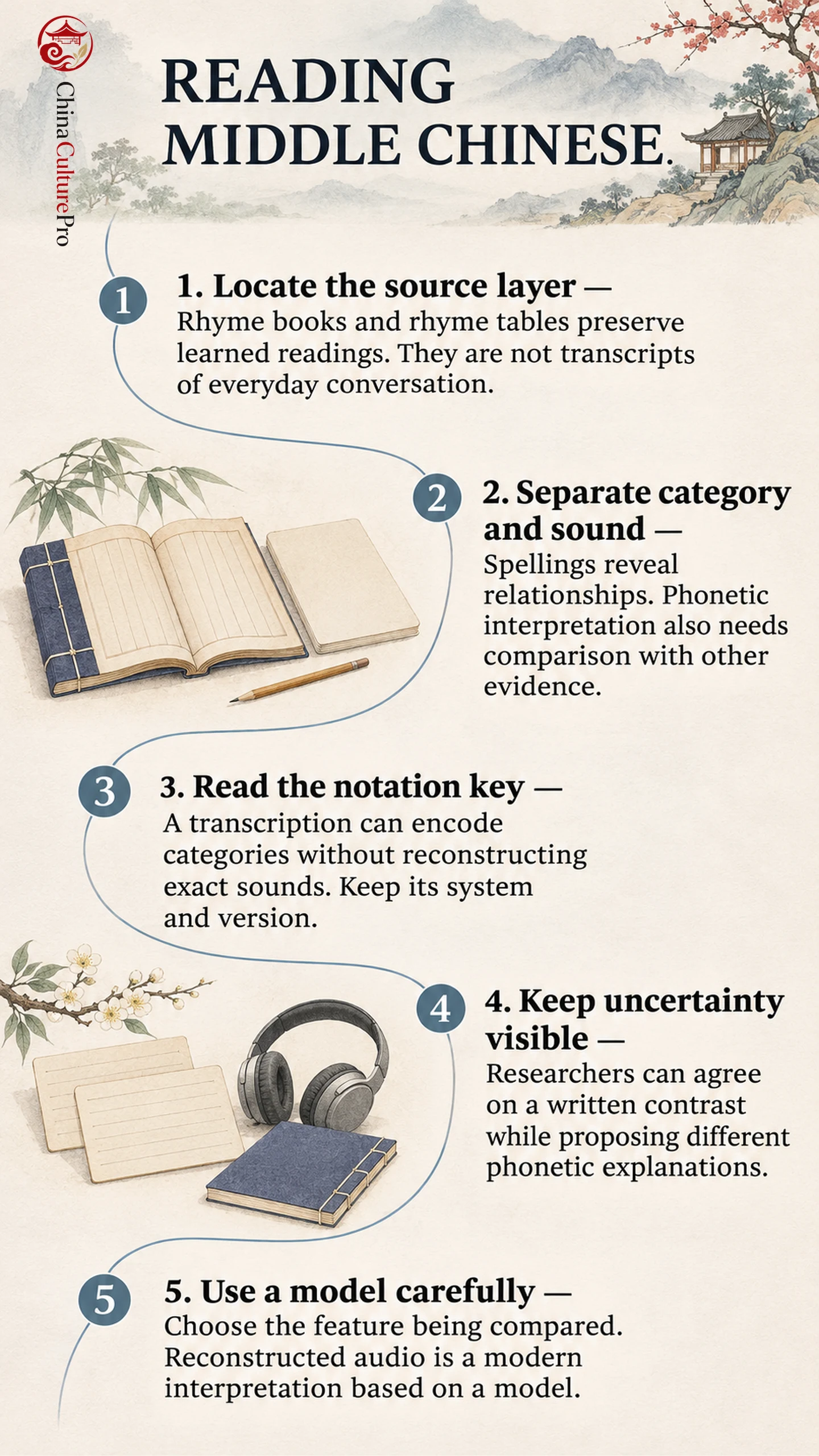
For a reference entry, separate two questions: which category does the source distinguish, and what sound value does the analysis assign to it? The first concerns the historical organization of the evidence; the second concerns its linguistic interpretation.
Reading a Transcription Without Treating It as Pinyin
The following examples use the Middle Chinese transcription in the Baxter–Sagart dataset, version 1.1, dated September 20, 2014. Its authors explicitly describe this notation as a representation of source information, rather than a phonetic reconstruction. Modern Mandarin readings below are identification aids.[4]
| Character and modern reading | Middle Chinese transcription | Category in this notation |
|---|---|---|
| 東 — dōng, “east” | tuwng | Level; no final X or H |
| 動 — dòng, “move” | duwngX | Rising; final X |
| 凍 — dòng, “freeze” | tuwngH | Departing; final H |
The capital X and H mark categories; they are not extra consonants to pronounce as English letters. Nor is tuwng a pinyin spelling. These rows select particular readings, not every reading a character may have.[4]
An Old Chinese(上古漢語,Shànggǔ Hànyǔ)column belongs to a different historical layer. Keep each form with its column, system and version, and retain its uncertainty marks.[4]
Why Reconstructions Differ
Identifying a rhyme-book contrast does not settle its phonetic explanation. One analysis of Qieyun rhymes argues that some distinctions preserve historical categories rather than different vowel-plus-ending combinations in a single contemporary sound system. That argument changes how many vowel distinctions an interpretation needs. It also shows why a dictionary’s category count cannot simply be treated as an inventory of sounds used by one speaker.[5]
Specific sound values remain debated too. A 2026 proposal interprets Division II through pharyngealized vowel qualities, while discussing earlier proposals involving different kinds of segments or features. This is a particular reconstruction argument, not a new official pronunciation standard.[6]
When two reference works print different forms, first check what each form represents. One may encode category membership while another proposes phonetic values. If both are reconstructions, compare their evidence and intended historical layer. Preserve the disagreement when a source does not resolve it.
Using Middle Chinese for Poetry and Language Comparison
Historical tone categories help explain verse patterns. A poem’s rhyme or metrical requirement is evidence to investigate, not an instruction to change modern pronunciation at random.[3] The guide to Chinese tones provides a separate introduction to the modern Mandarin system.
Compare a specific initial, final or tone category. Modern reflexes show mergers, splits and changed values; preserving one distinction does not establish an unchanged medieval system.[2]
Before using an online reading, save the character, the selected sense or reading, the notation system and its version. For reconstructed audio, also identify the model used by the performer. Listen as an interpretation based on that model. A recording can make a proposal easier to hear without proving that every medieval speaker sounded like its performer.
FAQs About Middle Chinese
Was Middle Chinese a single spoken language?
Do not assume that the complete rhyme-book framework represents one uniform everyday variety. Its relationship to actual speech requires historical analysis.
Is Middle Chinese the same as Classical Chinese?
No. Here Middle Chinese concerns historical pronunciation. Interpreting a Classical Chinese(文言文,Wényánwén)text’s grammar and meaning is a separate task.
Is Cantonese unchanged Middle Chinese?
No. A modern variety’s preservation of particular features does not make its whole sound system an unchanged medieval language.
Can I listen to a Middle Chinese reconstruction?
Yes. Identify the reconstruction model and performer; the result is a modern interpretation of historical evidence.
出典
[1] Zhongwei Shen. Middle Chinese: The Qieyun, chapter summary
[2] Guillaume Jacques. Traditional Chinese Phonology
[3] Guillaume Jacques. Introduction to Chinese Historical Phonology
[4] William H. Baxter and Laurent Sagart. Old Chinese reconstruction dataset, version 1.1: Middle Chinese column and notation
[5] Zhongwei Shen. Understanding the Qieyun Rhymes: abstract and introduction
[6] Tianheng Wang and Xun Gong. Reconstructing Pharyngealized Vowels for Qieyun Division II in Middle Chinese