
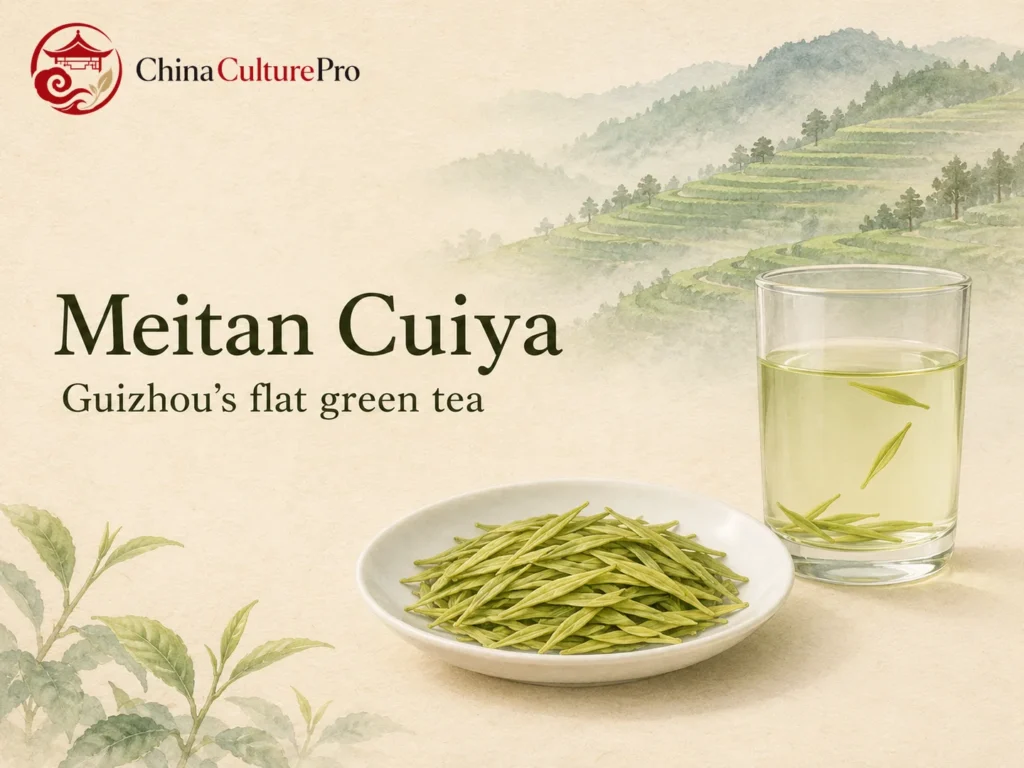

Quick Answer: What Is Meitan Cuiya Tea?
Meitan Cuiya(湄潭翠芽,méitán cuìyá)is a flat green tea associated with Meitan County in Guizhou, southwest China.[1]
- 外観: Straight, flattened leaves with a yellow-green sheen.
- Cup: Fresh aroma, refreshing taste and a light green infusion.[1]
- Preparation: A glass lets you observe the leaves while drinking and refilling.[5]
The tea’s shape identifies a finished style; it does not mean every packet comes from one cultivar or contains buds alone.

Flat leaf shape, harvest details and the brewing method each explain a different part of this Guizhou tea.
Meitan Origins and a Modern Tea Tradition
Meitan’s modern tea story includes an experimental tea farm established in 1939 and Zhejiang University’s wartime relocation there in 1940. Local tea makers adapted Longjing(龙井,lóngjǐng)craft to local leaves, developing a flat tea that evolved into today’s Meitan Cuiya.[2]
That processing connection does not make the teas identical. Older records of regional tea growing also do not establish an ancient origin for the modern named product.
How Meitan Cuiya Gets Its Flat Shape
The main operations include spreading fresh leaves, shaqing(杀青,shāqīng)or heat fixation, straightening, shaping, removing loose hairs, aroma finishing and screening. Buds and newly opened bud-and-leaf shoots can be used. Processing produces the finished flat shape.[1]
A dedicated recommended local processing standard, DB5203/T 44-2025, took effect in July 2025. The existence of a standard does not establish that every batch is handmade.[4] One documented commercial lot, for example, specifically describes hand picking and manual processing; that is information about the lot, not proof of a universal rule.[5]
What Meitan Cuiya Tastes Like
Freshness is the broad sensory theme. A spring single-bud example is described as delicate with a sweet, lingering finish, while a separate March 2022 lot reports herbal and green-bean notes.[1][5][6] Such tasting language compares sensations; it does not mean herbs or beans have been added.
Season and handling also matter. Research on summer Meitan Cuiya found that changing how long fresh leaves were spread before further processing affected bitterness, astringency and aroma. The findings concern the studied summer material, rather than a guarantee that every spring or summer batch tastes one particular way.[3]
How to Brew Meitan Cuiya in a Glass
For a complete glass-brewing example, one spring single-bud lot gives the following method:[5]
- Measure 3 g of tea into a heat-safe transparent glass.
- Add 300 ml of water at 80°C and steep for 4 minutes.
- Drink, leaving roughly one-third of the infusion in the glass, then refill with water at the same temperature.[5]
A separate general cup-brewing guide uses a stronger ratio of 3 g to 150–180 ml at about 80°C, wetting the leaves first and topping up when one-third remains. It gives no fixed initial steeping time.[1] Keep the two methods separate; adding the four-minute timing to the stronger ratio would create a different preparation.
When adjusting the cup, change one variable at a time. Keeping the water used for Chinese tea consistent makes differences in leaf quantity and infusion time easier to judge.
Choosing a Meitan Cuiya Batch
Check the harvest date, actual production place, picking description and processing information. Read origin labels rather than assuming a familiar product name answers every question about provenance.
Read any spring harvest timing claim alongside the harvest year. Ask whether a “single-bud” or “handmade” description applies to the actual batch you are buying. A clean description of the lot is more useful than an unexplained premium label.
FAQs About Meitan Cuiya Tea
Is Meitan Cuiya the Same as Longjing?
No. Both can be flat green teas, and their modern processing histories are connected, but Meitan Cuiya has its own Guizhou identity.[2]
Is Meitan Cuiya Always Made Only from Buds?
No. Picking can include a bud with a newly opened leaf. A seller’s single-bud description needs to be read as a claim about that particular lot.[1][5]
Can You Refill the Glass?
Yes. Leave some infusion in the glass and add more hot water. The example above refills when roughly one-third remains; flavor will change with successive top-ups.[5]
出典
[1] Agriculture Daily International / Ministry of Agriculture and Rural Affairs. 云贵小江南,湄潭出翠芽
[2] Guizhou CPPCC News. 贵州到底哪里的茶最好喝?
[3] Yihe Jiang and colleagues. Shorten spreading duration enhance the quality of summer Meitan Cuiya tea
[4] National Public Service Platform for Standards Information. 湄潭翠芽茶 加工技术规程: DB5203/T 44-2025
[5] Teasenz. Guizhou Emerald Tips – Mei Tan Cui Ya, Green Tea Buds
[6] Sazen Tea. Mei Tan Cui Ya