

Quick Answer: What Is a Manchu Dianzi?
A dianzi (钿子, diànzi) is a Manchu women’s headdress worn over a hair bun. Its shaped foundation supports groups of decorative fittings known as dianhua (钿花, diànhuā). Museum pieces preserve frames of wire or rattan and ornaments made with pearls, metalwork and other materials.[1][2][6]
- Half style: A bandian (半钿, bàndiàn) leaves more of the dark base visible between ornaments.[5]
- Full style: A mandian (满钿, mǎndiàn) carries a fuller arrangement. A surviving example has repeating double-happiness characters.[3]
- Phoenix style: A fengdian (凤钿, fèngdiàn) uses phoenix figures. One court example has birds with dangling strings of beads.[4]
Compare the foundation and the distribution of fittings before assigning a particular style or occasion.

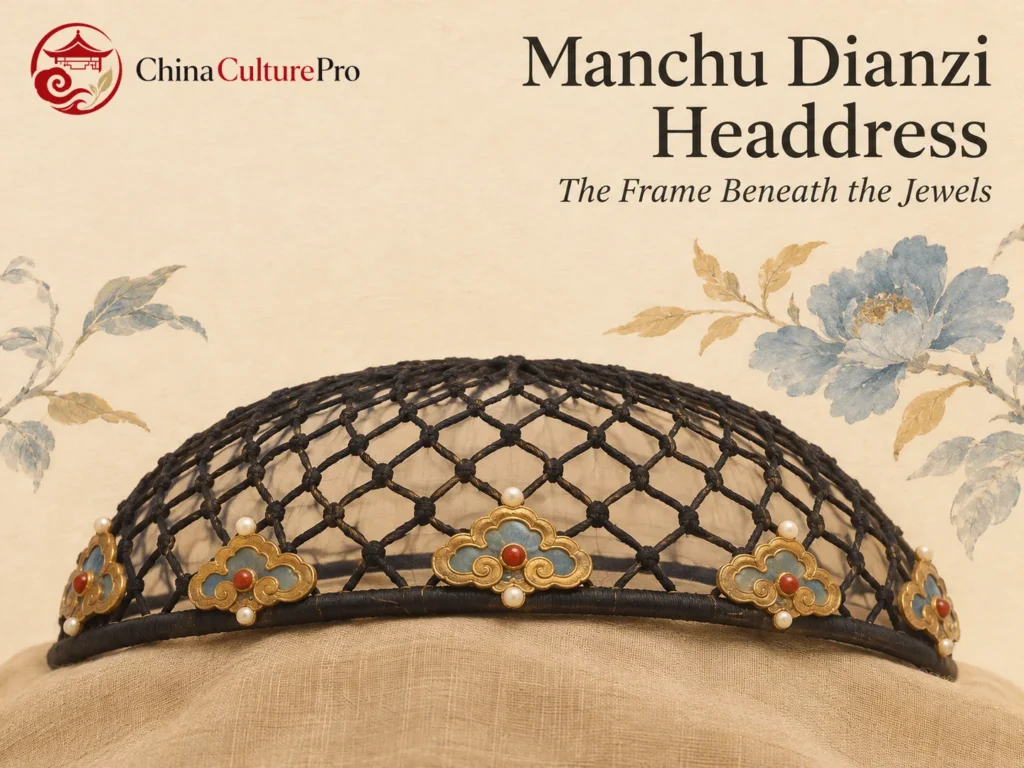
The easiest detail to miss on a richly decorated dianzi is the dark frame beneath the ornaments. A side view or a photograph of the inside can show how the headpiece sits over the hair and how the decoration is supported. Start with the frame’s silhouette, then look at the spacing and materials of the ornaments.
The Frame and the Ornaments
One Qing palace example has an inverted-bowl-shaped foundation made of iron wire wrapped in black velvet. Its surface carries groups of colored stones, coral and pearls supported by gilt metal. Another court example has rattan strips wrapped and tied with silk thread to form a netlike frame. The wire or rattan holds the shape. The textile covers or binds the frame, and the metal fittings carry the ornament.[2][4]
The Palace Museum describes the dianhua on a documented half-style piece as detachable. One motif combines seed pearls in the shape of an endless knot with a longevity character made of red coral beads. Removing or replacing a fitting changes the pattern you see without replacing the whole headpiece.[1]
Blue decoration on some examples comes from diancui (点翠, diǎncuì), a craft that uses kingfisher feathers on a shaped metal ground. A jewel may sit above the blue field, so one ornament can combine several materials in layers.[2][5]
Half, Full and Phoenix Forms
The half style can leave enough of the foundation visible to see how the ornaments are spaced. A Taipei catalog describes a common arrangement with ornaments at the top and forehead and elongated fittings along the sides. The Beijing half-style piece with coral and seed pearls is cataloged for less formal wear.[1][5]
The double-happiness full-style piece in Taipei has ornament arranged in rows and groups. The front uses plaques with coral characters and pearl details. A short fringe hangs over the forehead. The full arrangement is recognizable by the closely spaced decoration across the front and top.[3]
On a Guangxu-period phoenix example in Beijing, metal birds at the front and rear hold strings of pearls and stones. The museum identifies it with an empress’s auspicious dress. Use that association for this piece and compare the rest of a costume before assigning the same use to another headdress.[4]
When Qing Women Wore the Dianzi
Manchu women of different positions wore dianzi in the Qing dynasty. A dress study distinguishes ordinary uses from a late Qing practice of pairing a dianzi with jifu (吉服, jífú), auspicious attire, in place of the corresponding crown. Photographs of late Qing court women document some of those pairings.[5][6]
A photograph can establish that someone wore a particular combination. A dated caption or a record of the sitting helps establish the occasion. Compare the date, the sitter and the dress category in the record before reading the same combination into all periods. The guide to Qing court robes and informal robes explains why the clothing layers help with that distinction.
The liangbatou (两把头, liǎngbǎtóu) is a hair arrangement extending out to either side. Later enlarged headdresses could use fabric over a shaped base. Look for the dianzi’s cap-like frame over the bun before identifying a Manchu headpiece from the front alone.[1][6]
How to Read or Wear a Modern Interpretation
For a reproduction, request a side view and an inside view. Check where the frame rests over the bun or wig, how it is secured and whether the decorative fittings can move. Try the piece with its intended hairstyle and see whether it tips forward when you turn your head or sit.
A contemporary maker can use a blue textile or another clearly labeled substitute for the appearance of feather work. If you are comparing it with a historical object, note the substitute and which part of the museum piece inspired the design. Look at examples of fengguan (凤冠, fèngguān) as well if you are identifying a bridal crown with phoenixes. A shared motif tells you less about construction than a view of the base and the way it fits over the hair.
FAQs About the Manchu Dianzi
Is the dianzi a hairstyle?
It is a separate framed headpiece worn over arranged hair. Cataloged examples preserve wire or rattan foundations.[4][6]
Did all dianzi have kingfisher feathers?
Materials and ornament varied. The blue fields on certain examples are documented as feather work. Check the catalog for the particular piece before identifying a blue detail.[2][5]
Is a phoenix dianzi the same as a fengguan?
A phoenix dianzi is a named type of Qing Manchu dianzi. A phoenix motif can appear on other crowns, so the name, construction and period are all useful when identifying a piece.[4]
出典
[1] Palace Museum, Beijing. Dianzi With Seed Pearls and Coral
[2] Palace Museum, Beijing. Dianzi With Kingfisher Feather Work
[3] National Palace Museum, Taipei. Double-Happiness Dianzi
[4] Palace Museum, Beijing. Phoenix Dianzi With Pearls and Stones
[5] National Palace Museum, Taipei. Dianzi With Jewel and Pearl Inlay
[6] Palace Museum Journal. A Study of Empress Dowager Cixi’s Dress