

Quick Answer: Who Are the Jino?
The Jino people(基诺族,Jīnuòzú)are an officially recognized ethnic group whose main community area is in Xishuangbanna, Yunnan. Their cultural life includes local speech, oral narratives, farming knowledge, tea work, textile skills and seasonal gatherings.[1]
Tea and drum traditions are useful entry points, but neither describes every person’s occupation or beliefs. Understanding Jino culture means connecting a story with its teller, a tea practice with its place, and a performance with its occasion. Historical records, creation stories and modern public celebrations answer different questions about the community.
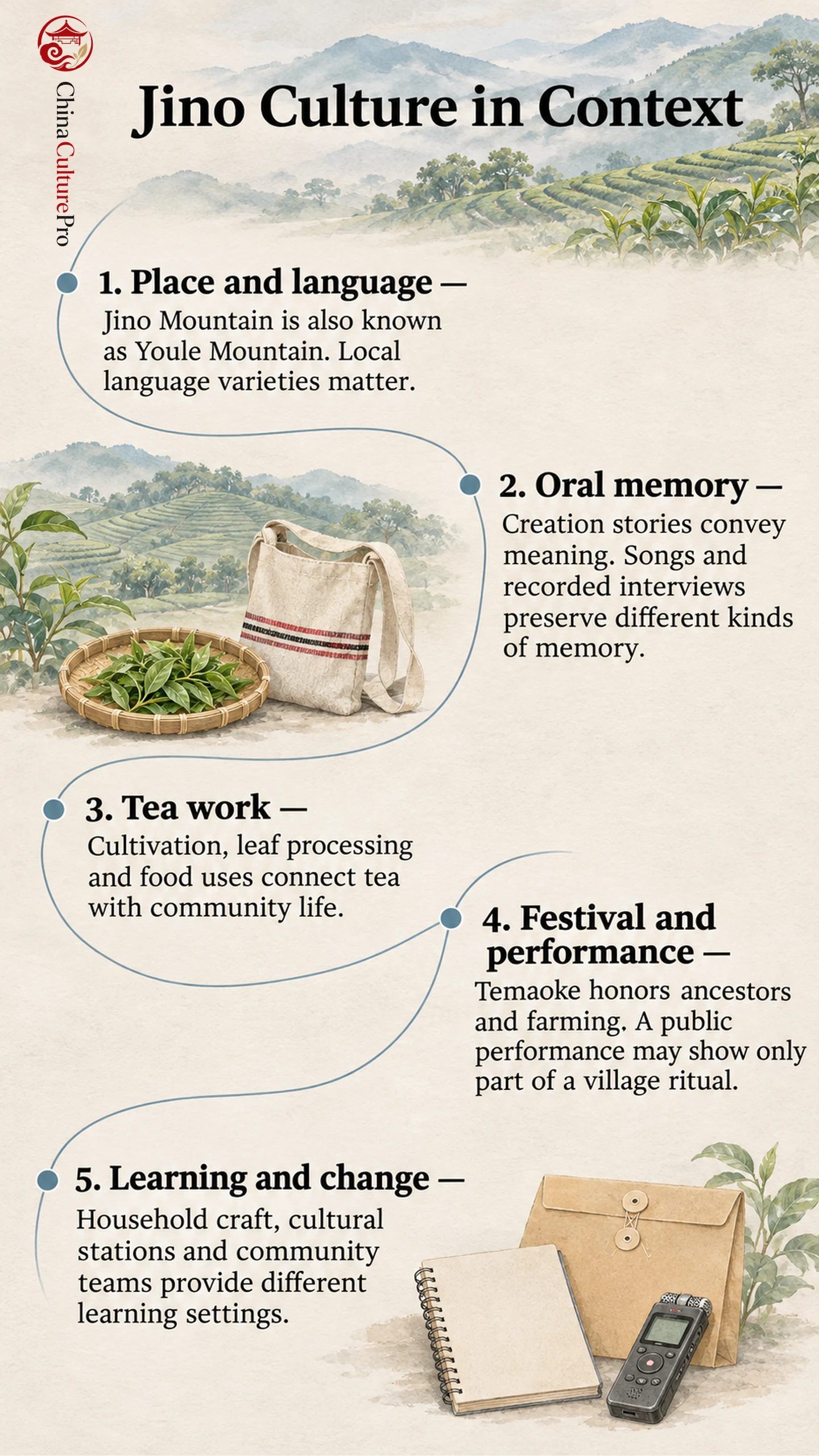
Tea leaves, a remembered song and a woven shoulder bag can each carry knowledge learned through participation. On the hills around Jinghong, these skills connect household work with a wider community history. This guide follows those connections, keeping the meanings of oral tradition, tea production and shared celebration distinct.
Jino Mountain, Community Names and Language
Jino Mountain(基诺山,Jīnuòshān)is the principal community setting, with nearby Jino settlements around Jinghong and smaller communities in parts of Mengla County. Youle Mountain(攸乐山,Yōulèshān)is an older Chinese name for the same mountain area, familiar in tea history. The group received formal recognition in 1979; that administrative date does not mark the beginning of its people or culture.[1]
The Jino language(基诺语,Jīnuòyǔ)belongs to the Sino-Tibetan family and is usually discussed within Tibeto-Burman. It has its own linguistic features rather than being a dialect of Mandarin.[1]
Language-resource work distinguishes the Youle and Buyuan varieties, with survey sites for both in Jinghong. These local distinctions matter when identifying a recording or translating a song. A research note describing one variety should name it instead of silently treating its forms as universal.[2]
The regional context is Yunnan’s diverse cultural landscape, where neighboring peoples and trading relationships form part of community history without erasing local identity.
Stories, Songs and Oral Memory
Oral tradition involves a voice, an audience and an occasion. In the tradition associated with the Large Drum Dance(基诺大鼓舞,Jīnuò Dàgǔwǔ), the creator goddess Amo Yaobai(阿嫫腰白,Āmó Yāobái)is remembered as saving people through a great drum. This is a creation and rescue story explaining the drum’s importance, rather than a verifiable account of a prehistoric event. Dance lyrics also convey history, moral ideas and customary knowledge.[3]
Recording adds a further layer. At a national oral-tradition archive event on January 25, 2024, Jino participants joined tradition bearers from several other Yunnan communities. The program included performances, oral-history interview demonstrations and audiovisual material from fieldwork.[4]
| Form of transmission | What it carries | How to read or listen to it |
|---|---|---|
| Creation narrative | An explanation of origins and the drum’s significance | Identify it as a traditional narrative and retain the teller’s context.[3] |
| Dance verses | Historical memory, moral ideas and customary knowledge within performance | Keep the words connected with their musical and ceremonial setting.[3] |
| Recorded oral history | A speaker’s remembered experience preserved through an interview | Retain the speaker, recording date and interview context.[4] |
A written translation can preserve words without reproducing every feature of delivery or audience response. When comparing folk tales and oral narratives, identify the recorded version rather than assuming one transcript contains every community’s telling.
Tea Work on Youle Mountain
Tea is both an agricultural livelihood and a body of practical knowledge. A study of Youle Village’s tea gardens describes leaf picking, spreading, heat treatment, rolling and sun drying. Its sun-dried green tea(晒青茶,shàiqīng chá)may be kept as loose material or subsequently processed into compressed forms. These are different stages between a fresh leaf and a finished product.[5]
Garden work and leaf processing require different skills. The Youle Village case connects the care of established tea gardens with the handling of harvested leaves, allowing cultivation and manufacture to be understood as related stages.[5]
Tea can also be eaten. Liangban cha(凉拌茶,liángbàn chá)is a seasoned fresh-leaf preparation, distinct from steeping dried tea for a drink. A tea-culture gathering on August 1, 2026 included a demonstration of this local practice as well as musical presentations and discussion of tea-garden care.[6]
These uses connect cultivation with preparation, exchange and public cultural expression. For the broader processing distinctions behind raw and ripe Pu-erh tea, the relevant question is how a product was made; the community name or mountain name alone cannot supply the full answer.
Temaoke and the Large Drum Dance
Temaoke(特懋克节,Tèmàokè Jié)is an early-spring festival associated with honoring ancestors, ironworking and preparations for cultivation. Its national heritage description identifies three central themes: the great drum, the blacksmith and the coming agricultural cycle. The festival entered China’s national intangible heritage list in 2021, under project Ⅹ-165.[7]
Its timing has changed. Earlier village elders selected dates with reference to seasonal signs, and villages celebrated in succession. Modern public celebrations commonly use February 6–8, while village observances can follow their own arrangements. A 2022 field study distinguishes the organized township event from gatherings within individual villages, rather than treating every activity as one fixed program.[7][8]
The Large Drum Dance has a separate national listing, dating to 2006, under project Ⅲ-38. Its traditional setting gives the drum a ceremonial role; it is more than an object used to keep a beat.[3]
A public demonstration can show movements and music while leaving out parts of a village ritual. To describe it accurately, identify whether the event is a community observance, a festival presentation or a selected performance. The distinction preserves its purpose without assuming that a short stage appearance reproduces an entire ceremonial sequence.
Household Skills and Changing Ways of Learning
Household craft provides another route into community knowledge. Historical descriptions record backstrap weaving, in which tension is maintained between the weaver’s body and an anchored end of the warp. They also describe bamboo used for baskets, containers and other domestic objects. These accounts identify learned material skills; they should not be turned into a claim that every woman weaves or every man makes bamboo objects today.[9]
Food accounts likewise connect rice with the working day, including rice carried to fields wrapped in leaves and rice prepared in bamboo. These examples show how available materials and work settings shape household practice, rather than providing one menu for every home.[9]
Change can occur within performance traditions too. He Guiying(何桂英,Hé Guìyīng)began training through a local cultural station in the 1980s and later helped form a women’s drum-dance team in Baduo Village. A 2022 study uses her experience to show women taking part in a practice earlier associated with male performers.[8]
Her experience places living cultural heritage in a particular learning history: cultural-station training, a named village and a women’s team. It shows how the people carrying a tradition can change alongside its presentation.
FAQs About Jino Culture
Were the Jino people first created as a group in 1979?
No. That year marks formal official recognition. Their communities, language and traditions existed before the administrative decision.
Is Jino a dialect of Chinese?
No. It is a distinct Sino-Tibetan language with local varieties. Sharing a broad language family with Chinese does not make it a Mandarin dialect.
Is a Jino origin story the same as documented history?
No. Origin narratives convey cultural memory and meaning. A claim about a dated historical event needs its own documentary or other historical evidence.
Is every public drum performance a complete village ritual?
No. A public presentation may select music or movements. Its setting and purpose need to be identified before calling it a complete ritual.
出典
[1] National Ethnic Affairs Commission. Jino Overview
[2] Minzu University National Language Resources Monitoring and Research Center. Jino Language Use, Development and Protection
[3] China Intangible Cultural Heritage Network. Jino Large Drum Dance
[4] Yunnan Intangible Cultural Heritage Protection Center. National Oral-Tradition Archive Launch and Yunnan Pilot Presentations
[5] Global Change Research Data Publishing and Repository. Jino Youle Tea Tropical Mountain Ancient Tea Garden Case
[6] Dai Zhenhua, Yunnan Daily. Youle Tribute Tea Culture Exchange on Jino Mountain
[7] China Intangible Cultural Heritage Network. Temaoke Festival
[8] He Diandian. Changing Forms and Continuing Ideas: Research on Jino Temaoke Transmission
[9] National Ethnic Affairs Commission. Jino Customs