


Quick Answer: What Is Hunan’s Diaojiaolou Tradition?
A Hunan diaojiaolou (吊脚楼, diàojiǎolóu) is a dwelling with a raised timber section. In the hills of Xiangxi (湘西, Xiāngxī), a Tujia (土家族, Tǔjiāzú) house can have a main building on level ground and a side wing on posts.[2][3]
- Terrain: The posts make room for an upper floor where the ground drops away.[2]
- Household: The main hall accommodates guests and family rituals. The open space below a raised wing can shelter animals or firewood.[2]
- Craft: In 2011, China listed the traditional Tujia building craft documented in Yongshun (永顺, Yǒngshùn) County as national intangible heritage.[1]
The same term is used for other kinds of Chinese stilt houses. The examples here come from western Hunan. The Miao stilt-house tradition has its own regional examples.
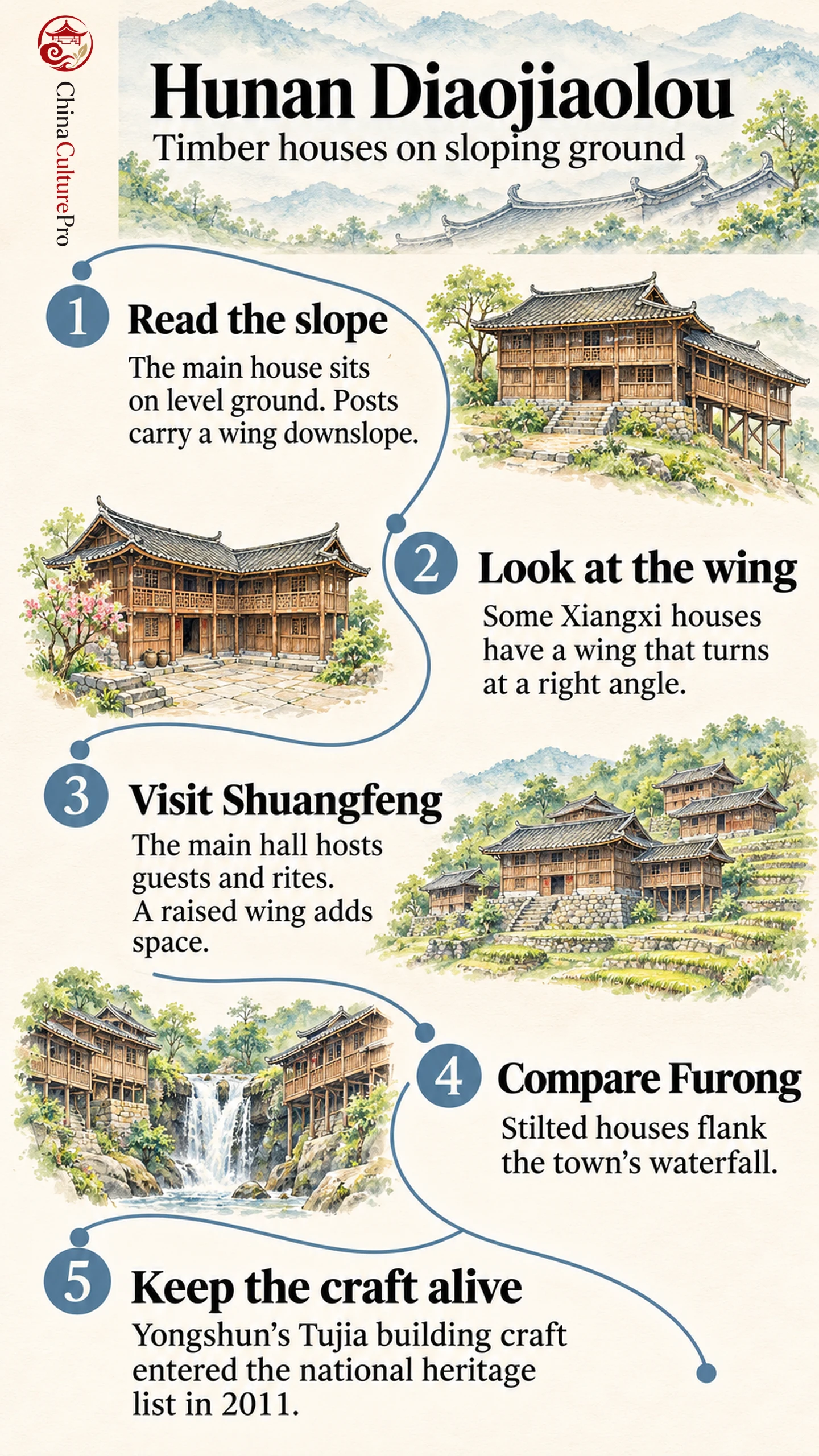
From the uphill lane, a house may seem to sit at ground level. The downhill view reveals the posts below its wing. This difference in viewpoint explains why rows of houses can look low from one side and tall from another.[2][3]
How Houses Fit the Slopes of Western Hunan
Xiangxi researchers studying courtyard geometry documented wings alongside the main building, wings turning a corner, and two wings facing into a court. In the L-shaped arrangement, one wing projects at a right angle to the main house.[3]
Look at where the posts meet the ground and where the wing joins the main building. A raised wing can extend the dwelling without widening the level ground beneath the main building. For details on the frame, see Tujia stilt-house structure.
Shuangfeng and Furong in Two Settings
A documented house layout in Shuangfeng (双凤, Shuāngfèng) places an ancestral shrine opposite the entrance to the main hall. The family receives guests and holds rites there. Cooking happens in side rooms.[2] The shrine is one way to see how room use expresses Tujia family life.
In Furong (芙蓉镇, Fúróng Zhèn), stilted buildings flank the waterfall. They are especially visible from across the water, where the slope and timber supports can be seen together. Recent tourism coverage highlights the waterfall and building fronts. The photos offer a view of the townscape, and a house’s date or former uses require evidence about the individual building.[4][7]
Carpentry as Living Heritage
The national inventory records the local name zhuanjiaolou (转角楼, zhuǎnjiǎolóu), or corner-wing building, for Yongshun’s Tujia tradition. It identifies a loss of practitioners as modern construction replaces traditional buildings. A 2019 heritage event in Furong exhibited models of the houses and brought visitors into contact with craft demonstrators.[1][5]
FAQs About Hunan Diaojiaolou
Does the Whole House Stand on Stilts?
In one common Xiangxi arrangement, the raised part is a side wing connected to a ground-supported main house. Layouts with two raised wings also occur.[2][3]
Are All Hunan Diaojiaolou Tujia Houses?
The term spans several local traditions. A UNESCO volunteer report documents Dong dwellings called diaojiaolou in Hunan’s Tongdao County.[6]
What Did the 2011 Heritage Listing Recognize?
It recognized the traditional craft of building Tujia diaojiaolou documented in Yongshun County.[1]
出典
[1] China Intangible Cultural Heritage Network. Tujia Diaojiaolou Construction Techniques
[2] Hunan Provincial Government. Tujia Stilt-House Village in Central China, a Home Grown from the Slopes
[3] Buildings. Courtyard Geometry and Lighting in Traditional Tujia Houses in Western Hunan
[4] Hunan Provincial Government. A Road Trip to Xiangxi’s Ancient Villages, Towns, and Cities
[5] Hunan Department of Culture and Tourism. Furong Town’s Dragon Boat Festival Heritage Demonstrations
[6] UNESCO World Heritage Centre. World Heritage Volunteers 2015
[7] Hunan Provincial Government. Furong Town Goes Viral on Overseas Social Media Platforms