

Quick Answer: What Is Huayin Laoqiang?
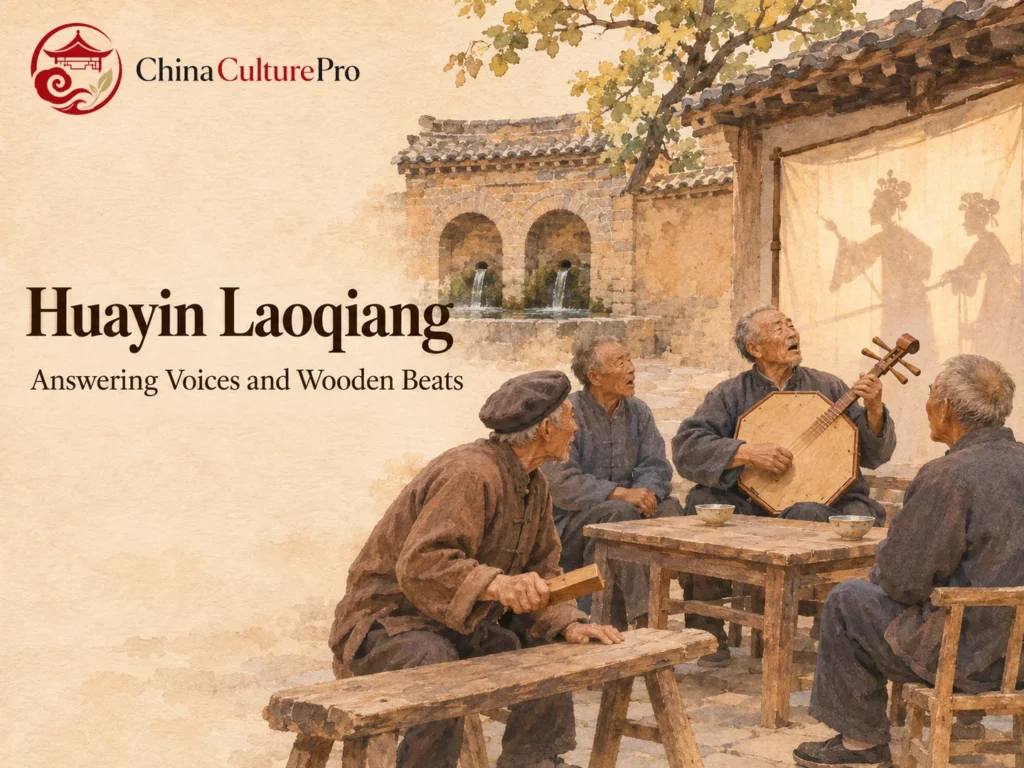
Huayin Laoqiang (华阴老腔, Huàyīn Lǎoqiāng) is a vocal and shadow-theater tradition from Huayin in 陝西. A lead singer can draw out a line before the others join in, with strings and percussion supporting the voices.[1][2][4]
- Place: The tradition is closely associated with a village in Huayin.[1][4]
- Sound: A single voice can give way to a strong group answer.[2][5]
- Stage: The performers can work behind a shadow screen or sing in view of the audience.[4][5]
Listen for the moment when the other voices come in. That cue is audible in both shadow-play and visible-stage settings.

A block striking a bench can mark a moment as sharply as a drum. When the musicians sit in view, the audience can see who makes that sound and watch the other performers answer it.
How the Sound Works Behind a Screen
The form is associated with Shuangquan (双泉, Shuāngquán), where it circulated as a family and village practice. The local shadow theater developed around the Ming to Qing transition, drawing on storytelling and older work-song material.[1][2][4]
In shadow puppetry, the audience sees the figures against a lit screen while the performers work behind it. One lead singer can voice different characters. A singer can use a rougher voice for a boisterous role and a softer voice for a female character.[1][5]
What the Voices and Wood Percussion Do
In the response called labo (拉波, lābō), the other voices join the lead to draw out the end of a line. Regional descriptions connect that kind of response with boat workers’ calls. The added voices make the end of the phrase a distinct part of what the audience hears.[1][2]
The ensemble can use a plucked yueqin (月琴, yuèqín), along with wooden percussion, drums and gongs. In visible-stage performances, a wooden block struck against a bench can give the accent a pronounced dry sound. A viewer can see the strike at the same moment the accent sounds.[4][5]
How the Performers Came Into View
Zhang Ximin (张喜民, Zhāng Xǐmín) learned the form in Shuangquan and established his own troupe in 1980. A 2006 stage adaptation of White Deer Plain (白鹿原, Báilù Yuán) used Laoqiang as part of its storytelling.[3][4]
Zhang’s group performed with singer Tan Weiwei (谭维维, Tán Wéiwéi) at the 2016 CCTV Spring Festival Gala. An earlier version of the collaboration appeared on the television competition China Star. The arrangement paired the group response and percussion with a rock-influenced song.[4][6]
What to Compare in Two Performances
At a 2026 presentation in Shuangquan, puppeteers performed an excerpt from Three Heroes Face Lü Bu (三英战吕布, Sān Yīng Zhàn Lǚ Bù). One singer voiced the roles as puppeteers worked the figures. Listen for the shift in tone between the characters.[5]
The Shuangquan musicians also performed A Command Shakes the Mountains (将令一声震山川, Jiànglìng Yī Shēng Zhèn Shānchuān) in view of the audience. Watch when the block strikes the bench and listen for where the group enters.[5]
FAQs About Huayin Laoqiang
Why is Huayin Laoqiang sometimes compared to rock?
The strong group sound and emphatic rhythm have led to comparisons with rock. A collaboration with Tan Weiwei put the tradition in direct contact with a rock arrangement.[4][6]
Does a Laoqiang performance always use puppets?
Performers can also present the music directly to an audience. The shadow-theater tradition and visible concert performances both continue to provide settings for the sound.[1][4][5]
出典
[1] China Intangible Cultural Heritage Network. Huayin Laoqiang Shadow Play
[2] China Intangible Cultural Heritage Network. Chinese Shadow Play Heritage Entries
[3] China Intangible Cultural Heritage Network. Zhang Ximin
[4] 中国無形文化遺産ネットワーク. Shaanxi Heritage Stories
[5] China National Radio. Huayin Laoqiang Behind and in Front of the Screen
[6] Ethnomusicology Review. Rocking the Tradition or Traditionalizing Rock?