

Quick Answer: What Is Yang Opera?
Yang opera (扬剧, Yángjù) is a form of 中国伝統演劇 associated with Yangzhou (扬州, Yángzhōu) in Jiangsu. Its stage music brings together local song, festival theater and melodies from short song-and-dance plays.[1][2]
- Place: Yangzhou, Zhenjiang and other cities supported the form.[1][2]
- Sound: Named melodies carry traces of its different musical sources.[1][2]
- First viewing: A play about a family matriarch gives you a larger work to start with.[3][4]
Listen to the music and check the genre credit when comparing the matriarch’s story across productions.
A regional style that grew from short song-and-dance pieces can also put an entire family story onstage. The sound of a sung line helps tie these different scales of performance together.
How Two Troupe Traditions Met in Shanghai
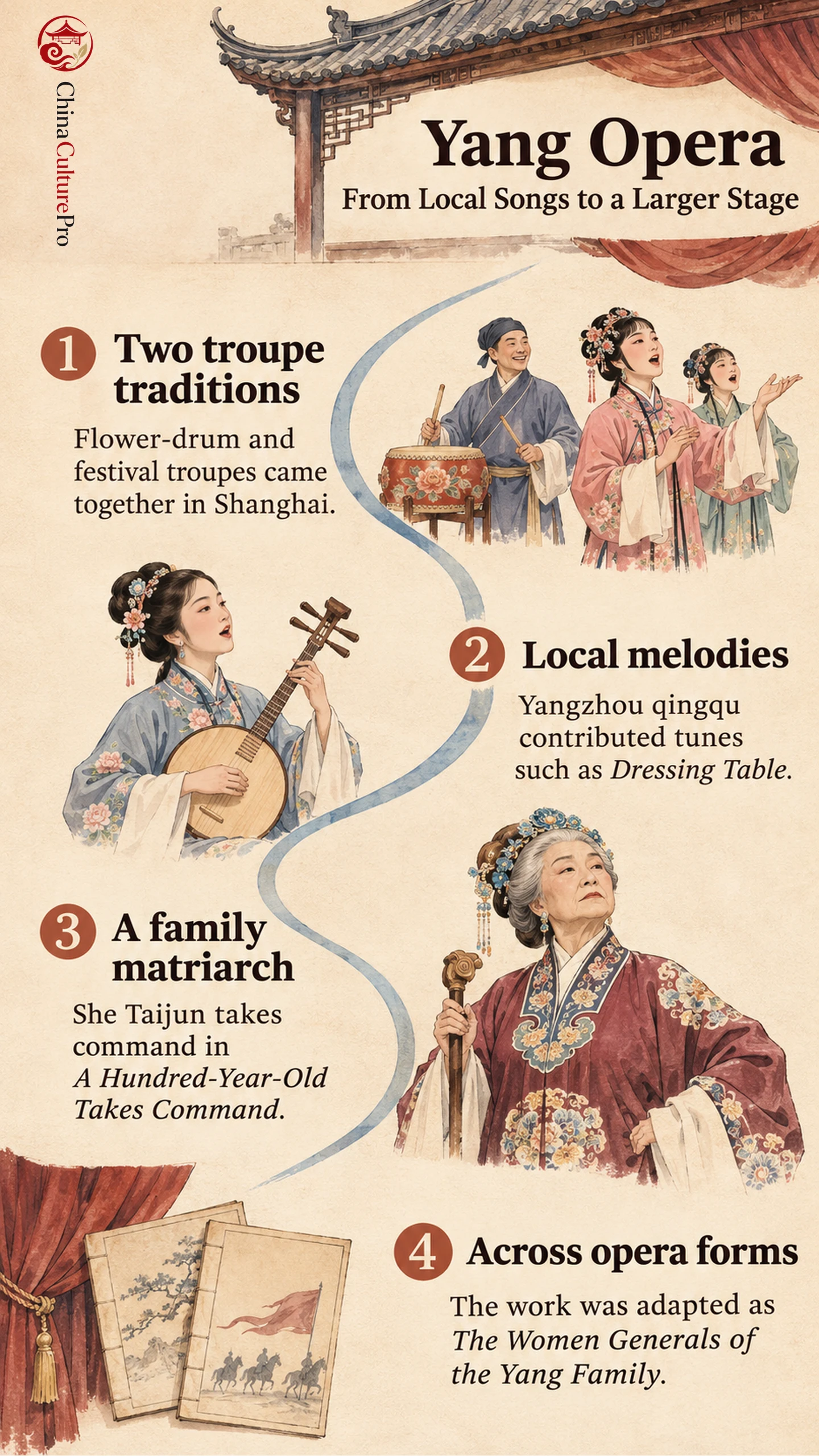
One predecessor was huaguxi (花鼓戏, huāgǔxì), the local flower-drum plays that combined song and movement. Another was xianghuoxi (香火戏, xiānghuǒxì), a form associated with ritual festivals in northern Jiangsu. Troupes from the festival tradition reached Shanghai first. Flower-drum troupes followed. The national heritage account dates their joining in Shanghai to the early 1930s.[1][2]
Three Sources for Its Musical Repertory
Yangzhou qingqu (扬州清曲, Yángzhōu Qīngqǔ), a local singing tradition, also contributed melodies. Named pieces such as Dressing Table (梳妆台, Shūzhuāngtái) came from that part of the repertory. A named melody gives you something to follow even when the words or the delivery change.[1][2]
The national account describes melodic instruments and percussion as distinct parts of the ensemble. It also notes a tradition of short comedies that pair a female role with a clown. In a comic duet, listen to how quickly one voice picks up a phrase from the other.[1]
A Yang Family Play Across Two Forms
In A Hundred-Year-Old Takes Command (百岁挂帅, Bǎisuì Guàshuài), the Yang family’s matriarch, She Taijun (佘太君, Shé Tàijūn), takes command. CCTV’s Yang opera version credits Wu Huiming as the matriarch and Liu Ronglan as Mu Guiying. Follow how a sung passage shifts the focus from one character to the other.[3][4]
The story was adapted as The Women Generals of the Yang Family in Peking opera. The broadcasts make it possible to compare the same family figures across two repertories.[4][5]
FAQs About Yang Opera
Does the Yang in Yang opera refer to the Yang family?
The genre takes its name from Yangzhou, written 扬州. The family surname is written 杨. A program for the play may contain both characters in different places.[1][4][5]
Was Yang opera only performed in Yangzhou?
It also circulated in Zhenjiang, Nanjing and parts of Anhui. Shanghai was important in the form’s development as well.[1][2]
出典
[1] China Intangible Cultural Heritage Network. Yang Opera in Yangzhou
[2] China Intangible Cultural Heritage Network. Yang Opera in Zhenjiang
[3] Jiangsu Provincial Political Consultative Conference. The Jiangsu Yang Opera Company
[4] CCTV. A Hundred-Year-Old Takes Command
[5] CCTV. The Women Generals of the Yang Family