


Quick Answer: What Are the Hidden Eight Immortals?
The Hidden Eight Immortals (暗八仙, ànbāxiān) are the objects associated with eight legendary figures in Daoism and Chinese popular religion. An artist can show a gourd, a fan, a sword and other attributes in place of the people who carry them.[1][2]
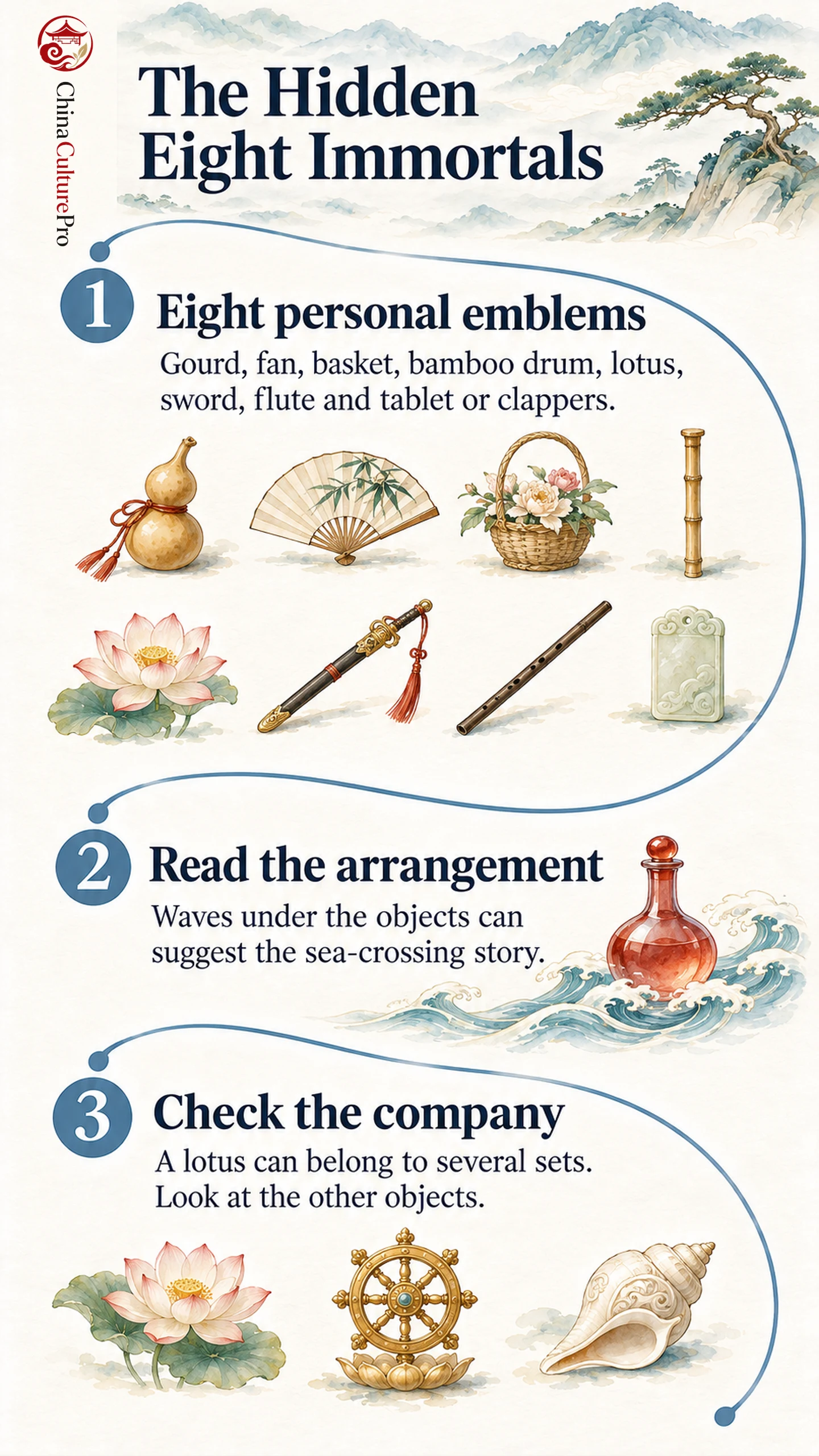
- Look for objects. A gourd, flute or flower basket can each point to a particular immortal.
- Read the group. Several companion objects make the set easier to identify.[1][2]
- Check the setting. Waves can connect the emblems to the story of the immortals crossing the sea.[3]
The word “hidden” refers to the way the people are represented through objects.
A Qing bowl can show the belongings of eight people without a single figure. On another vessel, the figures and their objects can appear in different layers. A glass snuff bottle sets the emblems on waves. A rotating porcelain vase uses them as openings that reveal painted figures.
The Eight Immortals and Their Emblems
Use this table to identify the most familiar objects in the decorative set. Catalogues may name a stylized object differently, particularly Cao Guojiu’s tablet or clappers.[1][2]
| 仙人 | Emblem | Shape to look for |
|---|---|---|
| Li Tieguai | Gourd | Two rounded parts joined at a narrow waist |
| Zhongli Quan | 扇 | Broad fan surface with a handle |
| 藍采和 | 花籠 | Basket filled with stems or blossoms |
| Zhang Guolao | Bamboo drum | Long drum body, sometimes shown with beaters |
| He Xiangu | 蓮 | A single bloom or stem |
| 呂洞賓 | 剣 | Long blade or scabbard with a hilt |
| Han Xiangzi | 笛 | Slender pipe that may show finger holes |
| Cao Guojiu | Jade tablet or clappers | Flat tablet or pair of short boards |
The Eight Immortals guide introduces the figures and their stories. In a decoration, the grouping may identify the set even when one of the objects is partly hidden.
How Qing Objects Arrange the Emblems
A glass snuff bottle in the Palace Museum carries a Qianlong mark. The lower part shows waves lifting the emblems, and the upper part has pendant-like ornament. The catalogue reads the waves as a clue to the Eight Immortals crossing the sea. It is the combination of belongings and water that suggests the episode.[3]
On a Qianlong rotating vase in the same collection, cutouts on the outer wall take the shapes of the emblems. Turning the neck moves the painted inner vessel. The figures come into view through the openings. A late eighteenth-century porcelain plate from Jingdezhen presents the emblems in painted enamels on a single surface.[4][5]
How to Distinguish the Other Auspicious Sets
Identify several objects before deciding. The 八宝 can include coins, books and lozenges. Their forms suggest treasured objects and wishes such as wealth or learning. A gourd, fan and flute point more directly toward the emblems of individuals.[1][2]
The lotus associated with He Xiangu can also appear as a separate sign in the Buddhist Eight Auspicious Symbols, where it appears with objects such as the wheel and conch. A Hundred Antiques composition may arrange precious things on stands or tables, with an emphasis on how they are displayed. Match the objects and the arrangement together.[2][6]
FAQs About the Hidden Eight Immortals
Does a ribbon tell you which immortal an object represents?
The underlying object is the better clue. A ribbon can decorate many auspicious emblems. Trace the shape under it to look for a blade, basket or other attribute.[1][2][5]
Does a lotus always represent He Xiangu?
A lotus can stand for He Xiangu among the other immortals’ emblems. In a Buddhist group or a painted pond, other meanings may apply. Its companions give the identification more weight.[1][2][6]
出典
[1] The Palace Museum. Hidden Eight Immortals, Catalogue Glossary
[2] USC Pacific Asia Museum. Rank and Style: Symbols in Imperial Chinese Dress
[3] The Palace Museum. Painted Enamel Glass Snuff Bottle with the Hidden Eight Immortals, object 00107715
[4] The Palace Museum. Qianlong Rotating Vase with the Hidden Eight Immortals, object 00153876
[5] The Metropolitan Museum of Art. Plate with Symbols of the Eight Immortals, object 02.5.79
[6] The Palace Museum. Eight Treasures: The Buddhist Emblems