

Quick Answer: What Was the Guozijian?
The Guozijian (國子監, Guózǐjiàn) was an institution of state education in imperial China. “Directorate of Education” emphasizes its administrative role, while “Imperial Academy” emphasizes its teaching and campus. The balance between those roles changed over time.[1][3][4]
- Administration: It oversaw schools and aspects of education for the imperial government.[1][3]
- Teaching: The Tang directorate contained several schools, including ones for classical study and specialist subjects.[1][2]
- Surviving site: Beijing preserves a Guozijian campus first established under the Yuan and developed under the Ming and Qing.[4][5]
The name can refer to an office in a historical record or to the buildings associated with it. The Beijing site represents a later stage in a much longer history.[1][4][5]
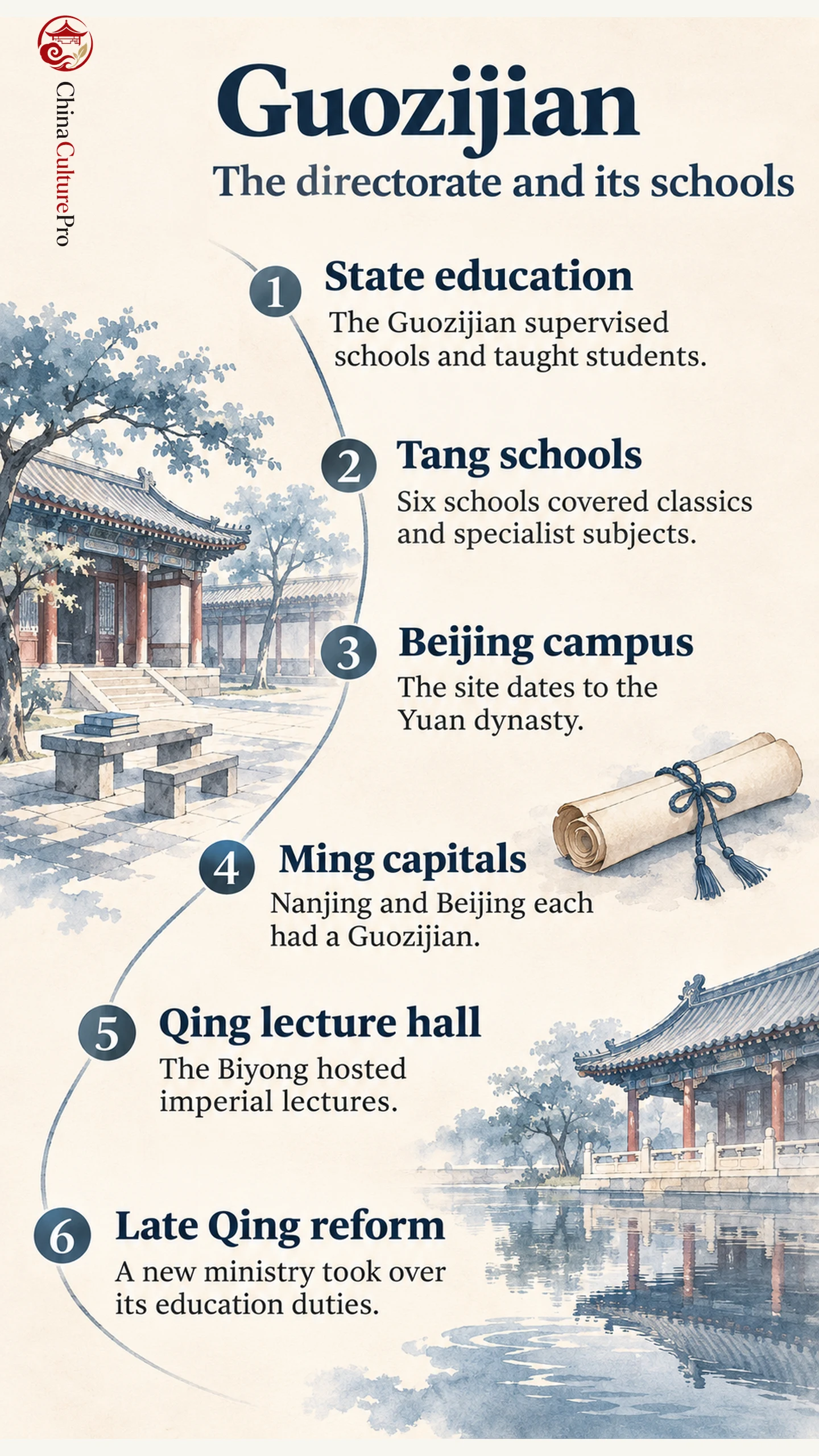
A Tang regulation can list several schools under the Guozijian, while a Ming record can name a directorate in either of the dynasty’s two capitals. At the Beijing site, the Qing lecture hall adds another layer to the same institution’s history.[1][4][5]
The Tang Directorate and Its Six Schools
The <em>Tang Six Statutes</em> describes an institution that divided education by course of study and admission category. It lists the following schools under the directorate.[1][2]
| School | Place in the Tang system |
|---|---|
| Guozixue (國子學, Guózǐxué) | A classical school with places for descendants of high officials and other privileged families. |
| Taixue (太學, Tàixué) | The Great Academy, whose rank-based qualifications admitted a broader range of official families. |
| Four Gates School (四門學, Sìménxué) | A classical school with places for some exceptionally qualified commoners as well as candidates from official families. |
| School of Law | Specialist training in law. |
| School of Writing | Specialist study of written forms. |
| School of Mathematics | Specialist study of calculation. |
A student’s field of study and the qualifications for admission both mattered. For example, a commoner might gain a place through talent in the Four Gates School or through expertise in a specialist subject. Those rules belonged to the Tang arrangement. Later directorates organized their schools differently.[1][2]
Ming Institutions in Nanjing and Beijing
In the Ming, the Guozijian operated in both Nanjing and Beijing. The Nanjing institution remained part of the educational system after Beijing became the principal seat of the court. When a source names the academy, the city can identify which body registered a student or administered a program.[3][7]
The Guozijian trained students and served an administrative role. People who attended were known as jiansheng (監生, jiànshēng). A label identifying an enrolled student tells you something different from a title conferred after passing a stage of the civil examinations. The examination system and the schools were connected parts of government, with their own requirements and records.[3][4][7]
What Survives at the Beijing Guozijian
The Beijing campus dates to the Yuan and was extended and altered under later rulers. The Qing Biyong (辟雍, Bìyōng), a hall surrounded by water, provided a setting for imperial lectures. It stood on the campus’s central axis. The Cultural Heritage Bureau identifies it with the Qianlong emperor’s visits to lecture at the academy.[4][5]
The neighboring Confucius Temple had a ceremonial purpose of its own. It was used for state rites honoring Confucius. The two adjoining grounds show how an imperial capital placed teaching and the formal honoring of learning close together while giving them separate buildings.[4][5]
The End of the Imperial Directorate
Late Qing reforms abolished the civil examinations in 1905 and established a new Ministry of Education. The Guozijian’s former responsibilities were absorbed into the new educational administration. Its buildings survived that change. In 1912 the site housed the preparatory office for a national history museum.[6]
The same English word “academy” also appears in the name of the Hanlin Academy (翰林院, Hànlín Yuàn), which is associated with scholarly service to the court. Guozijian records typically concern state education and the students or schools attached to it.[1][3][4]
FAQs About the Guozijian
Was the Guozijian the same as the Taixue?
In the Tang organization, the Taixue was one of the schools under the Guozijian. Some later descriptions use Taixue as another name for the imperial academy. Read the term in its dynastic setting.[1][4]
Did every student take the same route to admission?
Admissions varied. The Tang statutes describe several school categories, some with rank requirements and others with places for qualified commoners. The rules depended on the school and period.[1][2]
Does the Guozijian still exist?
The buildings in Beijing survive as a heritage site and museum. The imperial educational office lost its former function during the late Qing education reforms.[5][6]
出典
[1] Tang Six Statutes. Chapter 21 on the Directorate of Education and its schools
[2] London School of Economics, economic history working paper. Tang central education and specialist schools
[3] Architectural Institute of Japan. The Research on the Nanjing Guozijian in Ming Dynasty
[4] Beijing Municipal Government. Guozijian
[5] Beijing Municipal Cultural Heritage Bureau. Confucius Temple and Guozijian Museum
[6] Wang Linlin. Guozijian and the National Museum of History
[7] Beijing tourism information portal. Guozijian, a central institution of higher learning