


Quick Answer: What Does a Ganzhi Date Tell You?
A stem-branch date (干支, gānzhī) combines one Heavenly Stem (天干, tiāngān) and one Earthly Branch (地支, dìzhī). In a year inscription, the same pair recurs every 60 years. To choose the right year, check who wrote it, what it dates and which era or lifetime fits. [1][2][3]
- Find the pair: Read the two characters as a pair, then look for a season, month or era nearby. [1][2][3]
- Narrow the year: Compare the possible dates with the maker’s lifetime and the object’s context. [1][2]
- Read the whole line: The year can describe a past event that the artist writes about. [3]
A season or month narrows the date within a year. An era name, signature or another dated clue can identify which sixty-year cycle fits.
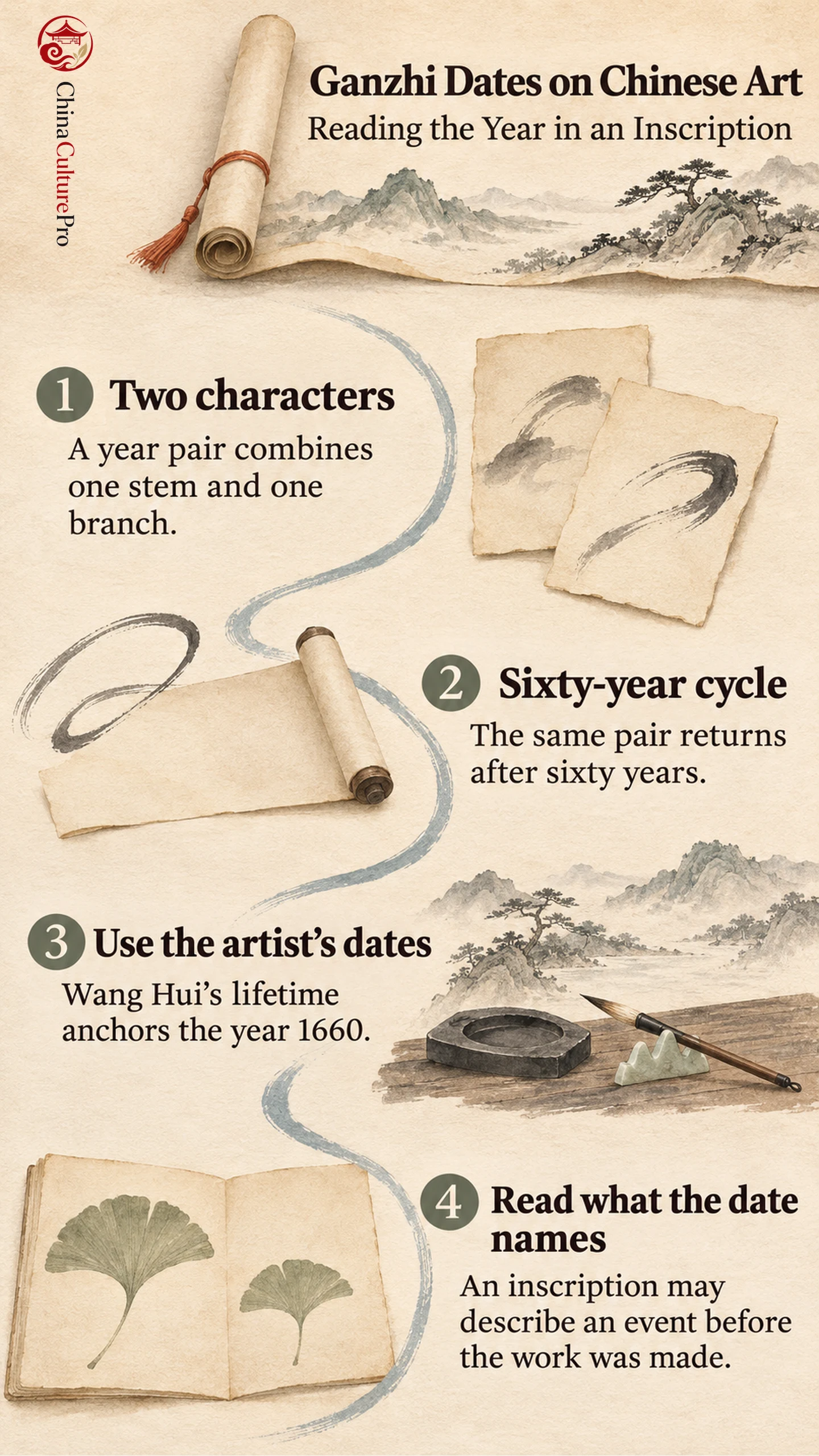
On a Princeton scroll, Wang Hui puts a winter date beside the name of the man for whom he painted it. On a Met album leaf, Wang Jun gives a year for an event that happened decades before he made the painting. [2][3]
How to Recognize a Ganzhi Year in an Inscription
The sixty-year cycle pairs ten stems with twelve branches in a repeating sequence. Gengzi (庚子, gēngzǐ) joins the seventh stem to the first branch. The pair labels 1660 in Wang Hui’s inscription and the lunar year that begins in 2020 in the Hong Kong Observatory’s tables. Six complete cycles separate the two years. [1][2][4]
Look next to the pair for a season, month or imperial era. The winter in Wang Hui’s inscription places the painting in a season, without specifying a Gregorian day. [2][3]
A Painting Dated Gengzi Winter
Wang Hui’s Landscape in the Style of Huang Gongwang, in the Princeton University Art Museum, bears an inscription with Gengzi and winter. The museum dates the scroll to 1660. Wang Hui lived from 1632 to 1717. The preceding Gengzi year, 1600, was before his birth. The next, 1720, was after his death. [1][2]
The inscription names Huang Gongwang’s brush style and records the work as a birthday gift. Wang Hui’s signature identifies the person who made the scroll. Princeton’s catalogue also explains that Wang Hui worked from a composition by his teacher Wang Jian, who had emulated the earlier painter. [2]
When the Date Belongs to a Story in the Painting
In Ten Sites Associated with Ruan Yuan, Wang Jun painted two ginkgo trees at a family temple. His inscription says they survived when the city was occupied in the Guichou year (癸丑, guǐchǒu) of the Xianfeng era (咸丰, Xiánfēng). The Metropolitan Museum of Art dates that event to 1853 and the album to 1883. The passage also refers to the building of the temple in the ninth Jiaqing year, 1804. A single inscription can contain several historical dates. [3]
When you find a date, look for the verb or event that goes with it. Check whether the inscription comes from the artist or a later writer. A calendar conversion is useful after you identify which event the original date names. [1][2][3]
FAQs About Ganzhi Dates on Chinese Art
Can a Ganzhi pair identify a single Gregorian year?
The same pair recurs every sixty years. A known maker, a named era or another chronological clue can narrow it to one cycle. [1][2][3]
Does a cyclical year give the exact date of a painting?
A year pair identifies a position in the cycle. To place a specific day, look for the month and day as well as a clue that fixes the cycle. [1][2][3]
出典
[1] Hong Kong Observatory. Heavenly Stems and Earthly Branches(天干と地支)
[2] Princeton University Art Museum. Landscape in the Style of Huang Gongwang
[3] Shi-yee Liu, The Metropolitan Museum of Art. Storytelling Through Inscriptions in Nonnarrative Chinese Paintings
[4] Hong Kong Observatory. 2020 Gregorian–Lunar Calendar Conversion Table