

Quick Answer: What Is Labor Day in China?
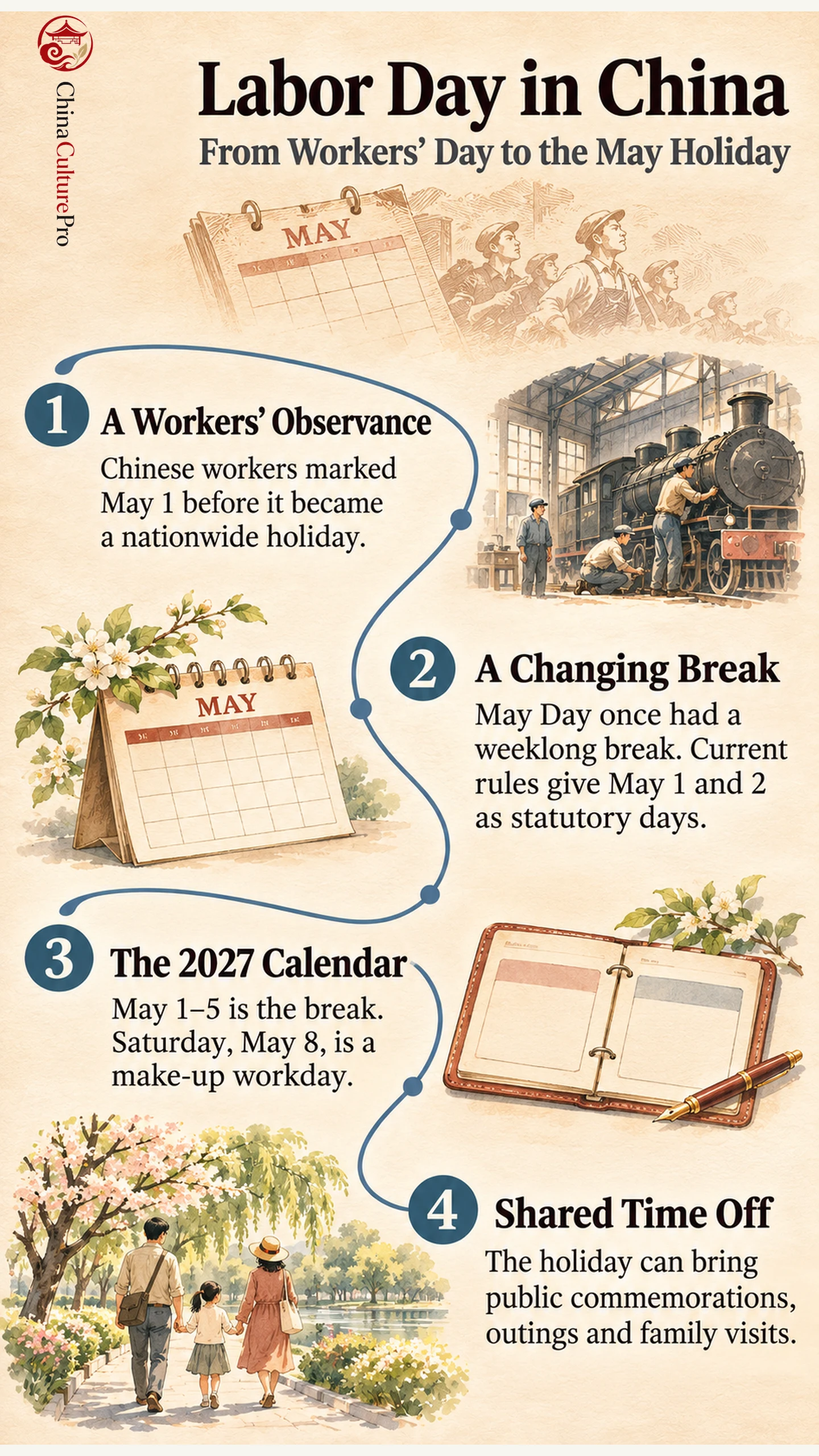
Labor Day (劳动节, Láodòng Jié), commonly called May Day (五一, Wǔyī), centers on May 1. It commemorates workers and is a nationwide public holiday in mainland China. Under the rules effective since 2025, May 1 and 2 are statutory days. The annual schedule can set a longer break. [1][2][3]
- History: Chinese workers marked the international observance before it became a nationwide holiday in 1949. [1][4]
- 2027 schedule: The published break is May 1–5. Saturday, May 8, is a make-up workday. [3]
- Holiday culture: The occasion connects worker recognition and a shared window for leisure and travel. [4][5]
May 1 remains the date of the observance as the length of the public break changes.
The name May Day can appear on a notice recognizing workers and on a calendar listing several days off. Both usages lead back to May 1. To see how they fit together, start with the commemorations and then follow the changes to the time allocated in the national holiday rules. [1][2][4]
How International Workers’ Day Became a Chinese Holiday
The International Labour Organization links May Day to labor campaigns of the 1880s, including demands for shorter working hours. A 1920 gathering in Shanghai is an early example of the date taking hold in China. The Hongkou district archives also describe a special Labor Day issue of New Youth, whose articles looked at workers in several Chinese cities and labor organizations elsewhere. [4][6]
By 1921, railway workers and other participants gathered at Changxindian in Beijing to mark May 1. These accounts show different ways an international date became part of the Chinese labor movement. The December 1949 regulation set May 1 as a nationwide day off. [1][4][7]
The special issue and the railway gathering also show how the observance reached people through different settings. In print, readers could encounter reports about work in other industries and cities. At Changxindian, workers and students met in person. A visit to a labor-history exhibition can make those earlier meanings visible alongside today’s calendar. [4][7]
How the Length of the May Holiday Changed
The 1999 version of the regulation granted three statutory days for Labor Day, May 1–3. Combined with rescheduled rest days, that supported a longer May break. The history of Golden Week explains why May Day appears alongside the October holiday in older accounts. [8]
The reform that took effect in 2008 shortened the statutory May holiday to one day and introduced statutory days for several other traditional festivals. The revision effective January 1, 2025, added May 2. The current rules give May 1 and 2 as the statutory dates. The published annual break can be longer because the rules allow rest days to be rearranged. [2][9]
For a concrete example, the 2027 notice puts the break on May 1–5 and designates Saturday, May 8, as a workday. In a calendar, mark the two statutory dates, the full break and the make-up Saturday separately. The full Chinese public holiday calendar compares those different dates across the year. [2][3]
What the May Break Looks Like Today
The date still carries its connection to labor history. A commemoration might focus on past worker organizing or present-day workers. A few days off also create time for trips, outings or family plans. A person who uses the break for travel and a museum that programs a labor-history event can be responding to different parts of the same holiday. [4][5][7]
In 2026, the All-China Federation of Trade Unions held a May Day award ceremony on April 28. The awards recognized individuals, organizations and work teams, with separate categories. The ceremony date shows how the commemoration can extend beyond an event held on May 1 itself. It also explains why news about workers’ awards can appear before a long holiday starts. [10]
The Ministry of Culture and Tourism estimated 325 million domestic tourist trips during the 2026 May break. That figure measures trips, so one person can appear in the total more than once. The same report describes a May holiday culture and tourism program. The combined effect of commemoration, institutional schedules and shared time off gives May Day a distinct place among Chinese holidays and festivals. [5]
FAQs About Labor Day in China
Is Labor Day always on May 1 in China?
May 1 is the annual observance. The legal dates off include May 1 and 2, and the break in the annual notice can include other dates. [2][3]
Why can May Day be a five-day break?
An annual scheduling notice can combine statutory days and other rest days. The 2027 notice gives May 1–5 as the break and includes a make-up workday. [2][3]
Was the May holiday once called Golden Week?
The weeklong May break dates to an earlier arrangement. The rules that took effect in 2008 reduced statutory May days, and later schedules have assigned breaks of different lengths. [8][9]
出典
[1] Ministry of Justice, National Administrative Regulations Database. Regulation on National Festivals and Memorial Days, 1949 version
[2] State Council of the People’s Republic of China. Regulation on Public Holidays for National Festivals and Memorial Days, amended in 2024
[3] General Office of the State Council. Notice on the 2027 Public Holiday Schedule
[4] Hongkou District Archives. Shanghai workers’ early International Workers’ Day commemoration
[5] Ministry of Culture and Tourism. Domestic tourism during the 2026 May Day holiday
[6] International Labour Organization. May Day: The International Day of Labour
[7] Beijing Municipal Government. Changxindian and the history of the Chinese labor movement
[8] State Council Gazette. State Council Decree 270
[9] National Development and Reform Commission. State Council Decree 513
[10] National Forestry and Grassland Administration. 2026 National May Day Labor Awards