
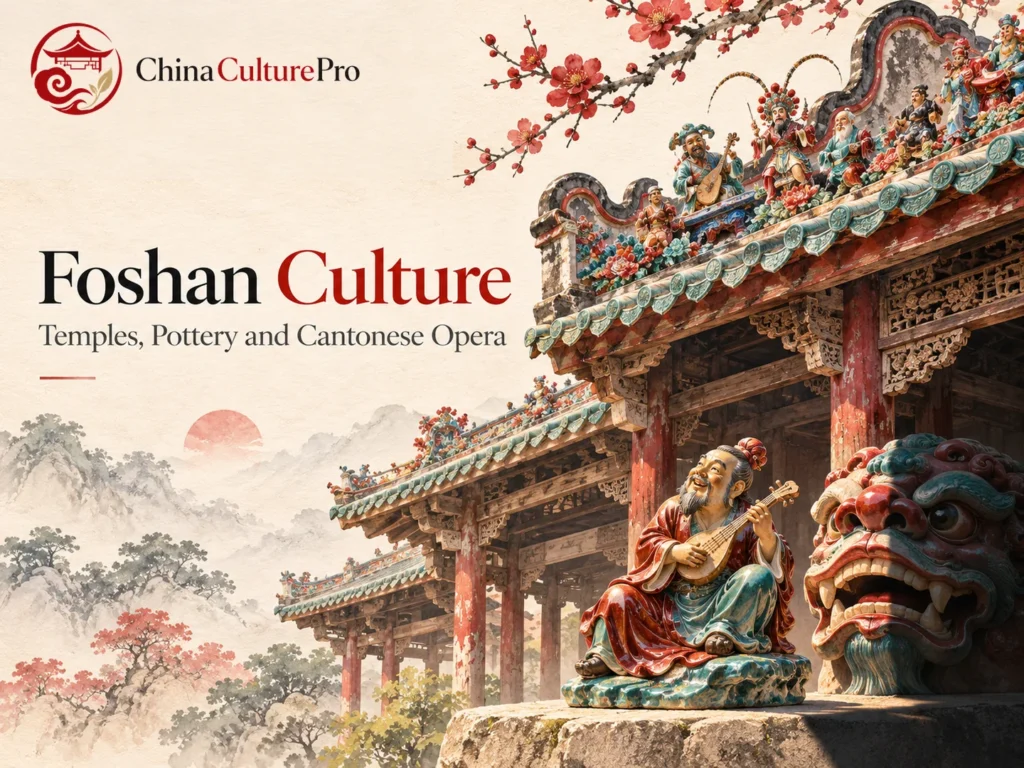

Quick Answer: What Is Foshan Known For Culturally?
Foshan (佛山, Fóshān) is a Guangdong city where temple worship, ceramic craft and Cantonese performance share public space. Its Ancestral Temple is dedicated to Beidi (北帝, Běidì), a deity associated with water. The surrounding complex includes an opera stage and ceramic roof decoration.[1][2][3]
- Temples: The Foshan Ancestral Temple (佛山祖庙, Fóshān Zǔmiào) is commonly called Zumiao (祖庙, Zǔmiào). The complex was expanded over several periods and has a public festival that honors Beidi.[1]
- Craft: Shiwan (石湾, Shíwān) potters made ceramic figures for buildings and everyday settings. An old dragon kiln in the district preserves a setting where this work developed.[2][4]
- Performance: Cantonese opera and southern lion dance each connect performers with local communities and events.[3][5]
Start with the relationship between the roof and the stage, then look at the separate workshops and groups that keep each practice going.
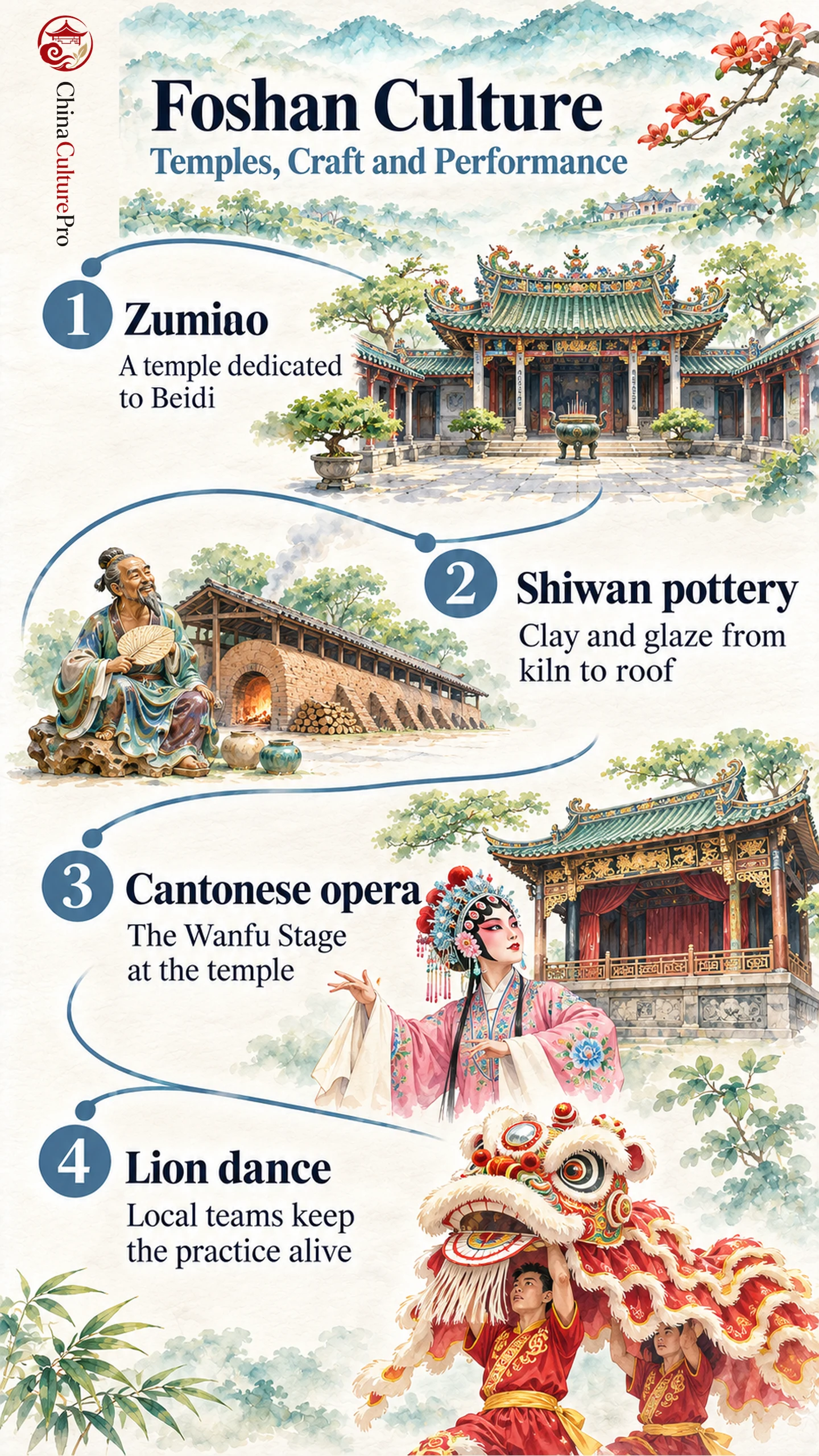
At Zumiao, a painted figure on the roof and an actor onstage show two ways of telling a story. The first depends on a potter and a kiln. The second calls for singers, accompanists and an audience.
Four Anchors for Foshan Culture
| 基準 | What you can notice | 文化的文脈 |
|---|---|---|
| Foshan Ancestral Temple | Beidi worship, layered halls and decorated roofs | A shared temple complex with a history of ritual, craft and performance.[1] |
| Shiwan pottery | Glazed figures, roof sculpture and kilns | Ceramic skills used for buildings, objects and display.[2][4] |
| Wanfu Stage | A raised performance space in the temple complex | A historic setting for Cantonese opera troupes.[1][3] |
| Guangdong lion dance | A southern-style lion costume, percussion and coordinated performers | A practice shaped by groups and celebratory occasions.[5] |
Zumiao Was Built for Beidi Worship
Foshan Ancestral Temple is commonly known as Zumiao. The original temple dates to the Yuanfeng era of the Northern Song, 1078–1085. Its buildings and ornament were enlarged and changed over time. It honors Beidi, the Northern Emperor, who is associated with water. The name “Ancestral Temple” can suggest a hall for one lineage. Here it refers to the city’s temple complex and its local worship tradition.[1]
Carved wood, relief decoration and modeled ceramics share space around the halls. The temple stages events related to Beidi’s birthday, while other parts of the site hold memorials for martial artists. The combination shows how a single institution in Lingnan culture can hold several kinds of public memory.[1]
What Shiwan Pottery Adds to the City
Shiwan is a pottery district in Foshan. The Nanfeng Kiln dates to the Zhengde era of the Ming dynasty, from 1506 to 1521. A dragon kiln is a long firing chamber built along a slope. That shape is part of the physical history of pottery workshops in Shiwan.[2]
The national record for Shiwan ceramic sculpture includes human and animal figures, vessels, miniature work and roof-ridge ceramics. Finished pieces can be expressive enough to catch a viewer’s attention at a distance. A ceramic figure can carry a story on a building as well as on a shelf.[4]
Cantonese Opera and Southern Lion Dance
The Wanfu Stage (万福台, Wànfú Tái), built in 1658 according to a Guangdong cultural-history account, served as an important stage for Cantonese opera. Troupes could use an opening performance there as part of their season. The tradition also developed in neighboring Guangzhou and elsewhere in the Cantonese-speaking world. Instruments, singing, stage movement and costume are all part of a performance.[3][6][7]
Foshan is also associated with Guangdong’s xingshi (醒狮, xǐngshī), a southern form of Chinese lion dance. A team brings the lion’s movements to life with the aid of percussion and closely timed coordination. At a celebration the dance can express wishes for good fortune. The tradition involves both local groups and the public events where they perform.[5]
FAQs About Foshan Culture
Is Foshan Ancestral Temple a Clan Hall?
Zumiao is a temple dedicated to Beidi. The city’s historic temple complex developed around that worship and includes such features as the Wanfu Stage.[1]
What Kind of Pottery Is Shiwan Known For?
Shiwan is known for modeled ceramic figures, including people and animals. Its pottery repertoire also includes vessels and larger pieces made for roof ridges.[4]
Are Cantonese Opera and Lion Dance the Same Tradition?
Cantonese opera uses song, acting and instruments to present a story. Lion dance uses a moving lion costume, coordinated performers and percussion. Both can appear at public festivals.[1][5][6]
出典
[1] Foreign Affairs Office of Guangdong Province. Foshan Ancestral Temple Museum
[2] Foreign Affairs Office of Guangdong Province. Nanfeng Kiln
[3] Guangdong Cultural History. Cultural Routes Through the Greater Bay Area
[4] China Intangible Cultural Heritage Digital Museum. Shiwan Ceramic Sculpture
[5] China Intangible Cultural Heritage Digital Museum. Guangdong Southern Lion Dance
[6] UNESCO. Yueju Opera
[7] Guangzhou Liwan District Government. History of Cantonese Opera in Xiguan