

Quick Answer: What Is Distinctive About Shenzhen Culture?
Shenzhen (深圳, Shēnzhèn) grew quickly after the establishment of its Special Economic Zone in 1980. New residents helped shape its workplaces and neighborhoods. Older places, including Nantou (南头, Nántóu), Dapeng and Hakka settlements, preserve separate chapters of its local history.[1][2][3][4]
- Migration: Jobs drew people from many parts of China. Those residents helped build businesses and ways of living in the city.[4][5]
- Urban villages (城中村, chéngzhōngcūn): These neighborhoods grew from settlements the expanding city absorbed. Many became important places to find rental rooms and everyday services.[4][5][6]
- Older communities: The histories of a county seat, a coastal fortress and a Hakka residence reach back before the modern city.[2][3][7]
Two dates help distinguish the modern municipality and the economic zone. The city was established in 1979, and the zone was set up in 1980.[1]

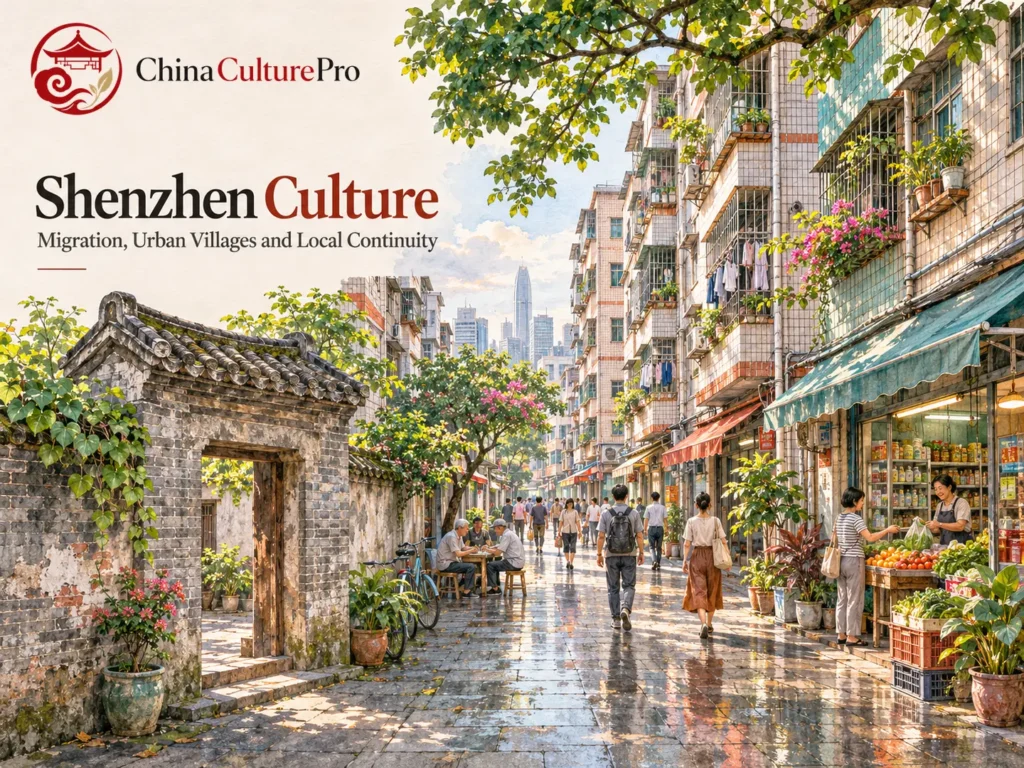
A lane of closely spaced rental buildings and a fortified old residence can both be part of Shenzhen’s story. The buildings reflect different ways of organizing life in a city that grew around older places.
Four Ways to Read Shenzhen Culture
| 基準 | 注目したい点 | What it explains |
|---|---|---|
| Nantou | Historic gates and signs of county administration | The area had political and market centers before the modern city.[2][8] |
| Dapeng Fortress | A walled settlement associated with coastal defense | The importance of the coast in the Ming and Qing periods.[3] |
| Urban villages | Dense rental housing alongside shops and older settlement patterns | How earlier villages and newcomers helped form neighborhoods.[4][5][6] |
| Dawan Ancestral Residence | A square Hakka residential enclosure | Local building traditions and the organization of a household or lineage compound.[7] |
The Places That Predate the Economic Zone
Nantou in Nanshan was established as a fortified site in 1394. It later served as a center of Xin’an County administration. Dapeng Fortress (大鹏所城, Dàpéng Suǒchéng), also founded in 1394, served coastal defense. Their locations and uses give two ways to understand the area before it became a fast-growing municipality.[2][3][8]
Dawan Ancestral Residence in present-day Pingshan District offers another view. Its square compound is an example of Hakka enclosed housing. It connects this part of Shenzhen to Hakka culture and a wider South China building tradition.[7]
How Migration Became Part of Daily Life
The Special Economic Zone accelerated industrial growth and attracted workers from across China. New arrivals found work in the developing economy and made homes in the neighborhoods around it. The city’s cultural life took shape through countless decisions about where to rent, work, shop and spend time. Older village communities were involved in many of those changes.[1][4][5][6]
The scale of modern migration helps explain why Shenzhen and nearby Guangzhou have different urban histories within the same region. An account of Shenzhen can include long-established Lingnan communities alongside people who arrived in much more recent decades.[4][7][9]
What an Urban Village Is
An urban village is a neighborhood that grew from a village incorporated into a larger city. In parts of Shenzhen, redevelopment and additional floors made dense rental housing possible. Shops and services grew alongside the housing. Researchers describe places that are both homes and local economies, where existing and incoming residents could use the same streets in different ways.[4][5][6]
A study of Pingshan village near Shenzhen’s University Town examines how older buildings, newer village streets and surrounding development coexist. That case also shows why “urban village” can mean several kinds of buildings at once. The form changes over time as owners, tenants and public projects affect its use.[5]
FAQs About Shenzhen Culture
Did Shenzhen’s History Begin in 1980?
The Special Economic Zone dates to 1980. The municipality was established in 1979, and older settlements such as Nantou and Dapeng have much earlier records.[1][2][3]
Why Do Urban Villages Matter to Shenzhen?
They provided rental housing and services for many newcomers as the city expanded. They also kept some older community structures within newer urban neighborhoods.[4][5][6]
Where Does Hakka Heritage Appear in Shenzhen?
Dawan Ancestral Residence in Pingshan District is one example. The square compound preserves a particular local form of Hakka residential architecture.[7]
出典
[1] Shenzhen Municipal Government. Shenzhen Basics
[2] Shenzhen Municipal Government. Nantou Ancient Town
[3] Shenzhen Municipal Government. Why Is Shenzhen Called Pengcheng?
[4] Jonathan Bach. Urban Villages and the Making of Shenzhen
[5] Cities. Traditions and Modernity in Urban Villages of Shenzhen
[6] Pu Hao, Richard Sliuzas and Stan Geertman. The Development and Redevelopment of Urban Villages in Shenzhen
[7] Shenzhen Municipal Government. Historical Sites and the Dawan Ancestral Residence
[8] Shenzhen Municipal Planning and Natural Resources Bureau. Shenzhen Gazetteer of Place Names, Volume 1
[9] Fitzwilliam Museum. Chinese Export Art: The Thirteen Hongs Collection