


Quick Answer: What Is Qian Xuan’s Eight Flowers?
Eight Flowers (八花图, Bā Huā Tú), by Qian Xuan (钱选, Qián Xuǎn), is a Yuan-dynasty flower handscroll in the Palace Museum, Beijing.
- Material and size: Colors on paper, 29.4 × 333.9 cm.
- Subject: Eight types of flowering plants, arranged as separate groups.
- Look first: Compare the direction of a branch with the position of its blossoms and leaves.
- Date to distinguish: The colophon is dated 1289; that is a written response, rather than an artist’s execution date.
Read the flowers as a succession of distinct arrangements, with intervals of paper between them.
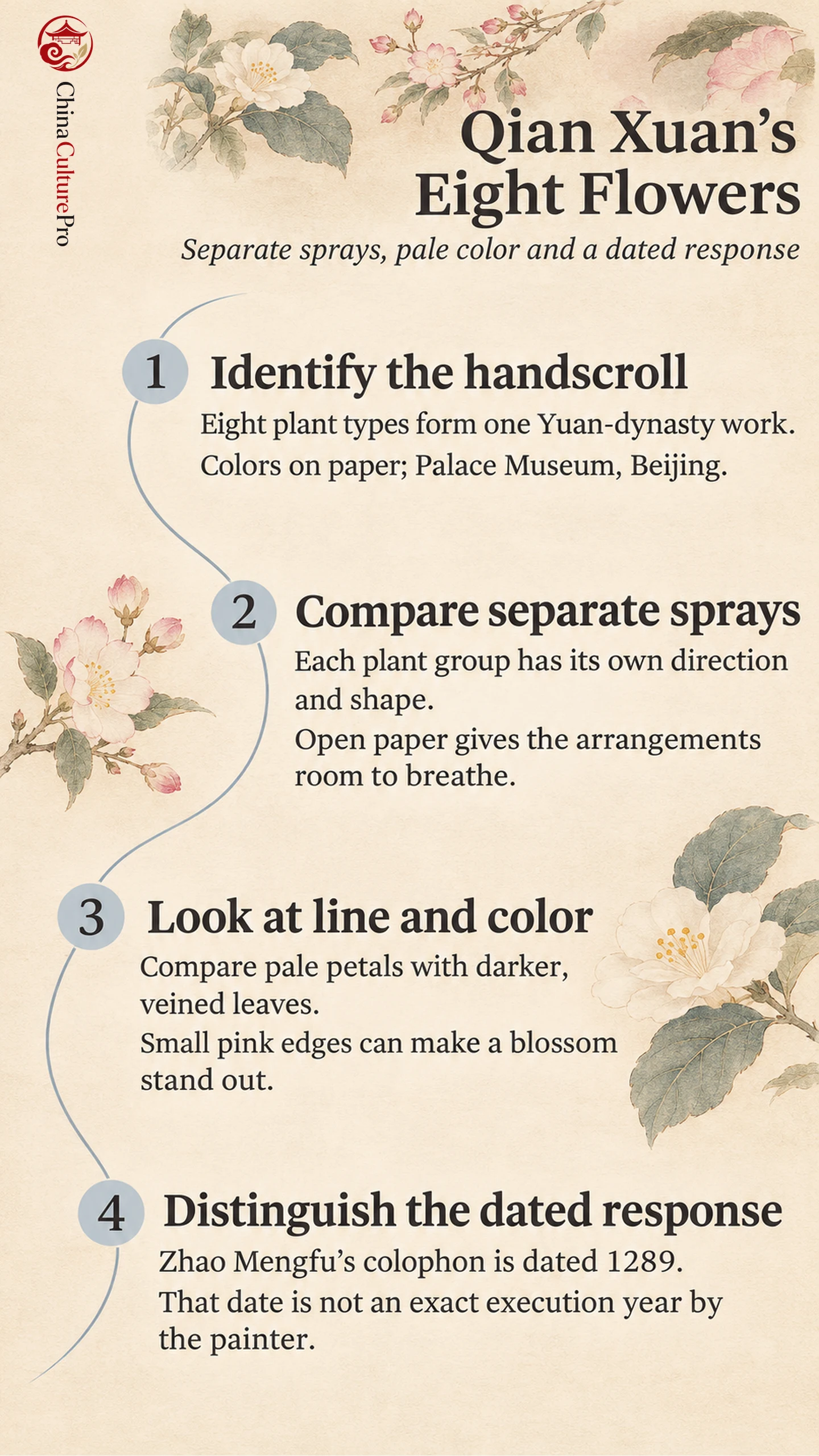
In the museum’s illustrated detail, broad white blossoms occupy the left side. Their pale petals contrast with a dense cluster of gray-green leaves below and around them.
A separate branch on the right carries smaller blossoms with pink edges. It leans across the paper, while a much lighter group of leaves appears behind it. The blank interval between the sprays makes their different shapes easy to compare.
Identify the Beijing Handscroll and Its Eight Plants
The Beijing work is catalogued as 新00135355. Its long, narrow painted field measures 29.4 × 333.9 cm; the eight plant groups belong to one handscroll. [1]
The Palace Museum’s 2017 exhibition entry identifies the following eight types. The list gives its plant names, rather than a claimed sequence of blooming seasons. [2]
- Crabapple
- Apricot
- 桃
- Citrus
- Pear
- Gardenia
- China rose
- 水仙
The 2017 list uses China rose. The shorter collection notice instead mentions peony among its examples, so the flower names should be read with that catalog difference in mind. [1]
For looking, the distinction encourages attention to leaves, branching and the placement of blooms alongside color. Compare the shapes of the leaves and the points where the blossoms attach to a stem.
The scroll-format guide explains the handscroll’s horizontal unfolding. Here, moving between groups lets you compare one arrangement with the next without requiring every flower to be visible at once.
Compare Separate Sprays as the Scroll Unfolds
Clipped-branch painting (折枝, Zhé Zhī) presents selected portions of plants. The 2017 entry places this work within that tradition of focused flower depiction. [2]
In the illustrated detail, follow the right-hand branch from its lower stem toward the upper blossom cluster. Its diagonal direction differs from the broader, more upright mass at the left.
Look at the empty interval between the groups. It keeps the sprays separate, while their similar scale allows a direct comparison across that gap.
Then compare the top and bottom of each group. The blossoms occupy a different kind of space from the denser leaves below them: one area opens into pale petal shapes, while the other gathers into overlapping darker forms.
A branch can direct the eye even when much of its stem remains hidden. Trace the points where a stalk becomes visible between leaves, then notice where its continuation has to be inferred.
The guide to meticulous and freehand approaches gives a broader comparison of pictorial methods. For this scroll, focus on the specific balance between controlled edges and open paper around each spray.
Look at Petal Edges, Leaves and Pale Color
The 2017 entry connects the carefully drawn, lightly colored flowers with earlier court-painting practice. [2]
Compare a white petal at the left with a neighboring leaf. The petal remains close in value to the surrounding paper, while the leaf supplies a darker boundary that makes the blossom easier to distinguish.
Several leaves show fine internal veins. Their lines are narrower than the larger silhouettes formed by overlapping foliage, so a close view reveals a second scale of drawing within the plant.
On the right, pink edges concentrate color around some blossoms. Look at the difference between an outlined petal and the paler interior it encloses.
The very light leaves behind the right-hand spray offer another contrast. Their reduced density makes them less prominent than the darker leaves immediately beside the flowers.
The painting-techniques guide develops the relation between outline and color. In this detail, choose one blossom and follow its edge all the way around before comparing it with an overlapping leaf.
Read the 1289 Colophon as a Response to the Painting
Zhao Mengfu (赵孟頫, Zhào Mèng Fǔ) wrote the appended colophon. Dated to the fourth day of the ninth lunar month in 1289, it praises the coloring and discusses imitation of Qian’s work. [2]
The painting itself has a courtesy-name seal but no artist’s written inscription in the 2017 description. Its dating evidence therefore needs to be distinguished from Zhao’s dated response. [2]
The Zhao Mengfu guide supplies context for the writer’s own artistic work. Here, his role is that of a named contemporary responding to the flowers.
The literati-painting guide develops the connection between painting and written exchange. The colophon’s praise of coloring can be compared with the pale petals and darker foliage in the illustrated detail.
The inscriptions-and-seals guide helps keep those kinds of evidence distinct. After reading the response, return to a pale flower edge and a darker leaf: the handling of color becomes a concrete place to test what the praise draws attention to.
FAQs About Qian Xuan’s Eight Flowers
Which museum holds Eight Flowers?
The Palace Museum in Beijing holds this handscroll, catalogued as 新00135355. Its painted field measures 29.4 × 333.9 cm.
What are the eight flowers?
The 2017 exhibition list names crabapple, apricot, peach, citrus, pear, gardenia, China rose and narcissus. The shorter collection description differs on China rose, mentioning peony instead.
Was Eight Flowers painted in 1289?
The dated text is Zhao’s colophon. It is evidence of a response to the painting in 1289, rather than an exact execution date written by the painter.
出典
[1] Palace Museum; Zhao Bingwen. Qian Xuan: Eight Flowers, collection record 新00135355
[2] Palace Museum; Li Shi. Eight Flowers, in Tracing the Origins of Zhao Mengfu’s Art