

Quick Answer: What Is Wintry Groves and Layered Banks?
Wintry Groves and Layered Banks(寒林重汀图,Hánlín chóngtīng tú)is a landscape traditionally attributed to Dong Yuan(董源,Dǒng Yuán)in Japan’s Kurokawa Institute of Ancient Cultures. The holding collection describes it as a copy transmitting his style.[1]
- Object: A silk hanging scroll with ink and light colour.
- Visual focus: Bare groves, rounded banks and repeated water passages.
- Winter evidence: Small details and reported analysis of white pigment.
The traditional attribution should not be mistaken for an uncontested identification of Dong’s own hand.

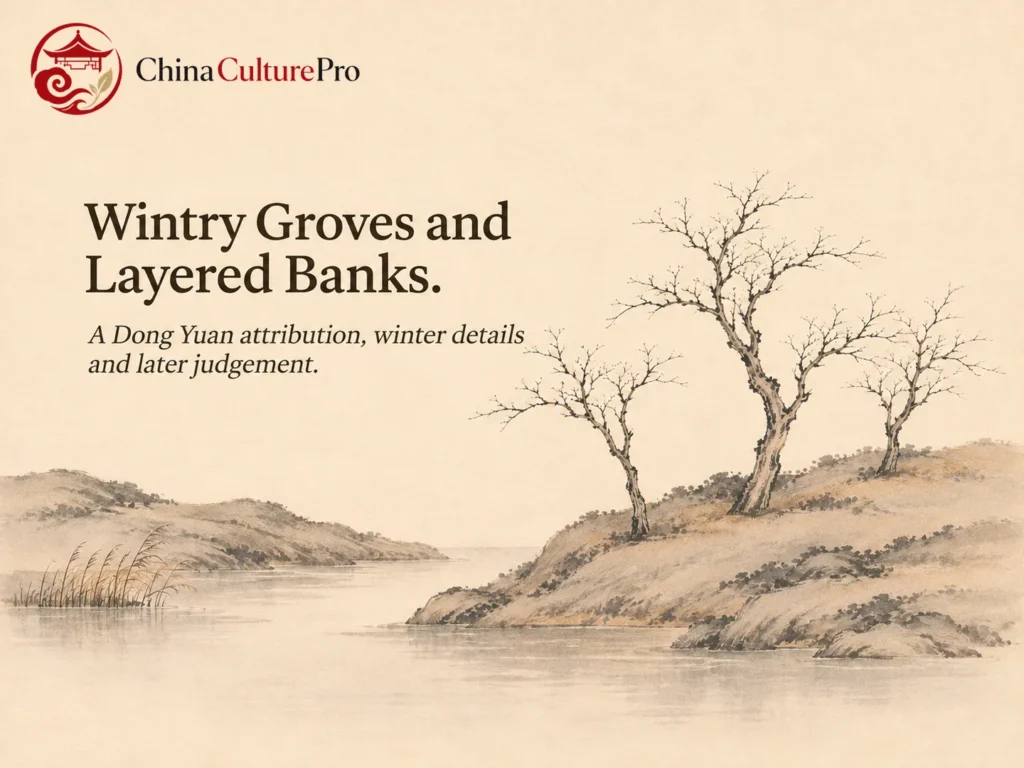
Low banks repeat across the water, becoming smaller and less distinct toward the top of the image. Bare trees rise from the nearer ground, while a small bridge and tucked-away buildings introduce traces of human life. The landscape’s depth emerges through repeated landforms rather than a single towering peak.
The Kurokawa Scroll and Its Traditional Attribution
The collection currently lists the work at 180.0 × 115.6 cm, with ink and light colour on silk. Its description links the transmitted image to a tenth-century original while treating the surviving painting as a copy. That wording separates the history of a design from certainty about the hand that painted this object.[1]
The attribution has also been defended more strongly. Wen Fong(方闻,Fāng Wén)argued that the painting was an autograph by Dong himself. His interpretation and the holding collection’s present description represent different positions, not a single settled conclusion. A precise year such as 950 or 960 should therefore not be treated as an inscribed date on the surviving scroll.[2]
Its hanging-scroll format allows the receding landscape to be seen within one vertical field. Close examination can distinguish the painting’s spatial structure from the separate question of who made it.
Following the Layered Banks and Groves
Begin with the narrow reed-covered strip near the bottom. Water separates it from the larger wooded bank beyond. Repeated intervals of land and water make the recession visible.
The nearer grove gathers many thin trunks and branching lines into one dark group. Around it, rounded slopes are marked by curving strokes and scattered dots. The broad surfaces remain legible even where individual marks are difficult to distinguish. To the right, a small bridge supplies a sharper, straighter element within this softer sequence.
Across the middle, heavier rounded landforms interrupt the horizontal movement. Beyond them, lower banks and tiny roof shapes carry the view onward. The upper field compresses water and land into narrow bands, extending the sense of distance without requiring a high mountain at the horizon.
The parallel, flowing surface marks have been discussed as hemp-fibre texture strokes(披麻皴,pīmá cūn). Looking at the brushwork alongside the repeated banks makes the term concrete: the marks follow and organize surfaces, while darker dots give their edges a different rhythm.[2]
This is a useful way into Chinese landscape painting. The space can be expansive even though the main forms are low and gently rounded.
Snowfall: Visible Details and Pigment Evidence
The winter reading rests on more than leafless trees. The holding collection identifies scattered white pigment as a representation of falling snow and reports that X-ray fluorescence analysis identified lead white. It also notes an umbrella-bearing figure among the small people in the scene.[1]
Those details change how the subdued landscape is understood. The settlements and travellers belong to an inhabited winter environment. They are easy to overlook when a reproduction is reduced to a small image, because the trees and banks occupy much more visual space.
The pigment finding should be kept separate from what any single screen image reveals. It supplies evidence about material used in the painting; identifying every pale fleck by eye is a different task.
Dong Qichang’s Later Inscription Above the Painting
A separate pale panel above the landscape carries large calligraphy by Dong Qichang(董其昌,Dǒng Qíchāng), the much later Ming painter and connoisseur. Its wording praises a painting associated with Dong Yuan as first under heaven. The collection named in it belonged to the Xu family, holders of the title Duke of Wei. Smaller writing at the left identifies Dong Qichang’s judgement.[3]
The panel records a historical act of attribution and appreciation. Its emphatic praise is not an objective ranking, and it does not mean that this was the first landscape ever painted. Nor is the large inscription Dong Yuan’s signature.
Its placement also matters visually. The bold characters occupy their own light strip above the darker landscape. Reading inscriptions and seals in relation to that mounting keeps a later collector’s statement distinct from marks within the image.
The painting thus offers two related experiences: following the banks into distance and examining how later viewers assigned authorship and value. Keeping those experiences distinct makes the traditional title more informative without asking it to settle every historical question.
FAQs About Wintry Groves and Layered Banks
Is this a surviving original by Dong Yuan?
That remains disputed. The holding collection describes a copy, while scholarship has also defended an autograph attribution.[1][2]
Does the painting show snow?
Yes. The collection’s interpretation is supported by its examination of white pigment and winter details.[1]
Did Dong Yuan write the large inscription?
No. The upper panel records the later connoisseurship of Dong Qichang.[1]
出典
[1] Kurokawa Institute of Ancient Cultures. Traditionally attributed to Dong Yuan: Wintry Groves and Layered Banks
[2] Wen Fong. Reconsidering two paintings attributed to Dong Yuan, relevant discussion on pages 1 and 8
[3] Kurokawa Institute researcher, published in ARTouch. Dong Qichang’s influence: discussion of the Wei collection and the painting