


Quick Answer: What Should You Notice in Early Spring?
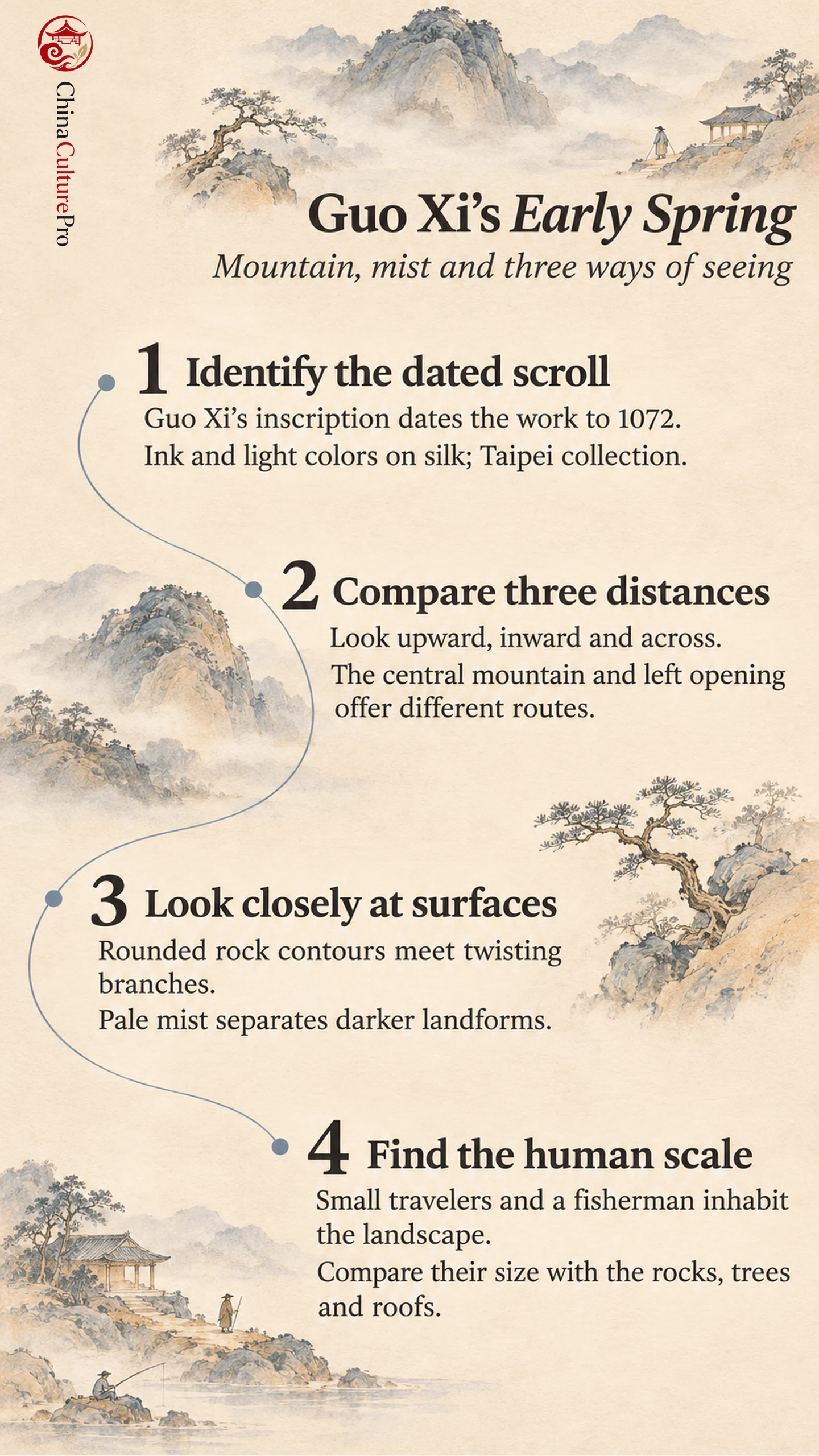
Early Spring (早春图, Zǎo Chūn Tú), by Guo Xi (郭熙, Guō Xī), is a Northern Song landscape dated 1072, now in the National Palace Museum, Taipei.
- Format: A hanging scroll, with ink and light colors on silk.
- Size: The painted field measures 158.3 × 108.1 cm.
- Look first: Follow the central mountain upward, then compare the broad opening to its left.
- Look closer: Branches, rock contours and small human activities give that enormous space different scales.
Compare the mist-filled gaps with the dark foreground before following the mountain upward.
A dark cluster of trees and rounded rocks fills the foreground. Above it, the mountain rises in a winding sequence, interrupted by lighter spaces before reaching the high summit.
At the left, low hills stretch across a much shallower band. Looking between those two areas immediately changes the direction in which the painting’s space appears to extend.
Identify the Dated Northern Song Hanging Scroll
The artist’s inscription gives the title and the cyclical year corresponding to 1072. The work is catalogued as 故畫000053, a silk hanging scroll with a painted field 158.3 cm high and 108.1 cm wide. [1]
Its vertical format matters. The lower rocks provide a place from which to look upward, while the summit stands much farther away within the same field. The scroll-format guide explains how this differs from a horizontally unfolding handscroll.
Guo worked at the Northern Song court and made large paintings for palace and hall settings. That background places the work within an ambitious court landscape tradition. [2]
The Song dynasty guide supplies the broader period context. For this picture, begin with the specific dated object rather than using the dynasty label to explain every visible feature.
The writing high on the right includes a much later imperial poem dated 1759. It belongs to the painting’s reception, whereas the artist’s smaller inscription supplies its original title and date. [1]
The inscriptions-and-seals guide develops that distinction. Compare the small vertical title inscription at the left with the larger block near the upper right before returning to the landscape.
Follow the Mountain through Three Kinds of Distance
The three distances (三远, Sān Yuǎn) describe different ways of extending pictorial space. Here their terms offer a vocabulary for comparing the upward thrust, overlapping recesses and sideways opening. [3]
| Spatial term | 意味 |
|---|---|
| High distance (高远, Gāo Yuǎn) | Looking upward from the mountain’s foot toward its summit. |
| Deep distance (深远, Shēn Yuǎn) | Looking beyond foreground mountains into the space behind them. |
| Level distance (平远, Píng Yuǎn) | Looking from nearby terrain toward distant hills across an extended view. |
Compare the mountain’s lower mass with its distant upper peak. Their separation becomes easier to read where a pale band interrupts the darker terrain.
Then look to either side of the central forms. A projecting rock can conceal what lies behind it; a narrow opening lets the gaze continue farther inward. Compare the front edge with the smaller forms visible beyond it.
Finally, turn toward the low hills at the left. Their smaller height and more continuous sideways extension give the eye a different route from the climb toward the summit.
The upward, inward and sideways views coexist. A single part of the painting can contribute to an upward movement while also hiding another layer behind it. The landscape-painting guide connects this vocabulary to wider compositional practice.
Compare Rock Contours, Branches and Mist
Curled-cloud texture strokes (卷云皴, Juǎn Yún Cūn) describe the rolling rock forms, while crab-claw branches (蟹爪枝, Xiè Zhǎo Zhī) name the distinctive twisting tree branches. Both belong to the vocabulary associated with Guo’s style. [2]
In the foreground detail, a rock’s outer contour bends through a succession of rounded projections. Inside it, shorter marks gather around some edges while leaving broader areas relatively light.
The nearby branches make a useful comparison. Several extend sideways before dividing into finer tips, placing dark, narrow lines across much larger pale rock surfaces.
Compare the densest cluster with an isolated branch. In the cluster, overlapping strokes can initially merge into a dark patch. At the edge, individual forks become easier to follow.
The painting-techniques guide explains differences among contour, texture and wash. Here those differences can be tested against a particular branch or rock rather than treated as an abstract checklist.
Mist changes the relationship between the solid forms. Near the center, the mountain seems to recede as its edges become less distinct, then becomes more clearly defined farther up.
The title points to the landscape’s emergence from winter and the renewal of early spring. The seasonal effect rests on shifting mist and awakening terrain rather than a field filled with conspicuous blossoms. [2]
Find Human Activity within the Vast Landscape
Small travelers occupy mountain paths. Near the left foreground, figures gather at a landing; at the right, a fisherman works with his net. These activities make the immense setting available to imagined human movement. [3]
Look back from those small figures to the nearest rock face. A surface that first appeared as one part of a compact composition now reads as a much larger obstacle beside a person.
Buildings offer another scale. At the right, roofs occupy a recess between steep terrain and trees. Their straight edges contrast with the surrounding irregular forms, helping a viewer recognize habitation within the mountain.
Follow a path only as far as it remains visible. Where terrain hides it, the continuation becomes an inference. That partial visibility contributes to the sense that the landscape contains places beyond the immediate view.
The Fan Kuan and Guo Xi guide places this work within Northern Song landscape painting. Return afterward to the leftward opening, then the summit: the small activities below make the change in scale more striking.
FAQs About Guo Xi’s Early Spring
When and where was Early Spring painted?
The artist dated it to 1072. The original hanging scroll is now in the National Palace Museum, Taipei; its collection location does not establish the exact place of execution.
Why is the scene called Early Spring?
Its title accompanies a landscape interpreted as emerging from winter, with mist and newly stirring life. The seasonal effect extends beyond flowering plants.
What do the three distances mean?
They distinguish looking upward toward a summit, inward behind overlapping mountains and outward across an extended view. The painting combines these spatial relations.
出典
[1] National Palace Museum. Guo Xi: Early Spring, digital collection record 故畫000053
[2] National Palace Museum. Early Spring: selected work
[3] National Palace Museum. A New Vision of National Treasures: Early Spring Landscape