


Quick Answer: How Do Chinese Stone Arch Bridges Work?
A stone arch bridge carries the deck and traffic above an opening. The stones press against one another along the curve, transferring forces to supports at each side. One large opening can cross the channel, or a succession of arches can cross between several piers.[1][2][3]
- Main arch: Follow the large curve that spans the gap between supports.[1][3]
- Shoulder opening: A smaller arch above a main arch can reduce the weight of its surrounding masonry.[1][2]
- Repeated spans: Piers can stand between a row of main arches in the river.[3]
To count the main spans, look at the largest openings and follow them down to their supports.[1][2][3]
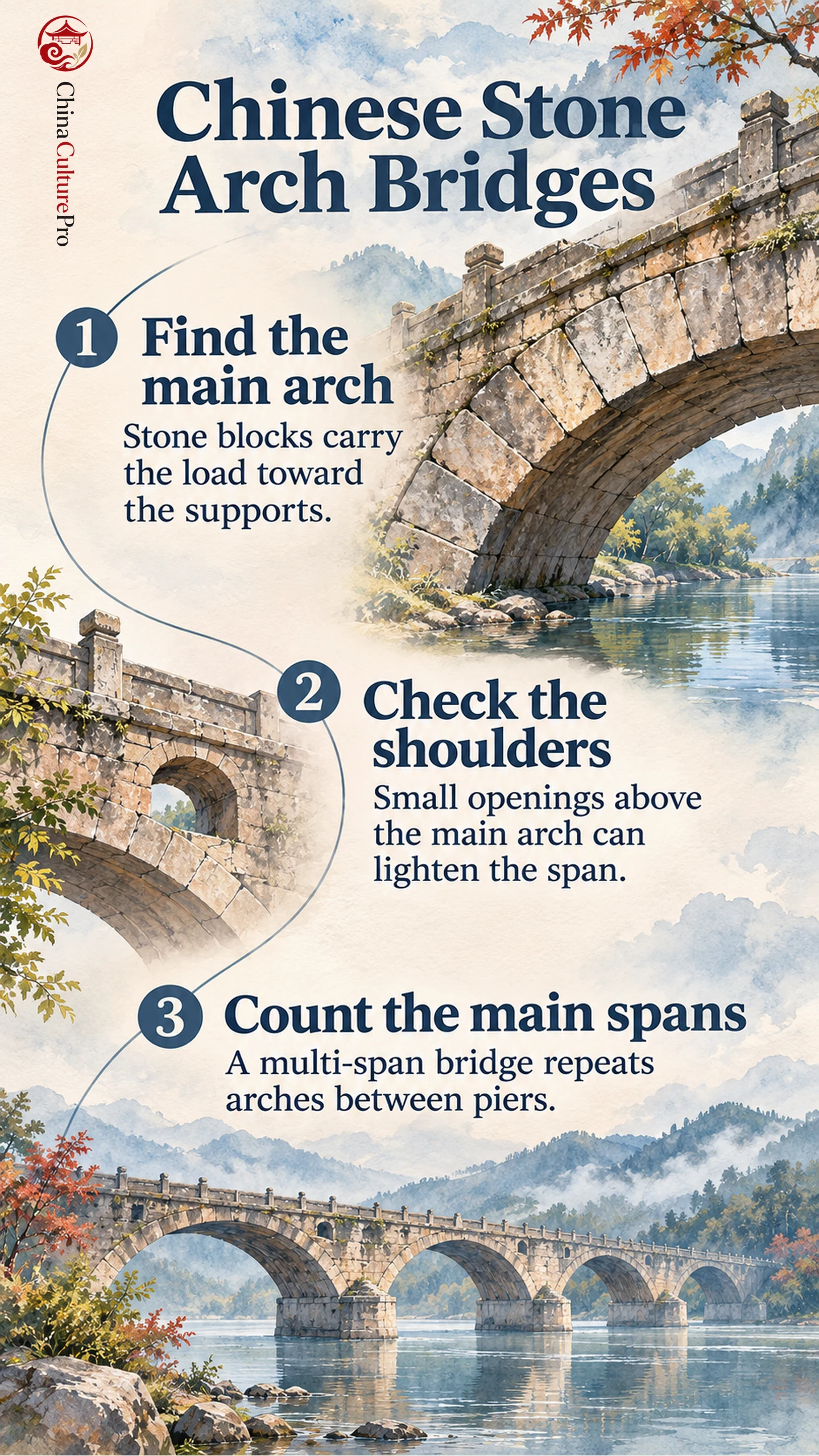
From a side view, the repeated stone joints show how the curve is assembled. A view from the deck makes those structural differences harder to see.[1][2]
How the Arch Passes the Load to Its Supports
An arch is built from pieces set along a curve. Under load, each stone bears against its neighbors. The compression follows the arch ring toward the feet of the arch. At the ends of a bridge, the abutments take the arch’s load and outward push. A multi-span bridge also uses intermediate piers between arches.[1][2][3]
Read the stonework before looking at the railing. The arch ring traces the load-bearing curve around the opening. The railing marks the edge of the deck above it. Those two lines can have very different shapes where the deck sits above the curve.[1][2]
Zhaozhou’s Wide Arch and Four Shoulder Openings
Zhaozhou Bridge (赵州桥, Zhàozhōu Qiáo), also called Anji Bridge, crosses the Jiao River in Hebei. It is attributed to the Sui-period builder Li Chun. Zhao County gives the main opening a clear span of 37.02 metres and a rise of 7.23 metres, measured from the line between the arch feet to the crown. The shallow curve is a segment of a circle. The main arch is assembled from 28 arch ribs set side by side across the width of the bridge.[1][2]
Two smaller arches open through the shoulder on each side of the main span. A shoulder, or spandrel, is the area above the arch toward its end. These openings reduce the mass above the main arch and can let water through in high flows. The bridge’s principal river opening is still the broad arch beneath them.[1][2]
Lugou’s Eleven Main Spans
Lugou Bridge (卢沟桥, Lúgōu Qiáo) crosses the Yongding River in Beijing. The Fengtai district heritage account records ten piers and eleven main arches. From the riverbank, the arch pattern repeats across the river, with the piers marking where one span ends and the next begins.[3]
To compare historic crossings in Chinese architecture, trace each opening to its supports. At Lugou, successive openings lie between the main supports. At Zhaozhou, the smaller openings sit above the sides of a single main arch. Their positions explain why the openings are counted differently.[1][2][3]
FAQs About Chinese Stone Arch Bridges
Does the arch have to be a semicircle?
A stone arch can follow a shallower segment of a circle. Zhaozhou’s rise is small compared with its span.[1][2]
Are the small openings at Zhaozhou separate river spans?
They pass through the shoulders above one main span. They can admit water when levels rise enough to reach them.[1][2]
Is the stone railing part of the arch?
The railing stands along the deck edge. The load-bearing arch is the curved masonry around the opening below.[1][3]
出典
[1] American Society of Civil Engineers. Historic Civil Engineering Landmark: Zhaozhou Bridge
[2] Zhao County Government. Zhaozhou Bridge: Historical and Structural Description
[3] Fengtai District Government of Beijing. Lugou Bridge and Its Stone Spans