

Quick Answer: What Makes Mount Emei a Sacred Buddhist Mountain?
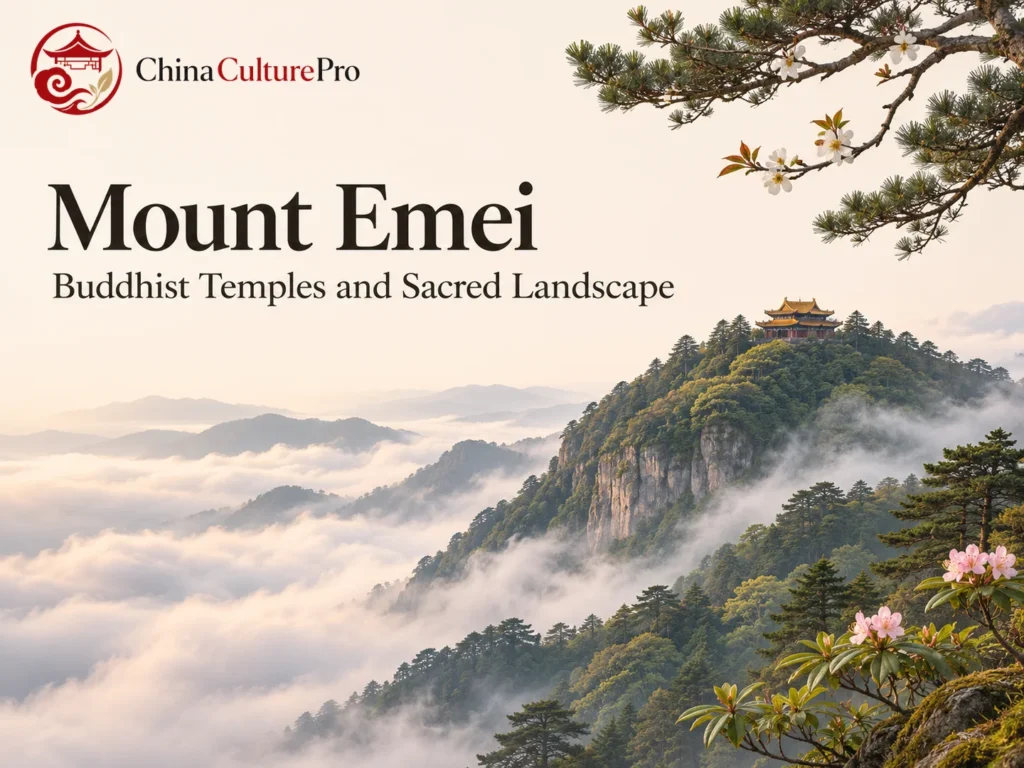
Mount Emei (峨眉山, Éméi Shān) in Sichuan is one of China’s four sacred Buddhist mountains. Temples at different elevations connect forest, rock and ridge with worship. The mountain is especially associated with the bodhisattva Samantabhadra (普贤菩萨, Pǔxián Púsà).[1][2]
- A sacred mountain. Emei’s religious landscape developed through several periods of temple building and renewal.[1]
- A focus of devotion. Wannian Temple (万年寺, Wànnián Sì) preserves a bronze image of Samantabhadra dating to 980.[1][2]
- A shared heritage property. The Leshan Giant Buddha (乐山大佛, Lèshān Dàfó) belongs to the same World Heritage listing at a separate riverside site.[1]
Treat the date of a foundation, the age of a surviving temple hall and the date of an individual image as separate questions.[1][2]
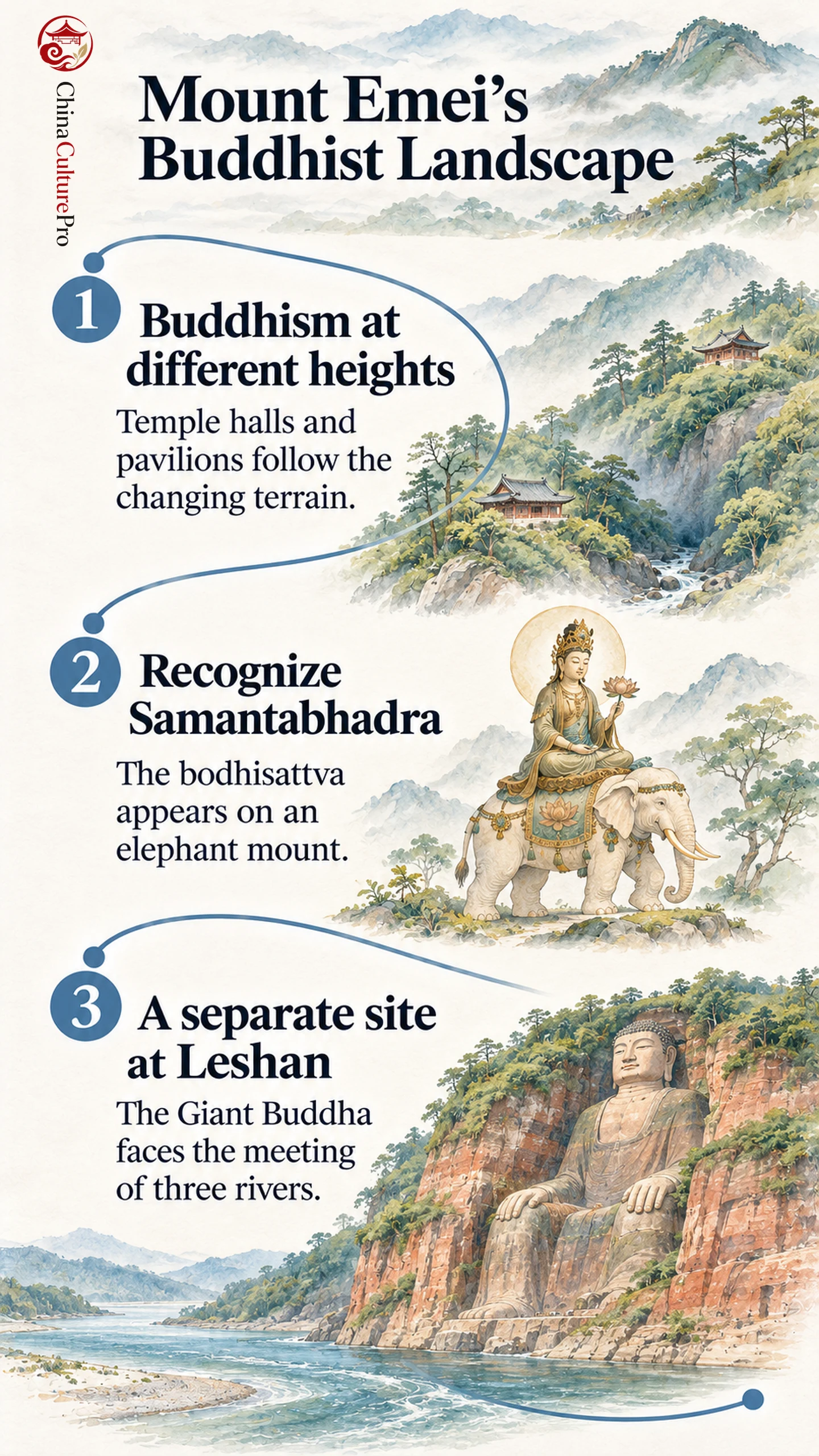
Emei’s Buddhist history is distributed across a mountain. Temples near its foot, pavilions among wooded slopes and shrines at the summit signal different ways of inhabiting the terrain. The images along the way also show how a mountain came to be identified with one figure.
Pilgrimage Through a Mountain Landscape
| 場所 | What it contributes to the religious landscape |
|---|---|
| Baoguo Temple | A monastery toward the foot of the mountain and a place of Buddhist activity |
| Qingyin Pavilion | Pavilions and platforms that work with water and wooded slopes |
| Wannian Temple | A hall and bronze image that focus worship on Samantabhadra |
| Golden Summit (金顶, Jīndǐng) | High-level temples and a prominent modern image overlooking the surrounding landscape |
Heritage accounts associate the summit with early Buddhist foundations, while the temples and images visible today belong to many periods. This layering is part of what makes Emei a landscape of Chinese Buddhism, with buildings and images from several periods.[1][2][3]
How to Recognize Samantabhadra at Emei
At Wannian Temple, a large bronze of Samantabhadra survives in a beamless hall. The figure dates to 980, during the Song dynasty. The elephant beneath the bodhisattva is an identifying detail. It helps distinguish this image from other Buddhas and bodhisattvas you may encounter in temple halls.[1][2]
At Emei’s Golden Summit, a modern golden monument presents the same bodhisattva with multiple faces, again above elephants. Both depict Samantabhadra above an elephant mount. Their dates, scale and setting differ. The bronze occupies a hall, while the summit monument addresses an open landscape.[2][3]
Why the Leshan Giant Buddha Shares the Heritage Listing
The Leshan Giant Buddha was carved into a cliff facing the meeting of the Min, Dadu and Qingyi rivers. Carving began in the eighth century. At about 71 metres high, it uses the river-facing cliff as part of its setting. Emei’s temples instead occupy different elevations within a forested mountain.[1][2]
The World Heritage property recognizes both places and their settings. The shared listing connects Buddhist architecture and sculpture with significant natural landscapes, while the mountain and cliff remain two distinct locations. For another example of setting changing how you read a Buddhist image, compare the halls and limestone carvings at Lingyin Temple.[1][4]
FAQs About Mount Emei’s Buddhist Culture
Which bodhisattva is associated with Mount Emei?
Samantabhadra, known in Chinese as Puxian, is especially associated with the mountain. Images at Wannian Temple and the summit depict him with elephants.[1][2][3]
Is the Leshan Giant Buddha at Emei’s Golden Summit?
The Giant Buddha is at Leshan’s river confluence. Emei’s Golden Summit is a separate place, although the two landscapes share a heritage listing.[1]
Is the golden summit statue the bronze cast in 980?
The bronze cast in 980 is in Wannian Temple. The golden summit monument is a different depiction of Samantabhadra.[2][3]
出典
[1] UNESCO World Heritage Centre. Mount Emei Scenic Area, including Leshan Giant Buddha Scenic Area
[2] Chinese Academy of Sciences, Institute of Geographic Sciences and Natural Resources Research. Emei Mountain and Giant Buddha of Leshan
[3] Xinhua Travel, via the Central Government Liaison Office. The Golden Summit and its Samantabhadra image
[4] Hangzhou municipal English portal. Lingyin Temple and its landscape